Sniff Research story
What Do Dogs Dream About? Sleep Recordings Can’t Say
Sniff, Purr, Preen & Shoal Published
TL;DR
What dogs dream about cannot be read from a sleep recording, which shows brain rhythms and sleep stages, not scenes. In a 2017 study of 15 pet dogs pet homes, learning new words for familiar commands changed the rhythms of the sleep that followed. Whether a dog experiences anything like a dream in its sleep is still unknown.
Doorplate
- Animal
- Adult pet dogs of several breeds and mixed breeds; the sleep study counts 9 breeds and 3 mixed breeds, the spindle paper 7 pure breeds and 3 mixed breeds
- Study
- Kis et al. 2017, Scientific Reports
- n (analysed / excluded)
- 15 / none reported for the main sleep comparisons; the REM comparisons report t(10), which fits 11 dogs; 3 dogs did not sleep in the first, task-free session; 53 / none reported in the one-hour break test
- Couch sample
- pet homes adult pet dogs whose owners volunteered
- Limits
- Mean age 3.67 years by the sleep study (3.87 in the 2018 correction to the spindle paper); 8 males, 7 females; one task, new English words for sit and lie down in dogs trained in Hungarian
- Setup in one line
- Three 3-hour sleep recordings per dog: a first session with no task, then after a learning task and after a non-learning task
- Replicated?
- As of 2026-11-20, a 2017 spindle reanalysis used the same 15 dogs; no independent repeat among the sources read
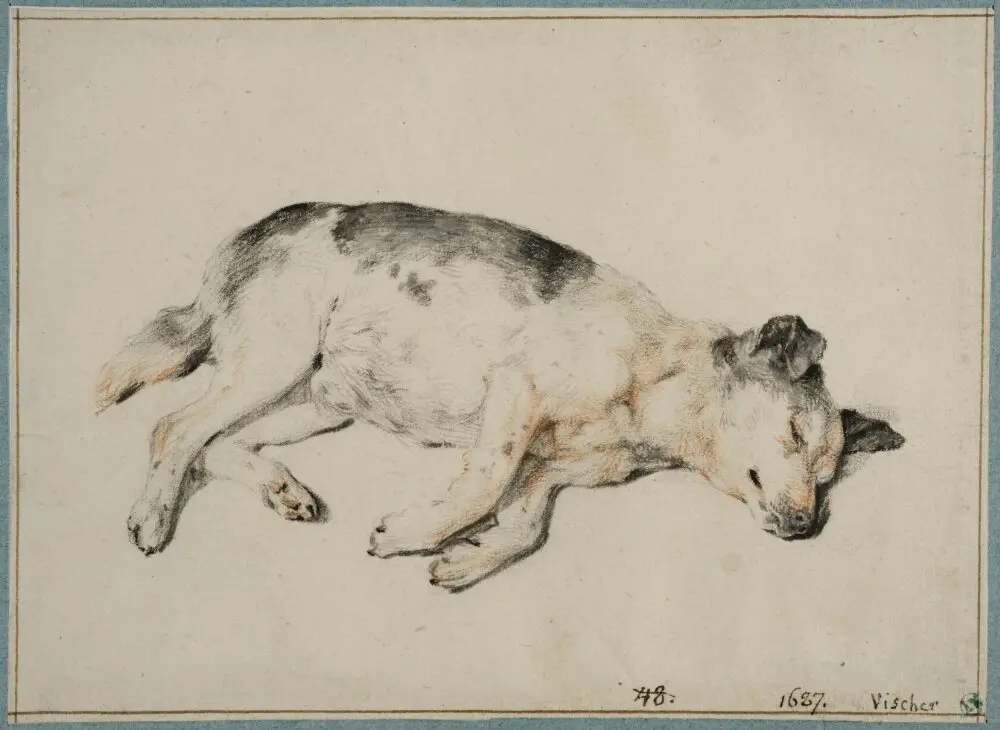
Cornelis Visscher’s study of a sleeping dog, drawn in the 1600s and now in the Nationalmuseum, Stockholm. A drawing records a posture, not what the dog was going through.
"Study of a Sleeping Dog" by Cornelis Visscher; Nationalmuseum, Stockholm (NMH 1878/1863) — https://commons.wikimedia.org/wiki/File:Cornelis_Visscher_-_Study_of_a_Sleeping_Dog_-_NMH_1878-1863_-_Nationalmuseum.jpg — Public domain (EU and US: Cornelis Visscher died 1658, more than 70 years ago (life plus 70 years))
Your dog is asleep on the rug, paws twitching, a muffled bark caught in its throat. A Budapest team led by Anna Kis recorded the sleep of 15 pet dogs pet homes three times each, for three hours a session, with electrodes resting on the surface of the head. The recordings showed when each dog was in REM sleep and when it was in non-REM sleep.
They could not show what, if anything, the dog was seeing.
How is a sleeping dog recorded?
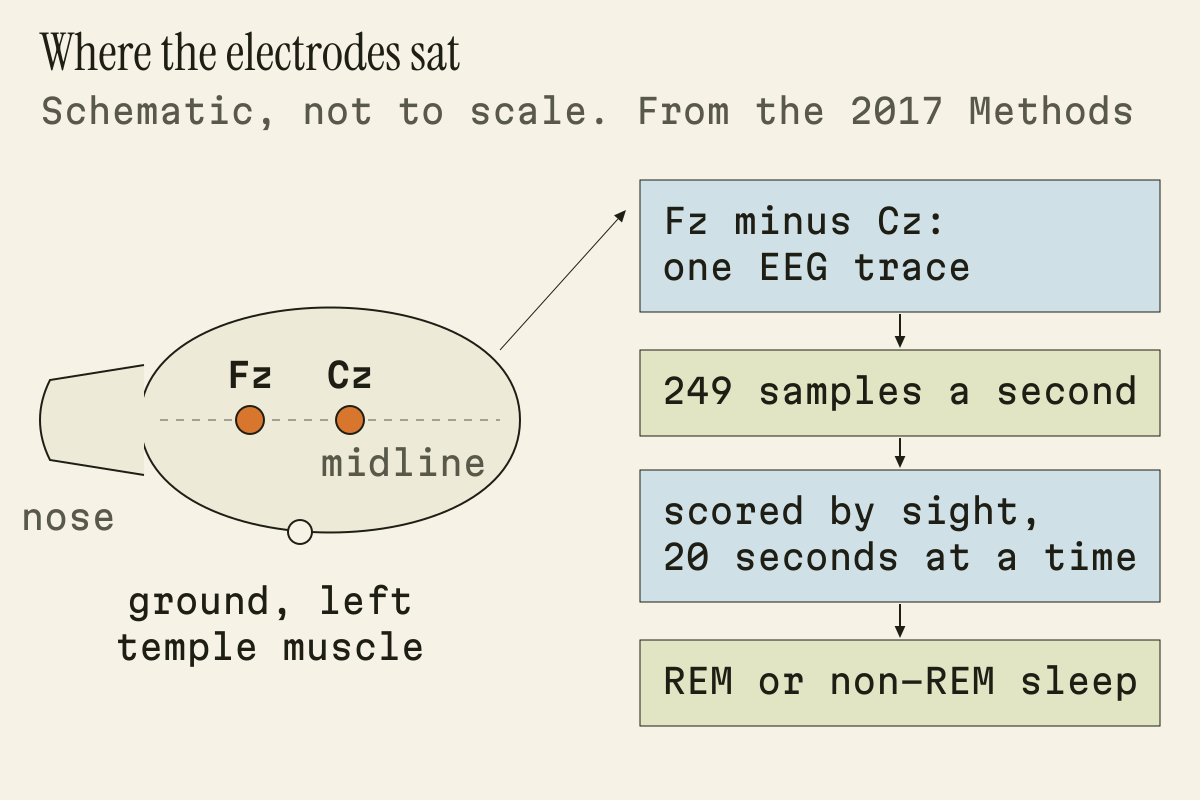
Schematic, not to scale: in the 2017 recordings, two electrodes on the midline of the head gave one EEG trace, with a ground electrode over the left temple muscle.
Worked from Electrode positions and recording settings in the Methods of Iotchev et al. 2017 and Kis et al. 2017; drawn as plain shapes, not to scale.
"Where the electrodes sat in the 2017 dog sleep recordings" by Sniff, Purr, Preen & Shoal, https://sniffpurrpreenandshoal.com/dogs/dog-dreams/, licensed under CC BY 4.0 (https://creativecommons.org/licenses/by/4.0/)
Data: Iotchev et al. (2017), Scientific Reports 7:12936, CC BY 4.0; Kis et al. (2017), Scientific Reports 7:41873, CC BY 4.0
The recording is a polysomnography: a sleep record built from sensors placed on the body. Its EEG, or electroencephalogram, picks up the brain’s electrical activity from the surface of the scalp. The method for dogs comes from a 2014 paper led by Kis, Development of a non-invasive polysomnography technique for dogs (Canis familiaris). Only that paper’s bibliographic record was consulted here, so none of its content is summarized.
In the 2017 recordings, the brain signal came from two electrodes on the midline of the skull, one toward the front (labeled Fz) and one at the center (Cz). The trace was the difference between them. A third electrode, over the muscle at the left temple, served as ground. Ivaylo Iotchev and colleagues report that the signal was sampled 249 times a second.
Each recording was then scored by sight, 20 seconds at a time, as REM sleep or non-REM sleep. REM stands for rapid eye movement. In dogs, the separate stages of non-REM sleep “are not clearly distinguishable,” Iotchev’s team wrote, so non-REM sleep was treated as a single stage.
A Hungarian ethics committee classed the work as “a non-invasive study that causes less pain or suffering than the equivalent of inserting a needle.” Every dog began with a session that had no task before it. In that first session, 3 of the 15 dogs pet homes did not sleep at all; the other 12 averaged 32.1 minutes of non-REM sleep, by the count in Iotchev and colleagues’ 2017 paper.
Does learning change a dog’s sleep?
The learning task gave familiar actions new names. The dogs already knew sit and lie down from Hungarian commands. In the learning session, the experimenter taught the same two actions with English phrases, then ran an 18-trial test. In the non-learning session, the dogs did the same actions to the familiar Hungarian words and hand signals.
Each dog had one session of each kind, on different days and in counterbalanced order, and each was followed by three hours of recorded sleep. The 2017 sleep study found that after learning, slow delta activity (1 to 4 Hz, or cycles per second) made up a larger share of the EEG power in non-REM sleep, and alpha activity (8 to 12 Hz) a smaller share. In REM sleep, the share of theta activity (4 to 8 Hz) rose. The paper found no effect of learning on stage times.
As a group, the 15 dogs pet homes did better on the new English commands after the recording than before it, though a second paper on the same dogs reports that one did worse. Dogs whose REM sleep held less delta activity and more beta activity (12 to 30 Hz) improved more. The authors wrote that dogs’ social learning skills “might be related to sleep-dependent memory consolidation,” the settling of a new memory during sleep, a role for sleep that they note is “still debated.”
The task rewarded the dogs for getting it right. The authors point out that most earlier evidence on sleep and memory in animals other than people came from aversive conditioning, learning driven by something unpleasant. A far older line of dog research, in which a sound came to mean dinner, is the subject of Pavlov’s dogs. Learning the names of things is another dog skill with its own studies; dog word learning covers what dogs learn by name and how few do.
What happened a week later?
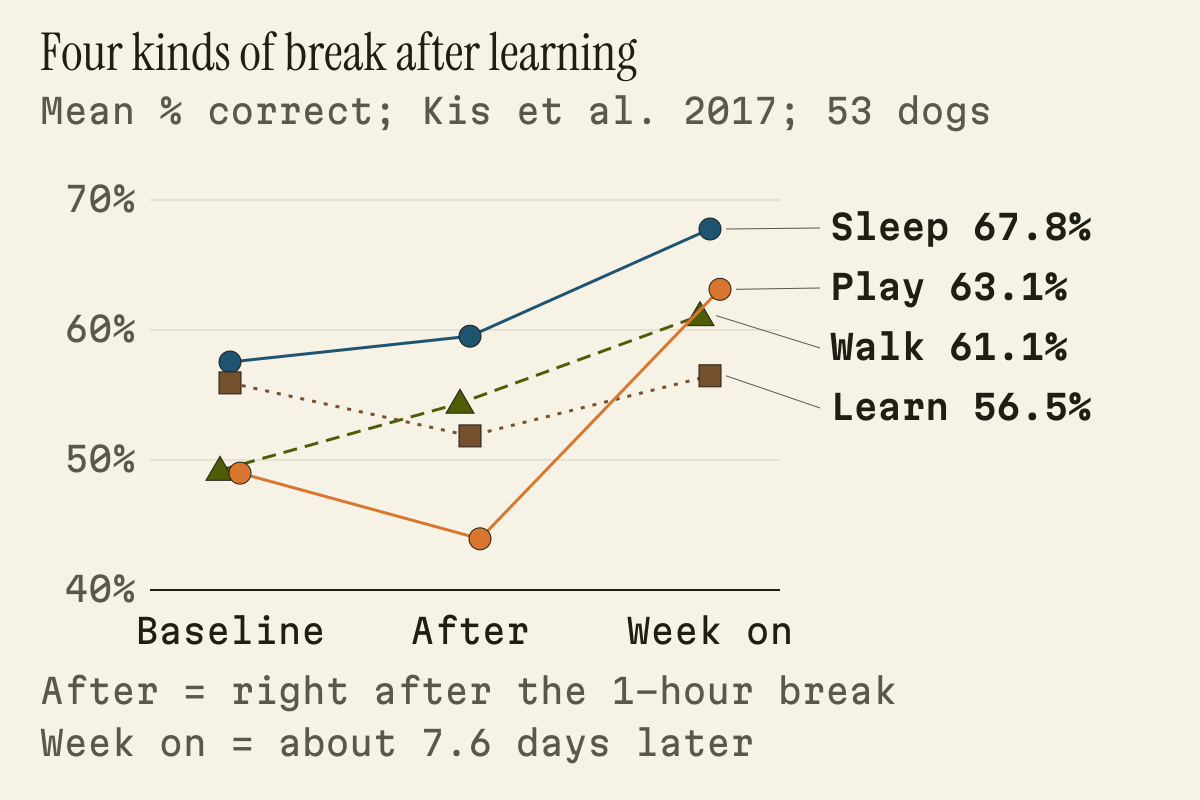
In one 2017 study of 53 pet dogs, the groups that slept, walked or played during a one-hour break scored higher about a week later than at baseline; the group that learned a second task was not reliably above its baseline.
Worked from Group means from Table 1 of Kis et al. 2017 and group sizes from its Methods; the week-later test came a mean of 7.64 days after the first.
"Percent correct for four one-hour break groups, Kis et al. 2017" by Sniff, Purr, Preen & Shoal, https://sniffpurrpreenandshoal.com/dogs/dog-dreams/, licensed under CC BY 4.0 (https://creativecommons.org/licenses/by/4.0/)
Data: Kis et al. (2017), Scientific Reports 7:41873, CC BY 4.0
A second experiment in the same paper tested 53 other pet dogs pet homes on the same command task. After the first test, each dog spent one hour in one of four ways: sleeping in the owner’s parked car (14 dogs), walking on a leash around a university campus (14), learning more new commands with the owner (12) or playing with a dog toy while lying down (13). The dogs were tested again right after the hour and once more about a week later.
Right after the hour, the sleep group was not reliably above its starting score. That seems to clash with the first experiment, where scores rose after three hours of sleep. The authors suggest the shorter break may explain it, since longer sleep has been linked to larger memory gains in people.
About a week later, the sleep, walk and play groups all scored higher than at baseline, while the group that had learned a second task was not reliably above its own starting score. The authors read this as memory consolidation during the dogs’ usual night sleep at home. That sleep was not recorded.
| Break (dogs) | Baseline | Right after | About a week later |
|---|---|---|---|
| Sleep (14) | 57.5% | 59.5% | 67.8% |
| Walk (14) | 49.2% | 54.4% | 61.1% |
| Learn (12) | 55.9% | 51.9% | 56.5% |
| Play (13) | 49.0% | 43.9% | 63.1% |
Download the study data (CSV) (what the file holds) Data: Kis et al. (2017), Scientific Reports 7:41873, CC BY 4.0; Iotchev et al. (2017), Scientific Reports 7:12936, CC BY 4.0; Iotchev et al. (2018), author correction, Scientific Reports 8:6138, CC BY 4.0
What are sleep spindles?
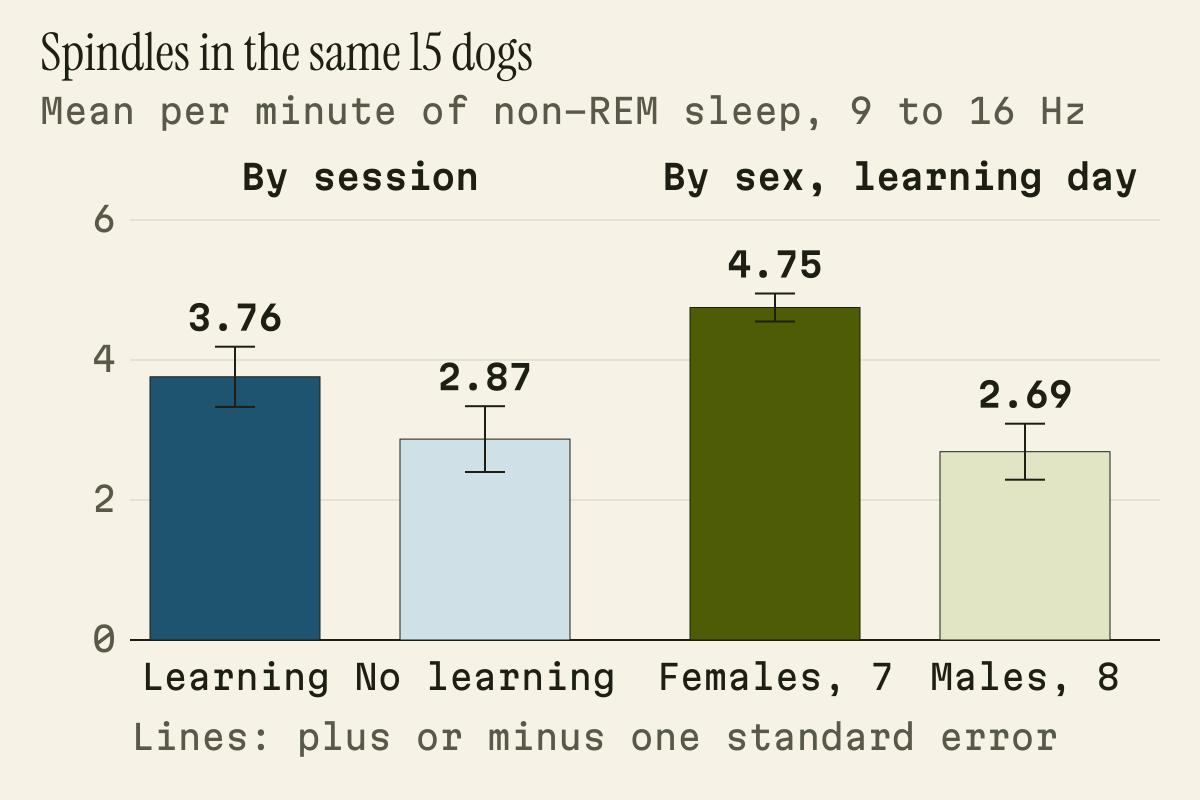
In the same 15 pet dogs, spindles came more often after the learning session than after the non-learning one, and more often in females than in males on the learning day.
Worked from Means and standard errors in the Results of Iotchev et al. 2017, for detections in the 9 to 16 Hz range.
"Spindles per minute of non-REM sleep in 15 pet dogs, Iotchev et al. 2017" by Sniff, Purr, Preen & Shoal, https://sniffpurrpreenandshoal.com/dogs/dog-dreams/, licensed under CC BY 4.0 (https://creativecommons.org/licenses/by/4.0/)
Data: Iotchev et al. (2017), Scientific Reports 7:12936, CC BY 4.0
Sleep spindles are “brief episodes of brain activity, at least 0.5 seconds long,” seen during non-REM sleep, Iotchev and colleagues wrote in a second 2017 paper. In people, they have been linked to memory and to stable sleep. Spindle-like activity in dogs had been described before but, in the authors’ words, “never quantified and related to function.”
Earlier estimates of its frequency in dogs ranged from 2 to 5 Hz up to 12 to 16 Hz, which the team took as a sign that people judging traces by eye did not agree.
The team ran an automatic detector over the recordings of the same 15 dogs pet homes and tried three frequency ranges. Only bursts in the 9 to 16 Hz range tracked learning. After the learning session the dogs averaged 3.76 spindles per minute of non-REM sleep, against 2.87 after the non-learning session, and dogs that improved more on the commands had more spindles.
On the learning day, the 7 females averaged 4.75 spindles per minute and the 8 males 2.69. Slow spindles, below 13 Hz, carried the link with learning. The authors add that their front electrode seemed to pick up slow spindles more reliably than fast ones.
Both papers rest on the same 15 dogs pet homes, so the spindle result is a second look at one set of recordings, not an independent repeat. The spindle paper also carries a 2018 correction notice, read for this page, which corrects some test statistics and the dogs’ mean age but leaves the spindle averages given here unchanged. How much of each source was read is set out on Sniff test.
So what do dogs dream about?
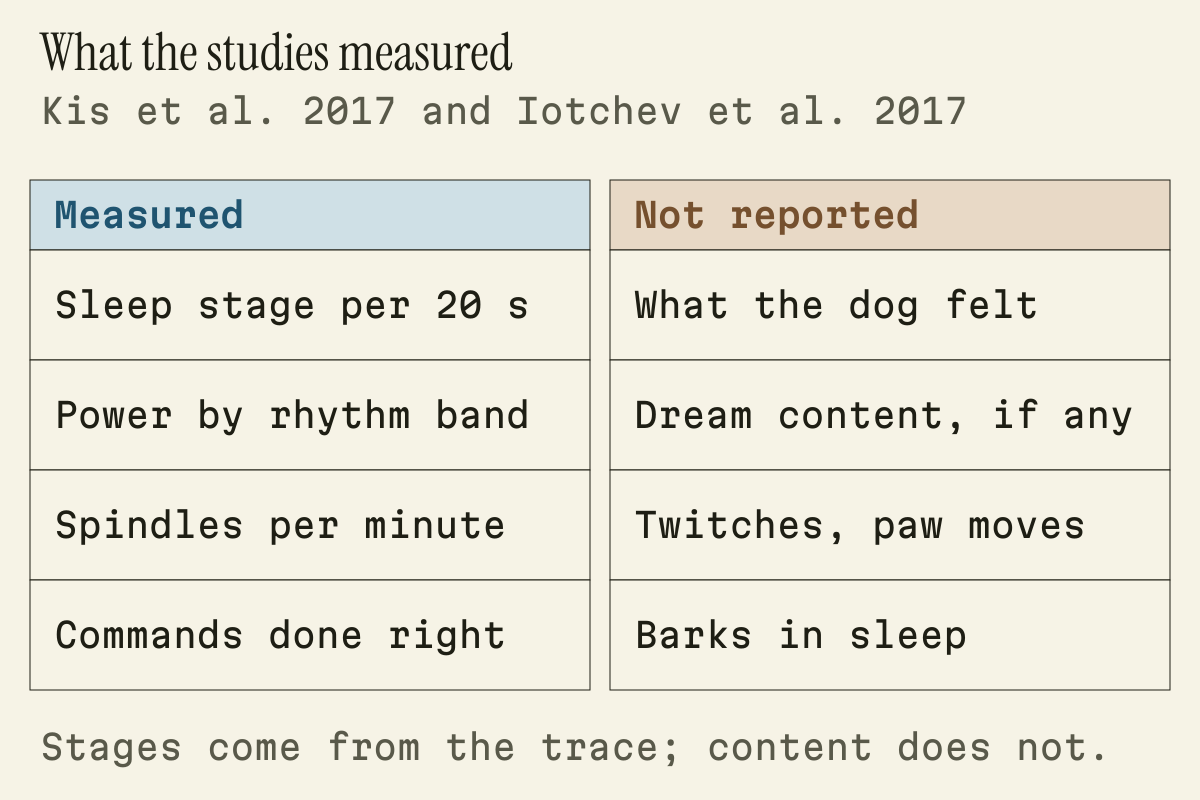
What the two 2017 papers measured, beside what neither paper reports.
Worked from The Methods and Results of Kis et al. 2017 and Iotchev et al. 2017, compared item by item.
This figure in words
- Measured: sleep stage, scored every 20 seconds; power in each rhythm band; spindles per minute of non-REM sleep; commands done right before and after sleep.
- Not reported in either paper: what the dog felt; dream content, if any; twitches and paw movements; barks during sleep.
"What the 2017 dog sleep studies measured and what neither reports, evidence table" by Sniff, Purr, Preen & Shoal, https://sniffpurrpreenandshoal.com/dogs/dog-dreams/, licensed under CC BY 4.0 (https://creativecommons.org/licenses/by/4.0/)
Data: Kis et al. (2017), Scientific Reports 7:41873, CC BY 4.0; Iotchev et al. (2017), Scientific Reports 7:12936, CC BY 4.0
No recording in these studies can say. The traces showed when a dog was in REM or non-REM sleep, how strong each rhythm was and how often spindles came; separate tests before and after sleep counted the commands a dog got right. Neither paper uses the word dream, or dreaming, in its own text. Dreaming appears once, in the title of a review on the reward system in sleep that the 2017 sleep paper cites.
Do dogs dream at all? A dream, as the question uses the word, is something lived through: a chase, a smell, a familiar voice. An EEG trace is voltage over time. The recordings show that dogs pass through both REM and non-REM sleep, but they cannot settle whether anything is experienced in either stage.
Twitching is not covered either. Neither paper reports twitches, paw movements or barks during sleep, so these studies cannot say why a sleeping dog twitches. If twitching in sleep worries you, ask a veterinarian; this page does not tell sleep twitches from seizures.
Neither study tested waking a dog, and nothing in these results is a reason to wake a sleeping dog to see what it is doing.
Much is still unknown. No study read for this page recorded a dog’s ordinary night at home, where the authors of the 2017 sleep study think the week-later gains formed. The dogs in the sleep recordings averaged 3.67 years of age by the sleep study’s count (the 2018 correction to the spindle paper gives 3.87 for the same dogs), and the authors name older dogs as a question for later work. Whether anything a dog lives through in REM sleep could ever be measured from outside is not known.
Sources
- Kis A, Szakadát S, Gácsi M, Kovács E, Simor P, Török C, Gombos F, Bódizs R, Topál J (2017). “The interrelated effect of sleep and learning in dogs (Canis familiaris); an EEG and behavioural study.” Scientific Reports 7:41873. doi.org/10.1038/srep41873Read: Full text, open license; CC BY 4.0Text license: CC BY 4.0 (terms)
- Iotchev IB, Kis A, Bódizs R, van Luijtelaar G, Kubinyi E (2017). “EEG Transients in the Sigma Range During non-REM Sleep Predict Learning in Dogs.” Scientific Reports 7:12936. doi.org/10.1038/s41598-017-13278-3Read: Full text, open license; CC BY 4.0; the 2018 author correction (Scientific Reports 8:6138, doi:10.1038/s41598-018-24096-6, CC BY 4.0) was also readText license: CC BY 4.0 (terms)
- Kis A, et al. (2014). “Development of a non-invasive polysomnography technique for dogs (Canis familiaris).” Physiology & Behavior 130:149–156. doi.org/10.1016/j.physbeh.2014.04.004Read: Bibliographic record only
Cite this page
Sniff, Purr, Preen & Shoal. “What Do Dogs Dream About? Sleep Recordings Can’t Say.” Published November 20, 2026. https://sniffpurrpreenandshoal.com/dogs/dog-dreams/. Accessed on the day you read it.
How studies are read and numbers recheckedMending basket: every correctionReport an error on this page (contact@sniffpurrpreenandshoal.com)
More from Dog Minds
Sniff Tool page
Dog Years: In One Labrador Study, Age 1 Matched About 31
Picture credit
"noah (1 of 1)" by Trevor Hurlbut — https://commons.wikimedia.org/wiki/File:Old_dog_noah_(1_of_1).jpg — CC BY 2.0 (https://creativecommons.org/licenses/by/2.0/)
Sniff Research story
How Many Words Do Dogs Know? A Gifted Few Learn Toy Names
Picture credit
"Puppy playing with a toy" by Justin Veenema (Unsplash) — https://commons.wikimedia.org/wiki/File:Puppy_playing_with_a_toy_(Unsplash).jpg — CC0 1.0 (https://creativecommons.org/publicdomain/zero/1.0/)
Sniff Research story
Pavlov’s Dogs: In the 1927 English Text, Metronomes Lead
Picture credit
"White Poodle in a Punt, by George Stubbs" by George Stubbs; National Gallery of Art, Washington (Paul Mellon Collection 1999.80.22) — https://commons.wikimedia.org/wiki/File:George_Stubbs,_White_Poodle_in_a_Punt,_c._1780,_NGA_110281FXD.jpg — CC0 1.0 (https://creativecommons.org/publicdomain/zero/1.0/); modified: color-adjusted version uploaded to Commons by another user from the National Gallery of Art file (other version listed on the gallery file page); not changed further