Sniff Research story
How Many Words Do Dogs Know? A Gifted Few Learn Toy Names
Sniff, Purr, Preen & Shoal Published
TL;DR
No study read for this page gives one count of the words dogs know. In a 2021 test, only 1 of 34 typical family dogs pet homes passed during three months of naming play, against all six dogs recruited because they already knew many toy names. Why a few dogs learn names so readily is unknown.
Doorplate
- Animal
- Family dogs: 34 typical dogs, puppies and adults, and 6 adult Border collies already known for toy names
- Study
- Fugazza, Dror, Sommese, Temesi & Miklosi 2021, Scientific Reports
- n (analysed / excluded)
- 34 typical dogs at the first monthly test, 33 and 32 at the second and third / 13 left before the first test (the Discussion says 30 of 47 owners completed); 6 word-knowledgeable dogs / none
- Couch sample
- pet homes owners volunteered; the 6 word-knowledgeable dogs were found by a worldwide search
- Limits
- 18 of the 34 typical dogs and all 6 word-knowledgeable dogs were Border collies; the one typical dog that passed was entered by an owner who thought her special
- Setup in one line
- 3 months of daily play naming two new toys; monthly two-toy tests of 12 trials with the toys out of the owner's view
- Replicated?
- As of 2026-11-20, a second 2021 paper by the same group found no evidence of learning in 20 typical dogs after 4 exposures; no independent repeat among the sources read
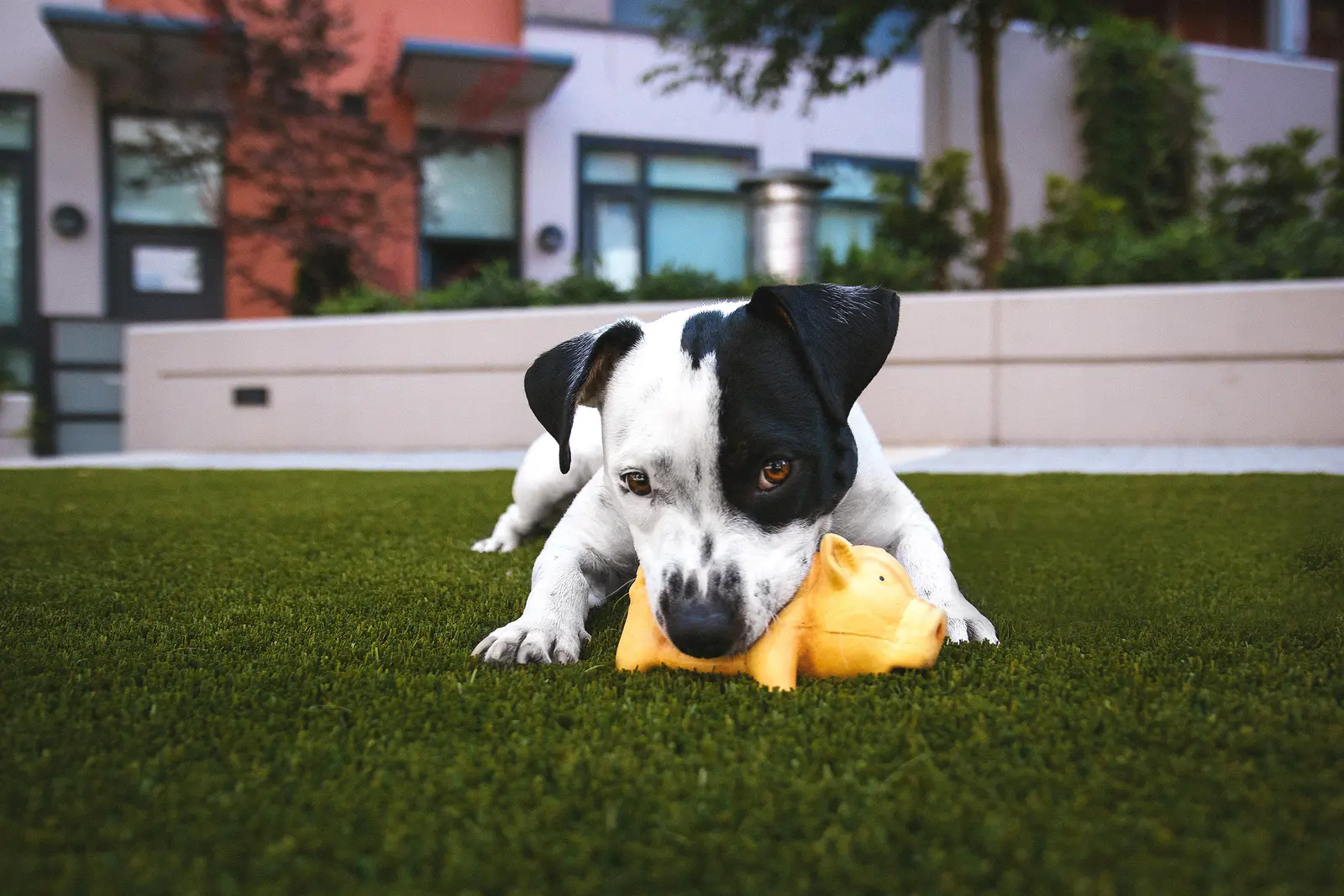
A puppy with a yellow toy pig, photographed in Vancouver in 2016. A dog holding a toy shows interest in it, not whether the dog knows what the toy is called.
"Puppy playing with a toy" by Justin Veenema (Unsplash) — https://commons.wikimedia.org/wiki/File:Puppy_playing_with_a_toy_(Unsplash).jpg — CC0 1.0 (https://creativecommons.org/publicdomain/zero/1.0/)
You say the word ball, and your dog turns toward the toy basket. A 2021 study from Eötvös Loránd University in Budapest asked how often that kind of moment reflects a learned name. Claudia Fugazza and colleagues enrolled 47 family dogs pet homes that liked to fetch, and 34 of them stayed long enough to be tested.
Their owners spent three months naming two new toys in daily play, and at each monthly test the toys had to be fetched by name alone, with no hint from anyone who could see them.
Only one of them could do it.
How was the test set up?
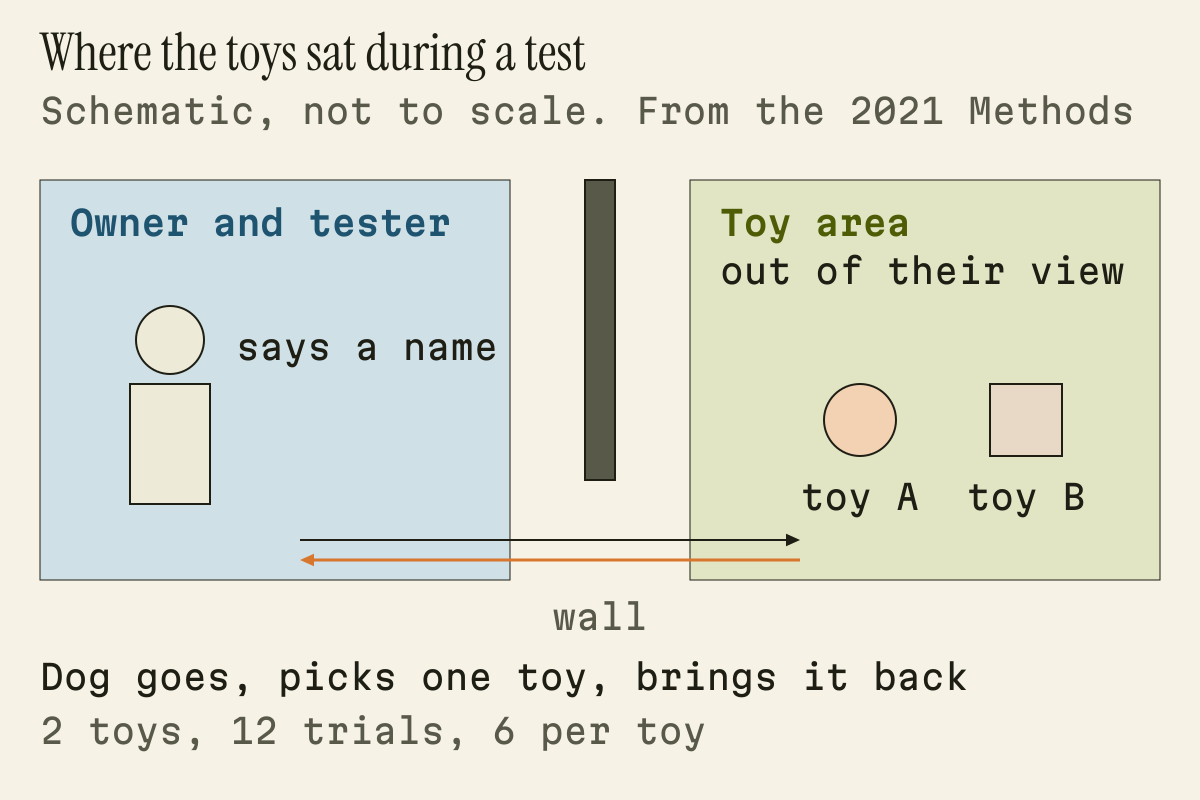
Schematic, not to scale: in the 2021 tests, the owner asked for a toy by name, and the two toys lay in an adjacent area out of the owner’s view, drawn here as the far side of a wall.
Worked from The test protocol in the Methods of Fugazza et al. 2021 (Scientific Reports 11:14070), with the tester’s place from the second 2021 paper (11:2222); positions drawn as plain shapes, not to scale.
"Where the toys sat during a word-learning test, Fugazza et al. 2021" by Sniff, Purr, Preen & Shoal, https://sniffpurrpreenandshoal.com/dogs/dog-word-learning/, licensed under CC BY 4.0 (https://creativecommons.org/licenses/by/4.0/)
Data: Fugazza et al. (2021), Scientific Reports 11:14070, CC BY 4.0; Fugazza et al. (2021), Scientific Reports 11:2222, CC BY 4.0
The study compared two groups. The first was 34 typical family dogs pet homes, which the paper calls naïve, meaning they had no known toy names: 19 adults and 15 puppies, most of them recruited in Budapest through the Family Dog Project database. To join, a dog had to pick up a toy from the floor three times in a row: the authors chose dogs that were keen on toys so that a failure could not be put down to a dog that simply would not fetch.
The second group was six adult dogs pet homes that the paper calls word knowledgeable. The team found them through two years of social media appeals around the world, looking for dogs whose owners said they knew the names of their toys.
What did the three months of play involve?
Both groups got the same program: several play sessions of about 5 to 10 minutes a day, in which owners named a toy again and again as they played with it. Once a week one of the authors, an experienced dog trainer, coached each owner in person or by video call.
After the first, second and third months, each dog took the same test on the first two toys it had been taught. Both toys were set out together, and the owner asked for one of them by name. The test ran 12 trials, six for each toy, and the requested toy was never the same more than twice in a row.
How did the test guard against the owner’s cues?
The two toys lay in a separate area that the owner could not see. The dog went there, picked a toy and carried it back, and the choice counted as the toy in its mouth when it reappeared. In the paper’s words, this was “to control for potential inadvertent visual cues directing the dog to the correct toy.”
That control matters because a dog watching a person can pick up a glance or a lean toward the right toy. With the toys out of view, the person asking does not know where the right toy is and cannot steer the dog toward it. A much older line of dog research, in which a sound came to mean that food was coming, is the subject of Pavlov’s dogs.
How many dogs learned the names?
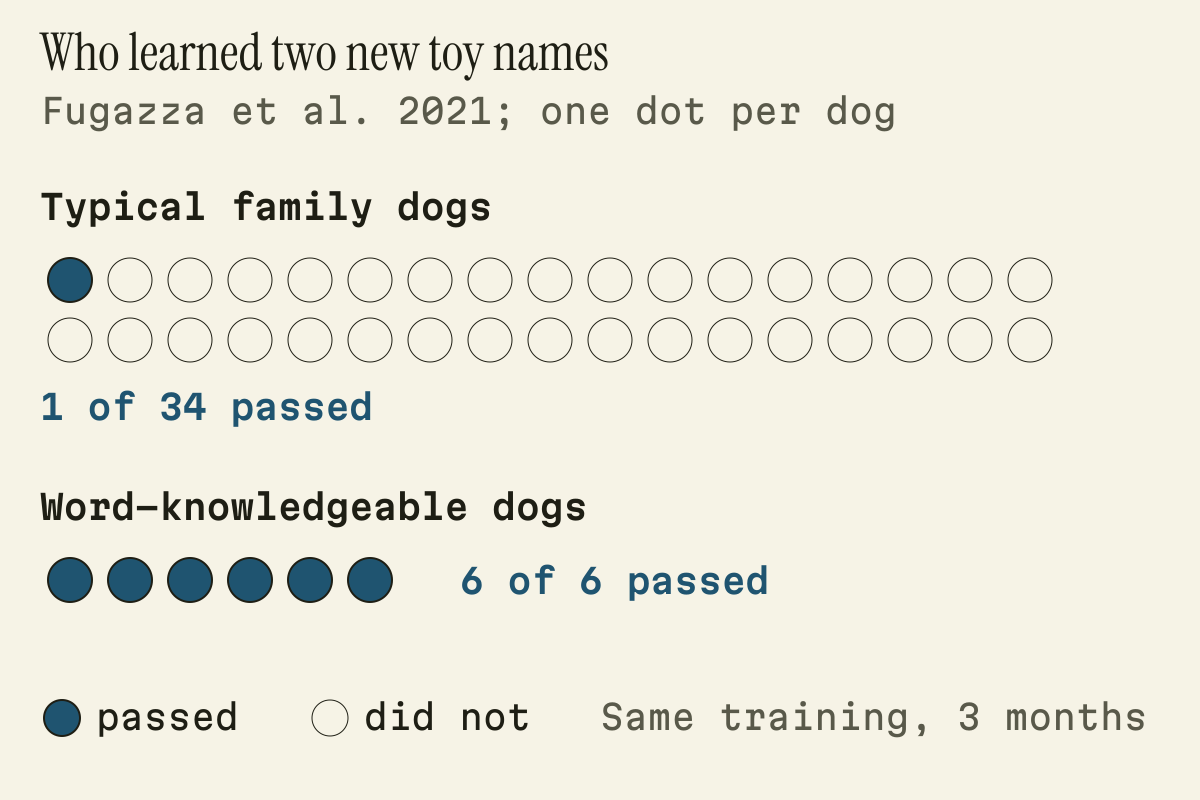
In one 2021 study, 1 of 34 typical family dogs and 6 of 6 word-knowledgeable dogs passed the test of two newly taught toy names, during the same three months of training.
Worked from Group sizes and pass counts in the abstract, Results and Methods of Fugazza et al. 2021 (Scientific Reports 11:14070); one dot per dog.
"Dogs that passed the two-toy name test, Fugazza et al. 2021" by Sniff, Purr, Preen & Shoal, https://sniffpurrpreenandshoal.com/dogs/dog-word-learning/, licensed under CC BY 4.0 (https://creativecommons.org/licenses/by/4.0/)
Data: Fugazza et al. (2021), Scientific Reports 11:14070, CC BY 4.0
| Group (one 2021 study) | Dogs tested | Dogs that passed |
|---|---|---|
| Typical family dogs | 34 | 1 |
| Word-knowledgeable dogs | 6 | 6 |
Download the study data (CSV) (what the file holds) Data: Fugazza et al. (2021), Scientific Reports 11:14070, CC BY 4.0; Fugazza et al. (2021), Scientific Reports 11:2222, CC BY 4.0
The result was lopsided. “Only 1 naïve and all 6 knowledgeable dogs passed the tests,” the authors wrote. Puppies and adults showed no significant difference, and the paper reports that the 33 typical dogs that did not pass kept fetching eagerly in every trial, but they did not use the name to choose.
Who was the one typical dog that passed?
Oliva, an adult Border collie from Brazil, was the one typical dog that passed. She chose the right toy in every trial of the first monthly test, but she was not a random recruit. Her owner had asked to join because she believed Oliva listened to speech in an unusual way. For that reason, the authors write, their rough figure of 3 in 100 “may well be an overestimation.”
The six word-knowledgeable dogs and Oliva then took monthly tests on every new toy their owners had added. Each of the six learned between 2 and 13 new toy names per month. Oliva learned 10 in the first month and 11 more in the second, and she was not tested in the third month because she died. In the abstract’s summary, only these dogs learned at least 10 new toy names over the three months.
The numbers thinned over time. Of 47 typical dogs recruited pet homes, 13 owners left before the first test, and 34, 33 and 32 typical dogs completed the three monthly tests. The paper’s Discussion also says that only 30 of 47 owners completed the program, a count that does not match the month-by-month figures, so both are reported here.
What is a gifted word learner?
A gifted word learner is the paper’s name for a dog that picks up many object names quickly, with little or no formal teaching. Fugazza and colleagues applied it to the six word-knowledgeable dogs and to Oliva, and before training began each of the six took a baseline test on its own toys. Whisky’s owners listed 59 named toys, and she brought back the right one 54 times out of 59.
Most of these owners said they had never set out to teach toy names. The authors write that the dogs “appeared to have learnt object-names spontaneously during the typical play interactions that occur between most owners and their dogs.”
The six gifted dogs were found by a worldwide search, so they are a recruited, special sample, and that is the point of the couch sample. A group gathered because it already does something rare shows what is possible, not what is typical. The animals in a study are not the one in the reader’s house, and these six were chosen precisely because they were unusual.
All seven dogs that learned names in this study were Border collies. Yet 18 of the 34 typical dogs were Border collies as well, and apart from Oliva none of them showed evidence of learning the two names. The authors call the many Border collies in this and earlier studies suggestive evidence of a genetic influence, but most Border collies in their own study did not show the skill, and two Yorkshire terriers in earlier reports learned many object names. A test like this does not rank breeds.
Which dog knew the most words?
Among the dogs in the two papers read for this page, Whisky had the longest list, with 59 named toys. Chaser, a Border collie, is the subject of a 2011 paper by John Pilley and Alliston Reid. Only that paper’s bibliographic record was consulted here, so its sample source cannot be assigned and its findings and vocabulary count are not summarized.
A second 2021 paper by the same Budapest group adds a caution about how such counts were made. It says earlier reports on Chaser and another Border collie tested new words by letting the dog pick a new toy from among familiar ones, a method that may not show a name was learned.
What counts as knowing a word in these tests?
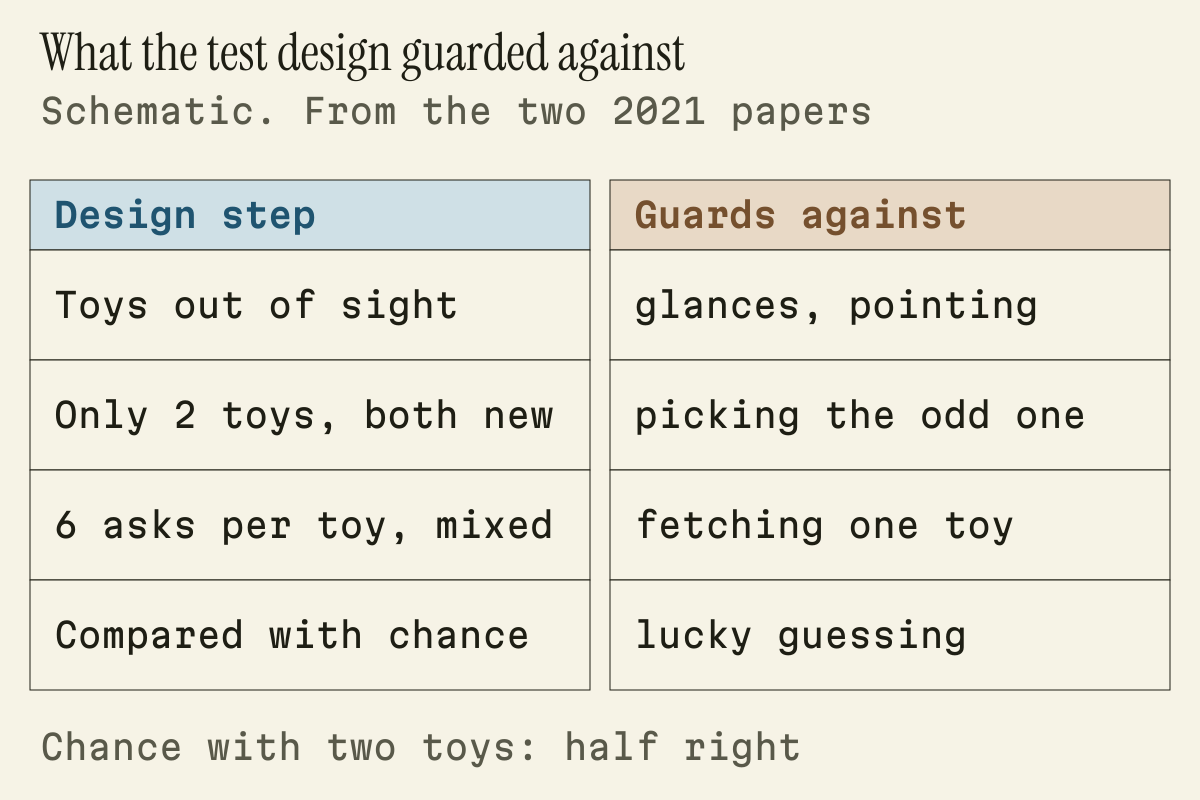
Schematic: each step of the 2021 test design and the shortcut it guards against.
Worked from The Methods of Fugazza et al. 2021 (Scientific Reports 11:14070 and 11:2222), compared step by step.
This figure in words
- Toys hidden from the owner: guards against glances and pointing.
- Only two toys, both newly named: guards against picking the odd one out.
- Names asked in mixed order, six times each: a dog that always fetches one toy scores only half right.
- Scores compared with chance, which is half right with two toys: guards against lucky guessing.
"What the 2021 word-learning test design guarded against, schematic" by Sniff, Purr, Preen & Shoal, https://sniffpurrpreenandshoal.com/dogs/dog-word-learning/, licensed under CC BY 4.0 (https://creativecommons.org/licenses/by/4.0/)
Data: Fugazza et al. (2021), Scientific Reports 11:14070, CC BY 4.0; Fugazza et al. (2021), Scientific Reports 11:2222, CC BY 4.0
The first 2021 paper does not set a fixed passing score in its Methods. It compared the two groups statistically across 12-trial tests, where chance is 50 percent, and the word-knowledgeable dogs did significantly better as a group. A separate test flagged Oliva, right every time, as an outlier. The paper gives no pass test for each gifted dog, so passing here means the authors’ own count of seven dogs.
How few exposures does a gifted dog need?
The second paper, “Rapid learning of object names in dogs,” asked how few exposures a gifted dog needs. Whisky, a Border collie, and Vicky Nina, a Yorkshire terrier pet homes, heard each new name only four times. Some new toys were named in play with the owner, and others were picked out by elimination from among seven familiar toys. In the test that followed, only the two new toys were present, so neither dog could simply pick the unfamiliar one.
After naming in play, Whisky chose correctly 17 times out of 24 and Vicky Nina 15 times out of 20. After the elimination task, the scores were 8 of 20 and 12 of 20, which the authors did not count as learning. Twenty typical family dogs pet homes given the play version averaged 49.8 percent correct over 480 trials, which is chance. Even the two gifted dogs did little better than chance when retested after 10 minutes and after an hour.
Can a family dog learn the names of its toys? These studies cannot say for any one dog, and this page gives no teaching method. They show only that, under strict testing, 33 of the 34 typical dogs tested in the three-month study showed no evidence of learning two names, while a small recruited group learned many. How dogs learn other things, and what happens in their sleep afterward, is covered in dog dreams.
Much is still unknown: the authors could not separate talent from earlier practice, since the gifted dogs had already learned toy names in everyday play before the study began. Whether an earlier start in puppyhood or a different method would change the result is untested, and both papers rest on a handful of gifted dogs. No study read for this page measured how many words any dog understands outside toy names.
Sources
- Fugazza C, Dror S, Sommese A, Temesi A, Miklósi Á (2021). “Word learning dogs (Canis familiaris) provide an animal model for studying exceptional performance.” Scientific Reports 11:14070. doi.org/10.1038/s41598-021-93581-2Read: Full text, open license; CC BY 4.0Text license: CC BY 4.0 (terms)
- Fugazza C, Andics A, Magyari L, Dror S, Zempléni A, Miklósi Á (2021). “Rapid learning of object names in dogs.” Scientific Reports 11:2222. doi.org/10.1038/s41598-021-81699-2Read: Full text, open license; CC BY 4.0Text license: CC BY 4.0 (terms)
- Pilley JW, Reid AK (2011). “Border collie comprehends object-names as verbal referents.” Behavioural Processes 86:184–195. doi.org/10.1016/j.beproc.2010.11.007Read: Bibliographic record only
Cite this page
Sniff, Purr, Preen & Shoal. “How Many Words Do Dogs Know? A Gifted Few Learn Toy Names.” Published November 20, 2026. https://sniffpurrpreenandshoal.com/dogs/dog-word-learning/. Accessed on the day you read it.
How studies are read and numbers recheckedMending basket: every correctionReport an error on this page (contact@sniffpurrpreenandshoal.com)
More from Dog Minds
Sniff Tool page
Dog Years: In One Labrador Study, Age 1 Matched About 31
Picture credit
"noah (1 of 1)" by Trevor Hurlbut — https://commons.wikimedia.org/wiki/File:Old_dog_noah_(1_of_1).jpg — CC BY 2.0 (https://creativecommons.org/licenses/by/2.0/)
Sniff Research story
What Do Dogs Dream About? Sleep Recordings Can’t Say
Picture credit
"Study of a Sleeping Dog" by Cornelis Visscher; Nationalmuseum, Stockholm (NMH 1878/1863) — https://commons.wikimedia.org/wiki/File:Cornelis_Visscher_-_Study_of_a_Sleeping_Dog_-_NMH_1878-1863_-_Nationalmuseum.jpg — Public domain (EU and US: Cornelis Visscher died 1658, more than 70 years ago (life plus 70 years))
Sniff Research story
Pavlov’s Dogs: In the 1927 English Text, Metronomes Lead
Picture credit
"White Poodle in a Punt, by George Stubbs" by George Stubbs; National Gallery of Art, Washington (Paul Mellon Collection 1999.80.22) — https://commons.wikimedia.org/wiki/File:George_Stubbs,_White_Poodle_in_a_Punt,_c._1780,_NGA_110281FXD.jpg — CC0 1.0 (https://creativecommons.org/publicdomain/zero/1.0/); modified: color-adjusted version uploaded to Commons by another user from the National Gallery of Art file (other version listed on the gallery file page); not changed further