Sense Mechanism explainer
Dog Sense of Smell: A 2010 Model Traces a Sniff’s Side Path
Sniff, Purr, Preen & Shoal Published
TL;DR
In a 2010 model of one dog's nose, about 12 to 13 percent of the inhaled air took its own channel to the scent tissue at the back. The same paper puts a dog's smell at 10,000 to 100,000 times a human's, citing two studies read here only by title. Still unknown here: the dog-to-human gap for any one odor.
Doorplate
- Animal
- Dog (Canis familiaris)
- Study
- Craven, Paterson & Settles, 2010, Journal of the Royal Society Interface
- n (analysed / excluded)
- 7 dogs recorded in 45 trials of over 300 sniffs / exclusions not stated; airflow model built from 1 nose
- Couch sample
- cannot be assigned: volunteers trained the dogs, but where the dogs lived is not stated; the modeled nose came from a cadaver of unstated origin
- Limits
- 7 dogs of 6.8 to 52.9 kg sniffing while wearing a measuring muzzle; one 29.5 kg Labrador retriever mix in the model, relaxed nostril; no odor thresholds measured
- Setup in one line
- Sniff airflow recorded through a muzzle as dogs sniffed food and neutral objects; airflow inside a nose rebuilt from MRI scans, computed in a simulation
- Replicated?
- No repeat of the airflow model among the sources read, as of 2026-11-20
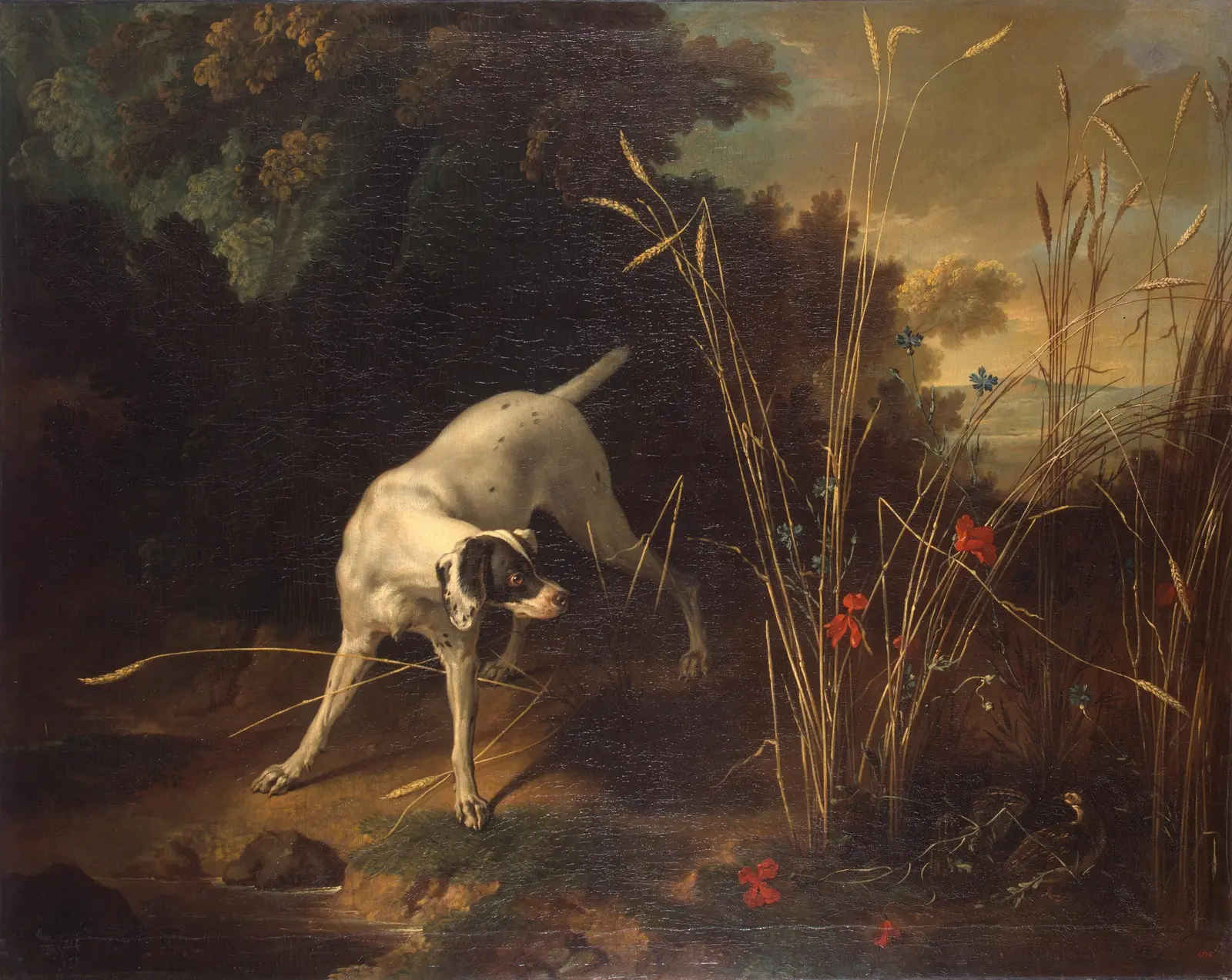
Jean-Baptiste Oudry's "Dog Pointing a Partridge," painted in 1725: the dog has stopped short beside the grass where two partridges sit.
"Dog Pointing a Partridge, by Jean-Baptiste Oudry" by Jean-Baptiste Oudry; Hermitage Museum, Saint Petersburg (inv. 2528) — https://commons.wikimedia.org/wiki/File:Jean-Baptiste_Oudry_-_Dog_Pointing_a_Partridge_-_WGA16781.jpg — Public domain (EU: Jean-Baptiste Oudry died 1755, more than 70 years ago (life plus 70 years); US: published before 1931; faithful photographic reproduction of a two-dimensional work)
On the walk, your dog stops at the same lamppost for a full minute. In a 2010 study, Brent Craven, Eric Paterson and Gary Settles recorded seven dogs sniffing at 4 to 7 sniffs per second, far faster than they breathed at rest. The paper does not say where the dogs lived, so their sample source cannot be assigned.
The same team then built a computer model of one dog's nose and followed the air inside it. Part of each sniff, the model showed, splits off from the air bound for the lungs and travels to a separate pocket at the back of the nose.
What happens inside a sniffing nose?
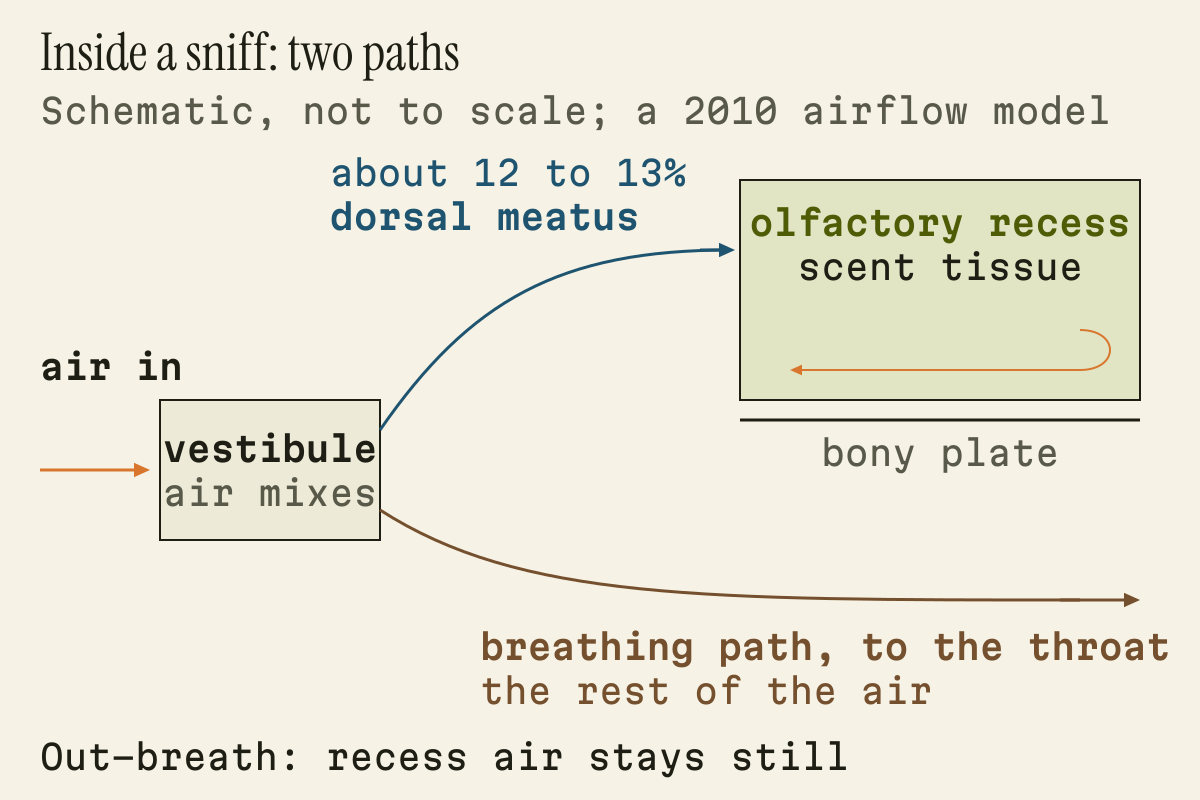
Schematic, not to scale, of the two air paths in a 2010 computer model of one dog's nose. About 12 to 13 percent of the inhaled air reached the scent region.
Worked from Facts restated from the text of Craven, Paterson & Settles 2010 (sections 1, 3.2 and 4.3), read only; not traced from the paper's figures.
"Two paths for inhaled air in a dog's nose, from a 2010 airflow model" by Sniff, Purr, Preen & Shoal, https://sniffpurrpreenandshoal.com/how-they-sense/dog-sense-of-smell/, licensed under CC BY 4.0 (https://creativecommons.org/licenses/by/4.0/)
Data: Craven, Paterson & Settles (2010), Journal of the Royal Society Interface 7:933, doi:10.1098/rsif.2009.0490 (facts restated)
A sniff does more than pull air toward the lungs. Craven's team built their model from MRI scans of the nose of one dog, a 29.5 kg female Labrador retriever mix, and computed how air moves through it during a sniff at five sniffs per second. The paper does not say where that dog came from, so its sample source cannot be assigned. Air entering the nostril is first stirred in the vestibule, the chamber just inside the nose, so the sample that moves on is well mixed.
From there the air splits. One channel along the top of the nose, called the dorsal meatus, carries air to the olfactory recess, a pocket at the back of the nose lined with scent-sensing tissue. A bony plate, the lamina transversa, keeps that pocket out of the main breathing path, and the rest of the inhaled air heads for the throat.
In the model, about 12 to 13 percent of the inhaled air reached the scent region, with the nostril relaxed and still. The authors note that a moving nostril might raise that share, but the way a dog's nostril moves while sniffing had not yet been described well enough to model.
Slow air at the back
Inside the recess the air behaves differently again. It rushes to the back, turns around and seeps slowly forward through thin, scroll-shaped airways with a surface of about 200 square centimeters, a figure the paper takes from the same group's earlier work. On the out-breath almost no air enters or leaves the recess, so the air there, with whatever scent it carries, sits still for a while.
The authors argue that this pattern suits smelling: air moves one way through the scent tissue on the in-breath, then rests there on the out-breath, which gives scent molecules more time to be taken up. The human nose, they point out, has no such recess, and its scent tissue sits near the roof of the main air passage.
Other noses, other layouts
The paper sets the dog beside other animals that rank as keen smellers. In its account, keen-smelling species, with examples among carnivores, rodents, hoofed mammals and marsupials, apparently all have a passage like the dorsal meatus that bypasses the breathing airways and leads to a scent pocket. Earlier computer models of the rat nose, the paper adds, found a similar split. The authors propose that the air paths this shared layout creates may largely explain why some mammals smell so keenly.
In people the arrangement differs. Because the scent tissue lies along the main air path, each out-breath either flushes it or brings a fresh sample up from the mouth and throat. In the dog model, the shape of the nose keeps that back route closed, so scent already drawn in can keep working on the scent tissue through the out-breath.
What the nasal cycle changes
Noses swell and shrink on a slow cycle, as blood vessels in the lining of the breathing passages widen and narrow. The paper notes that this happens in the breathing part of the nose, where blood vessels are plentiful, and not in the scent tissue, which has far fewer. The cycle could shift how much air goes up each side, but the authors do not expect it to change the overall pattern of the two paths.
This is a model of one nose. It shows the path the air takes, not how many times better a dog smells than a person does.
What a nose looks like up close
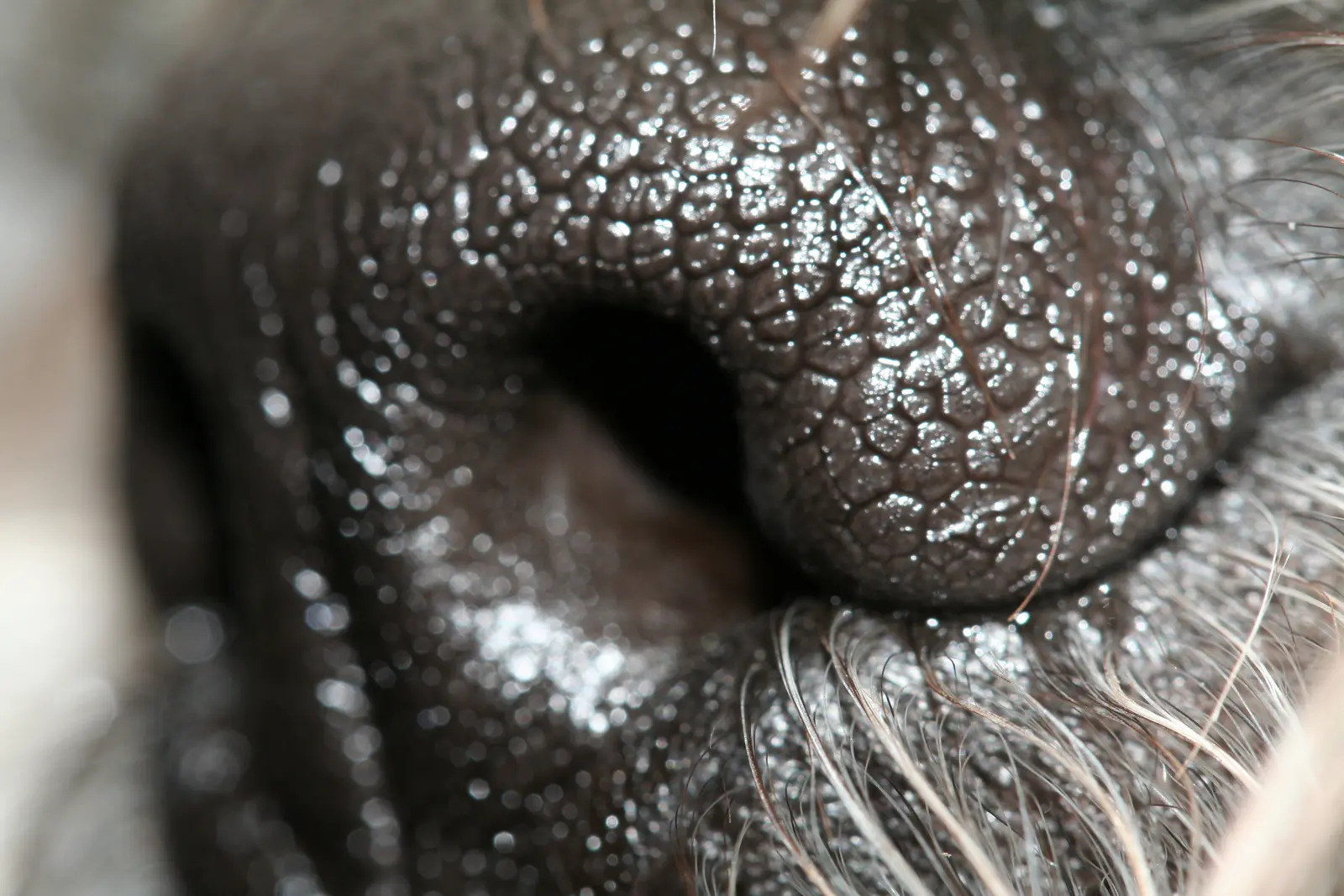
Close-up of a Lhasa Apso's nose, as the breed is labeled on the photo's file page: pebbled skin around one nostril.
"Dog nose macro close up" by Stockimagery — https://commons.wikimedia.org/wiki/File:Dog_nose_macro_close_up.JPG — CC BY-SA 3.0 (https://creativecommons.org/licenses/by-sa/3.0/)
From the outside, a nose shows only its nostrils. The 2010 model also followed the air just in front of them. At the peak of an in-breath, each nostril drew air from a small zone reaching about 1 cm ahead of it, a distance smaller than the gap between the two nostrils.
That means each nostril samples a different patch of air. The authors suggest a dog could compare the two samples to work out which side a smell is coming from, an idea the model raises but does not test. The 1 cm reach also matches the distance at which, according to a 1993 tracking study the paper cites, dogs hold their noses above the ground while following a trail.
The out-breath matters too. Because of the shape just inside the nostril, the exhaled air in the model leaves sideways and downward. When a dog sniffs a surface, the authors argue, those jets stir up smells below while keeping blow-off of the air just ahead of the nostril to a minimum, and they pull smells from the sides back toward the nose, which the authors describe as extending the reach of the nose. The paper cites earlier high-speed flow images of sniffing dogs that showed the same pattern.
A second smell organ
The scent pocket is not the only chemical sensor in a dog's nose. The paper notes that pheromone detection in dogs has traditionally been credited to the vomeronasal organ, which sits low in the front part of the nasal cavity. Citing a 2006 finding of a second class of chemical-sensing receptors in the scent tissue of mice, the authors add that dogs might also carry pheromone receptors in the lining of the scent pocket. That idea is raised, not tested, in the paper.
Other animals in the house sense the world at close range with other tools, such as the hairs a cat feels with, and one bowl study. These descriptions are about noses in general; questions about one dog's nose or breathing are for a veterinarian.
How fast does a dog sniff?
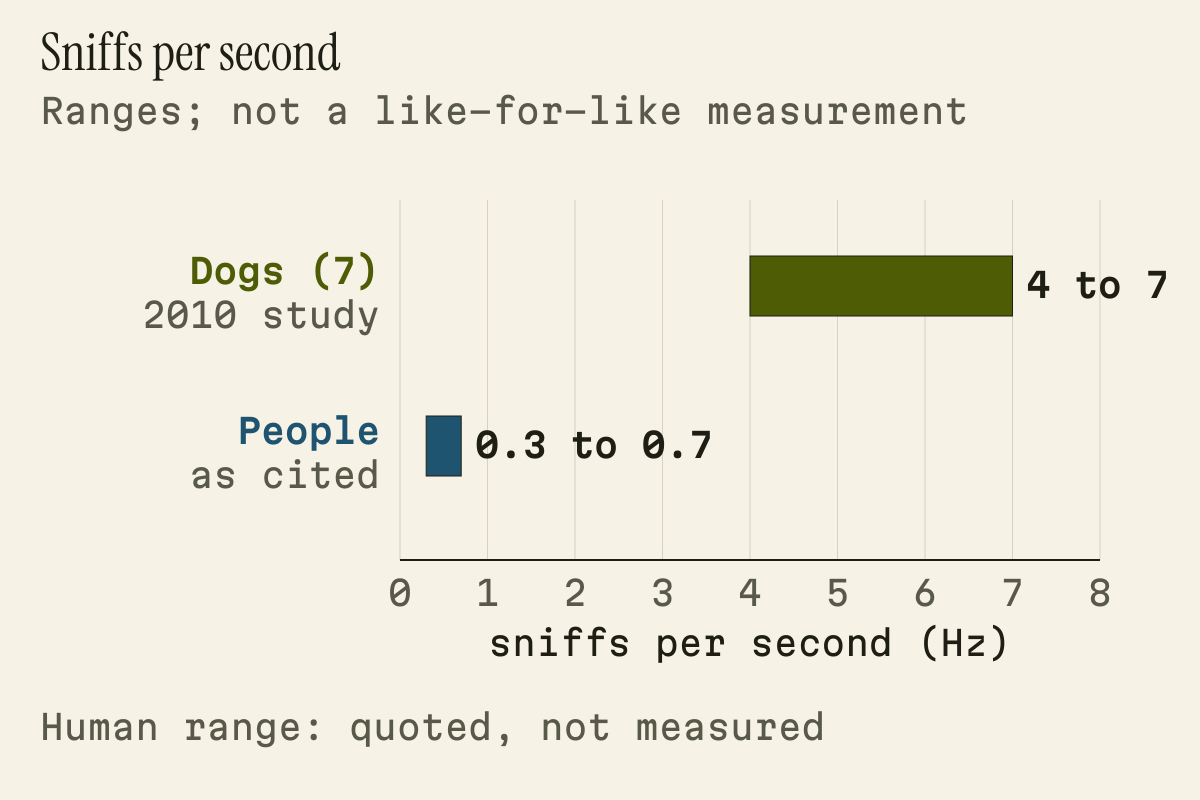
Sniff rates: 4 to 7 per second for the seven dogs in a 2010 study, and 0.3 to 0.7 per second for people as quoted in the same paper from earlier studies. Not a like-for-like measurement.
Worked from Ranges as printed in Craven, Paterson & Settles 2010 (section 4.1), read only; the human range is the paper's citation of earlier studies.
"Sniff rates: seven dogs in a 2010 study and people as cited in the same paper" by Sniff, Purr, Preen & Shoal, https://sniffpurrpreenandshoal.com/how-they-sense/dog-sense-of-smell/, licensed under CC BY 4.0 (https://creativecommons.org/licenses/by/4.0/)
Data: Craven, Paterson & Settles (2010), Journal of the Royal Society Interface 7:933, doi:10.1098/rsif.2009.0490 (facts restated)
The seven dogs in the sniffing tests weighed 6.8 to 52.9 kg, from a Pomeranian at one end to a Labrador retriever at the other. Each wore a clear muzzle with a sensor that measured the air flowing in, while it sniffed food and neutral objects it had not met before. Across 45 trials and over 300 sniffs, every dog sniffed at 4 to 7 times a second, whatever its size.
The muzzle itself took some design. Larger inlets in early trials distracted the dogs and stopped them sniffing naturally, as did muzzles they could not see through, so the final one was small and transparent. The authors put the error in its inflow readings at no more than 10 percent, while outflow readings were less accurate and are described only in general terms.
Bigger dogs did pull in more air with each sniff, roughly in step with their body weight, but the sniff rate stayed in the same band.
Sniffs come in bursts
A bout of sniffing usually started with a weak sniff, built up to the strongest one and then tailed off. Long bouts rose and fell in strength in slow waves, 0.5 to 1.5 times a second, and each burst of sniffs lasted about half a second to two seconds. The outflow rates recorded were never higher than the inflow rates, which the authors read as air building up in a dog's lungs while it sniffs.
The 4 to 7 band sits close to the rate at which dogs pant, which an earlier study put at about 5.3 times a second, near the natural rhythm of a dog's breathing system. The authors suggest that dogs may sniff at this rate partly to save effort, as has been proposed for panting. Rats, mice and rabbits, other keen smellers, sniff at similar rates.
For comparison, the paper quotes earlier studies that put human sniffing at 0.3 to 0.7 times a second, about ten times slower. Those numbers come from other studies and methods, so the two ranges in the chart are not a like-for-like measurement.
| Measure | Value | Kind |
|---|---|---|
| Dogs recorded | 7, from 6.8 to 52.9 kg | measured |
| Trials and sniffs | 45 trials, over 300 sniffs | measured |
| Dog sniff rate | 4 to 7 per second | measured |
| Human sniff rate | 0.3 to 0.7 per second | quoted from earlier studies |
| Air reaching the scent region | about 12 to 13 percent | model, nostril still |
| Reach of one nostril | about 1 cm | model |
Download the airflow facts (CSV) (what the file holds) Data: Craven, Paterson & Settles (2010), Journal of the Royal Society Interface 7:933, doi:10.1098/rsif.2009.0490 (facts restated)
Where does the 10,000 times figure come from?
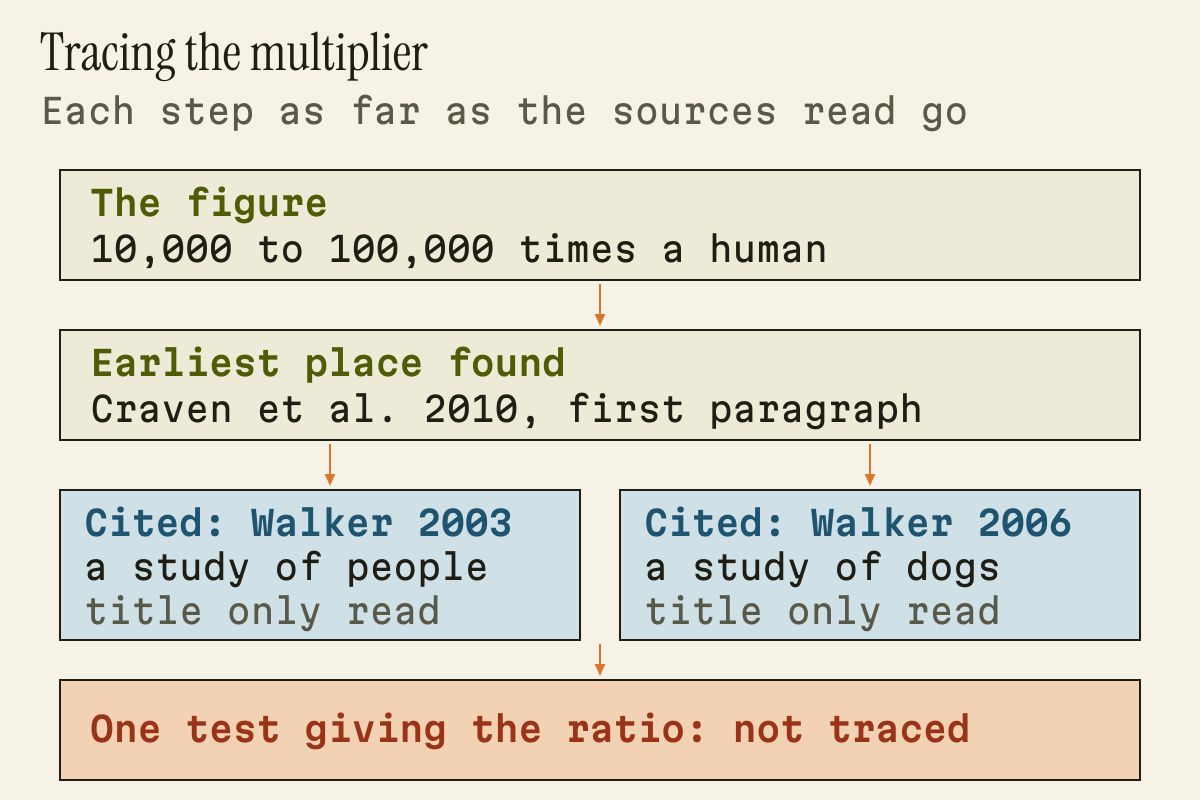
Where the 10,000 to 100,000 times figure was traced: to the opening of a 2010 paper, and from there to two cited studies known here only by their titles.
Worked from The introduction and reference list of Craven, Paterson & Settles 2010, read only; the two cited papers as bibliographic records only.
This figure in words
each step in the chain.
| Step | What was found |
|---|---|
| The figure | 10,000 to 100,000 times a human's sense of smell |
| Earliest place found | Craven, Paterson & Settles 2010, first sentence of the introduction |
| Cited there | Walker and colleagues 2003 (people) and Walker and colleagues 2006 (dogs) |
| How much was read | the two cited papers: titles only |
| One test giving the ratio | not traced |
"Where the 10,000 to 100,000 times figure was traced" by Sniff, Purr, Preen & Shoal, https://sniffpurrpreenandshoal.com/how-they-sense/dog-sense-of-smell/, licensed under CC BY 4.0 (https://creativecommons.org/licenses/by/4.0/)
Data: Craven, Paterson & Settles (2010), Journal of the Royal Society Interface 7:933, doi:10.1098/rsif.2009.0490 (introduction and reference list)
Download the source trace (CSV) (what the file holds)
How good is a dog's sense of smell, in a single number? The 2010 paper opens by stating that dogs can detect odors at concentrations of 1 to 2 parts per trillion and that their sense of smell is roughly 10,000 to 100,000 times as keen as a human's. Both numbers carry the same two citations: papers by Walker and colleagues from 2003 and 2006. Where the dogs in the 2006 paper came from cannot be assigned from its title alone.
Four steps for one number
Checked the way the hand-me-down rule sets out, the figure goes through four steps: earliest source, mechanism, counterexamples and a verdict.
Earliest source. Among the sources read for this page, the oldest statement of the range is that 2010 sentence. By their titles, the two papers it cites are different kinds of work: the 2003 paper is about how people detect odors and how to measure their thresholds, and the 2006 paper is about how sensitive dogs are. Neither was read beyond its bibliographic record, so this page cannot say how, or whether, either paper arrives at a ratio.
No test behind the range could be checked here. A ratio of dog to human sensitivity needs both species measured on comparable terms, and nothing read for this page shows such a comparison. The figure could not be traced to a test.
Mechanism. The 2010 paper does offer reasons a dog's nose could be keener: the airflow described above, plus a larger scent organ, more scent cells packed together and more working smell genes, which it cites from other studies. Its abstract describes the dog's nasal cavity as holding hundreds of millions of sensory neurons.
None of these is a measurement of how many times better a dog smells. The Sniff test page explains how a reading level limits what a page can say.
Why can't one number sum up a nose?
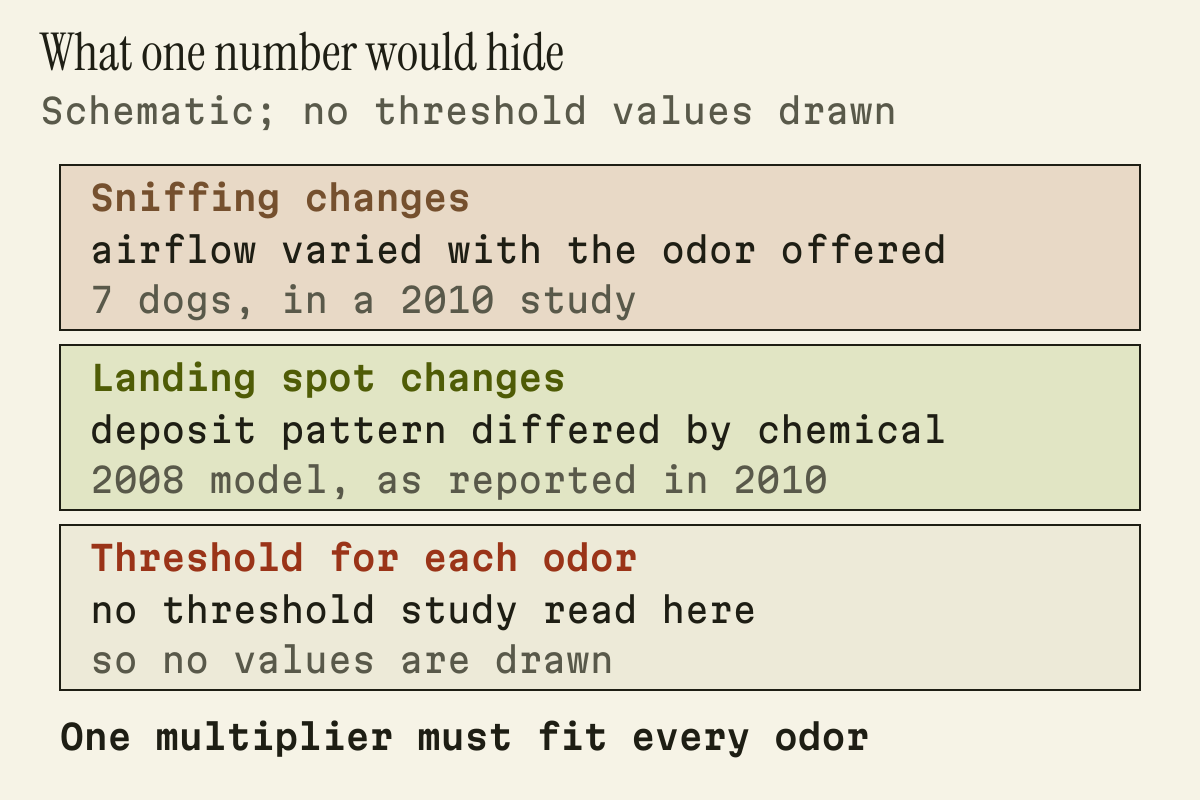
Schematic of three things that can change from one odor to the next, one of them from a 2008 vapor model. No threshold values are drawn, because no threshold study was read for this page.
Worked from Statements in Craven, Paterson & Settles 2010 (sections 3.1 and 5.1), read only; no threshold values drawn.
This figure in words
the three rows of the schematic.
- Sniffing changes: in the 2010 paper's sniffing tests, the seven dogs' airflow varied with the odor offered.
- Landing spot changes: in a 2008 vapor model, as the 2010 paper reports it, different chemicals left different patterns on the scent tissue.
- Threshold for each odor: no threshold study was read for this page, so no values are drawn.
"Three things that can change from one odor to the next" by Sniff, Purr, Preen & Shoal, https://sniffpurrpreenandshoal.com/how-they-sense/dog-sense-of-smell/, licensed under CC BY 4.0 (https://creativecommons.org/licenses/by/4.0/)
Data: Craven, Paterson & Settles (2010), Journal of the Royal Society Interface 7:933, doi:10.1098/rsif.2009.0490 (statements restated)
Counterexamples. A single multiplier does not say which odors it rests on, and the 2010 paper describes two things that change from one odor to the next. In the sniffing tests, the dogs' airflow varied with the odor they were offered, though the team did not analyze that link. And a vapor model from Craven's 2008 Penn State study, as the paper reports it, found that different chemicals settle onto the scent tissue in different patterns over time.
The authors suggest dogs may use those patterns to tell smells apart. A detection threshold is the weakest concentration of a particular odor that is still noticed, so any ratio built from thresholds belongs to the odors that were tested. Comparing dogs with people also depends on how each test is run; for one example of guarding dog tests against hidden cues, see how word tests keep owners from giving away the answer.
Verdict: rewrite. The sources read support a narrower sentence: a 2010 airflow paper states a range of 10,000 to 100,000 times and cites two studies for it, and nothing read here shows the size of the gap for any one odor. Calling the multiplier a hand-me-down rule describes how it travels, not proof that it is wrong; the cited studies may support some version of it.
What stays open
Can dogs smell fear? None of the papers read for this page put that question to dogs, so it stays open here.
Other gaps remain in what the sources read can say. The model held the nostril still, so how much air a moving nostril sends to the scent region is unknown. The modeled nose came from one Labrador mix with a medium-length head, and whether flat-faced or long-nosed dogs route air the same way was not tested. The thresholds behind the 10,000 to 100,000 times range were not read, and no repeat of the airflow model was among the sources read.
Sources
- Craven BA, Paterson EG, Settles GS (2010). "The fluid dynamics of canine olfaction: unique nasal airflow patterns as an explanation of macrosmia." Journal of the Royal Society Interface 7(47):933–943. doi.org/10.1098/rsif.2009.0490Read: Full text, read only; facts restated, no text, tables or figures reproduced
- Walker DB, Walker JC, Cavnar PJ, Taylor JL, Pickel DH, Hall SB, Suarez JC (2006). "Naturalistic quantification of canine olfactory sensitivity." Applied Animal Behaviour Science 97:241–254. doi.org/10.1016/j.applanim.2005.07.009Read: Bibliographic record only
- Walker JC, Hall SB, Walker DB, Kendal-Reed MS, Hood AF, Niu XF (2003). "Human odor detectability: new methodology used to determine threshold and variation." Chemical Senses 28(9):817–826. doi.org/10.1093/chemse/bjg075Read: Bibliographic record only
Cite this page
Sniff, Purr, Preen & Shoal. “Dog Sense of Smell: A 2010 Model Traces a Sniff’s Side Path.” Published November 20, 2026. https://sniffpurrpreenandshoal.com/how-they-sense/dog-sense-of-smell/. Accessed on the day you read it.
How studies are read and numbers recheckedMending basket: every correctionReport an error on this page (contact@sniffpurrpreenandshoal.com)
More from How They Sense the House
Sense Mechanism explainer
Can Dogs See Color? Yes, With Two Cone Types, Not Three
Picture credit
"A Golden Retriever lying on grass" by Barras — https://commons.wikimedia.org/wiki/File:A_Golden_Retriever-9_(Barras).JPG — CC BY 3.0 (https://creativecommons.org/licenses/by/3.0/)
Sense Mechanism explainer
Can Cats See in the Dark? Why Their Eyes Shine Back at You
Picture credit
"Tapetum lucidum en gato" by Dropus — https://commons.wikimedia.org/wiki/File:Tapetum_lucidum_gato.jpg — CC BY 3.0 (https://creativecommons.org/licenses/by/3.0/)
Sense Mechanism explainer
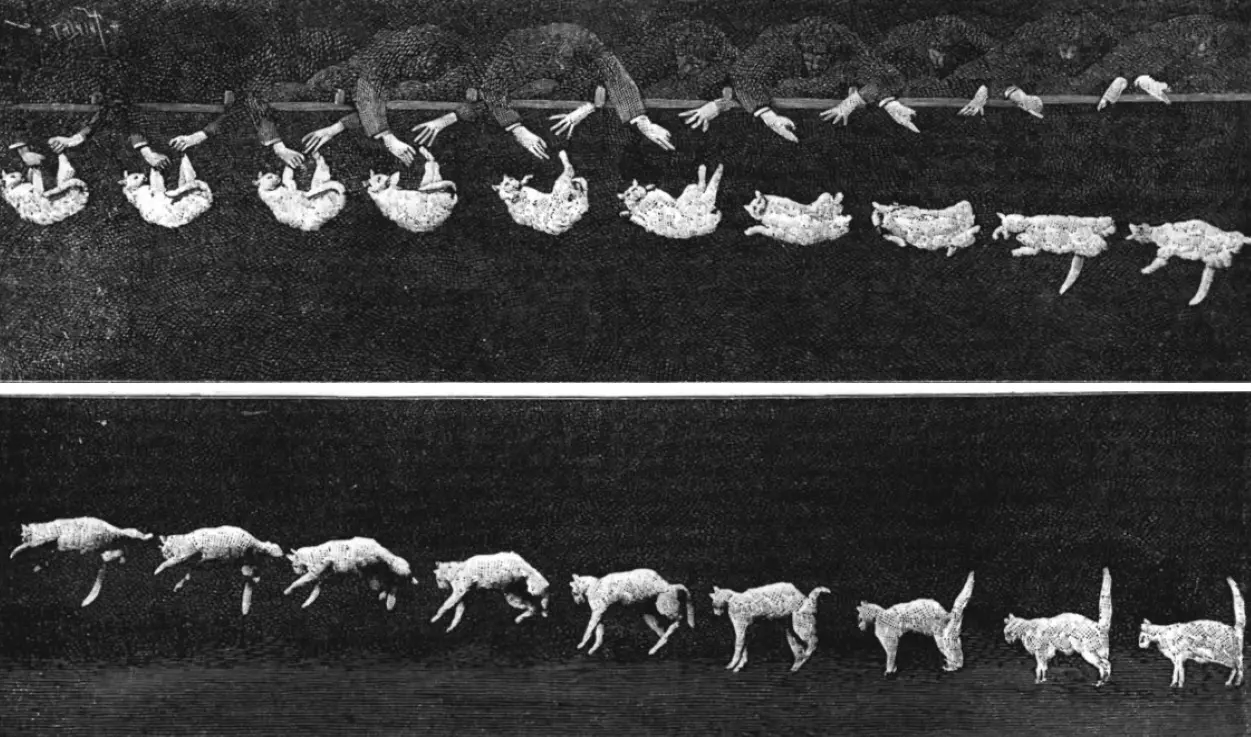
How Do Cats Land on Their Feet? Marey Photographed the Twist
Picture credit
"Falling cat, 1894" by Étienne-Jules Marey; Wikimedia Commons — https://commons.wikimedia.org/wiki/File:Falling_cat_1894.jpg — Public domain (EU: Étienne-Jules Marey died 1904, more than 70 years ago (life plus 70 years); US: published before 1931; the engraver who signed the print is not identified and the print's first publication is not traced)