Sense Mechanism explainer
Can Cats See in the Dark? Why Their Eyes Shine Back at You
Sniff, Purr, Preen & Shoal Published
TL;DR
A cat's eye makes more of dim light but still needs some light: the tapetum lucidum, a reflective layer behind the retina, sends light back through the retina a second time. Some leaves the eye again as shine. Still unknown, in the sources read here, is how much the second pass lowers the faintest light a cat can detect.
Doorplate
- Animal
- Domestic cat; fresh tissue studied outside the body
- Study
- Coles, 1971, Journal of Physiology
- n (analysed / excluded)
- not in the abstract read
- Couch sample
- cannot be assigned: the abstract does not say where the cats came from
- Limits
- Abstract only; fresh tissue taken out of the eye, not living cats; not in the abstract read beyond that
- Setup in one line
- Fresh isolated tapetum viewed under a low-power microscope; one reflecting domain at a time lit with a narrow pencil of white light and the color and direction of the reflection observed
- Replicated?
- As of 2026-11-20: the 2022 review by Zueva and colleagues restates the shallow-blue, deep-red finding; no independent repeat among the sources read
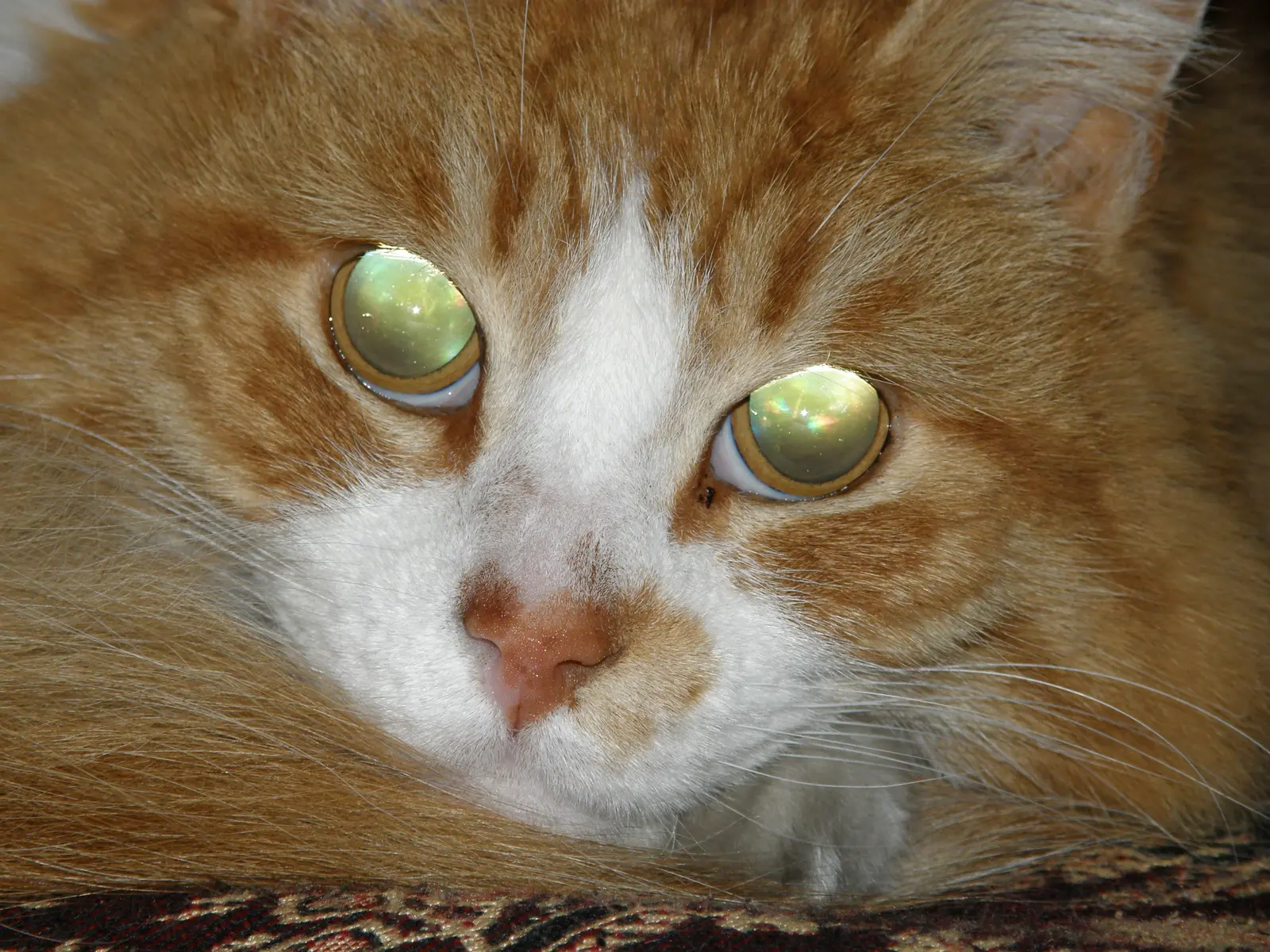
A red tabby and white cat whose wide pupils shine yellow-green, within the color range the 2022 review gives for living cats' eyes.
"Tapetum lucidum en gato" by Dropus — https://commons.wikimedia.org/wiki/File:Tapetum_lucidum_gato.jpg — CC BY 3.0 (https://creativecommons.org/licenses/by/3.0/)
The hall light is off, and the cat's eyes catch the glow from your phone. That glow is light coming back out of the eye. A 2022 review by Lidia Zueva and colleagues in the Journal of Biophotonics traces it to the tapetum lucidum, which in the cat is a stack of 15 to 30 cell layers at its center.
A reflector can only send back light that reaches it. It makes no light of its own, so it can help in a dim room and has nothing to work with in a room that is fully dark.
Why do cats' eyes glow?
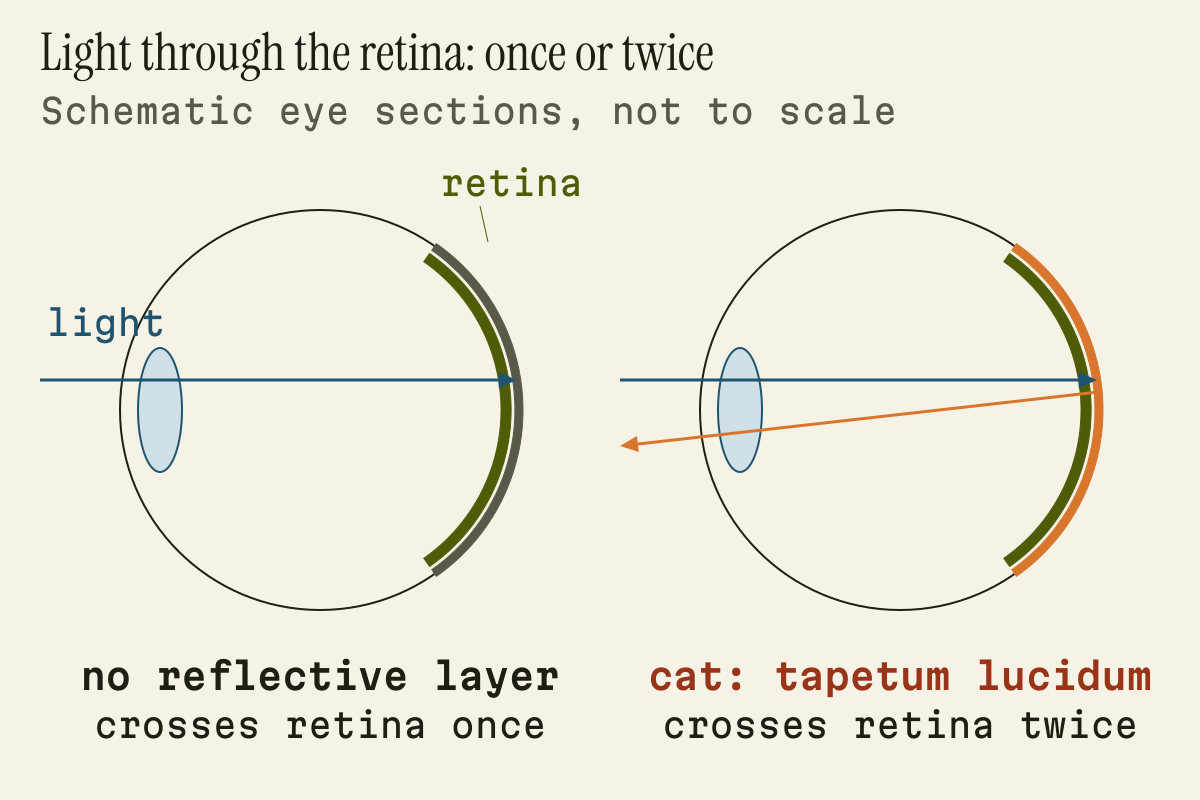
Schematic, not to scale: without a reflective layer, light crosses the retina once; in a cat's eye, the tapetum lucidum sends part of it back for a second pass, and some leaves the eye as shine.
Worked from Layer order as described in the 2022 review by Zueva and colleagues; not to scale.
"Light passes the retina once without a reflective layer, twice with a tapetum lucidum" by Sniff, Purr, Preen & Shoal, https://sniffpurrpreenandshoal.com/how-they-sense/cat-night-vision/, licensed under CC BY 4.0 (https://creativecommons.org/licenses/by/4.0/)
Data: Zueva et al. (2022), Journal of Biophotonics 15(6):e202200002, doi:10.1002/jbio.202200002, CC BY 4.0
The retina is the sheet of light-sensing cells at the back of the eye. Light that gets through it without being caught would otherwise be lost. The 2022 review describes the tapetum lucidum as a biological reflector that returns this light, giving the light-sensing cells “a second chance for photoreceptor stimulation” and raising the eye's sensitivity at low light levels. The review is published under a CC BY 4.0 license.
Not all of the returning light is caught on the second pass either. Some of it travels back out through the pupil, and that escaping light is the shine. The light itself comes from the lamp, the screen or the flash. The layer only sends it back.
According to the review, many animals with backbones have a tapetum, though some species lack it, mostly ones active by day. Its position differs between groups. In cats and other carnivores it lies in the choroid, the layer of blood vessels between the retina and the tough outer wall of the eye, the sclera.
The layer is old. The review cites a comparative study suggesting that it had evolved, at least in sharks, sturgeon and lobe-finned fish, in the Devonian period, 345 to 395 million years ago. Very different animals reflect light in their eyes by much the same optical means, the review concludes, even where the reflecting material differs.
What is the reflective layer made of?
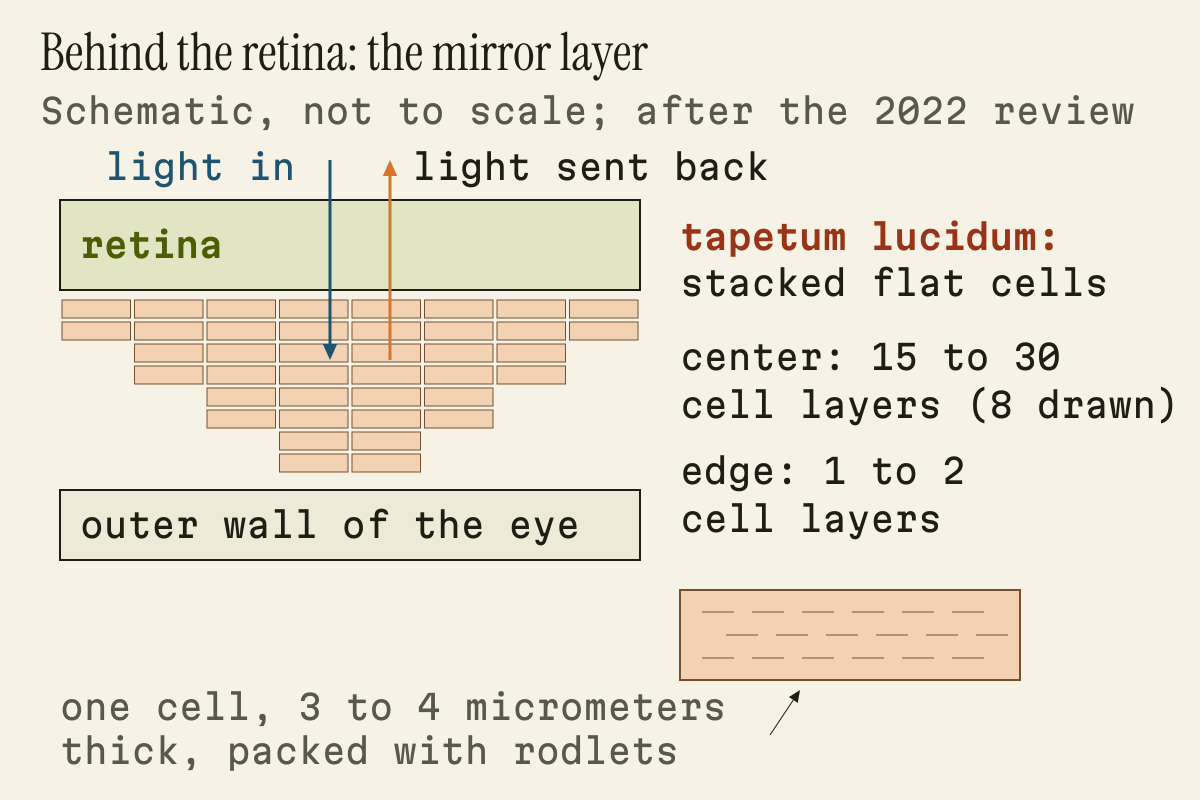
Schematic, not to scale, of the cat's reflective layer as the 2022 review describes it: a stack of flat cells behind the retina, thickest at the center and packed with tiny rods that reflect light.
Worked from Layer counts and cell sizes as summarized in the 2022 review by Zueva and colleagues; not to scale, with 8 layers drawn at the center.
"The cat's reflective layer behind the retina, schematic" by Sniff, Purr, Preen & Shoal, https://sniffpurrpreenandshoal.com/how-they-sense/cat-night-vision/, licensed under CC BY 4.0 (https://creativecommons.org/licenses/by/4.0/)
Data: Zueva et al. (2022), Journal of Biophotonics 15(6):e202200002, doi:10.1002/jbio.202200002, CC BY 4.0
In the cat, the tapetum is a stack of flat cells. The 2022 review, summing up electron microscope studies, puts it at 15 to 30 layers of cells at the center, thinning to only 1 or 2 layers at the edge. Each cell is 3 to 4 micrometers thick, a micrometer being a thousandth of a millimeter. The cells are packed with rodlets, tiny rods about 5 micrometers long, lined up in bundles.
Inside a bundle the rodlets sit in a regular six-sided grid with even gaps between them. The review explains that how strongly such a grid reflects depends on the wavelength of the light and on the distance between the rods. By the review's dating, the idea that the cat's tapetum reflects by light interference is about 150 years old.
The measured sizes do not agree. Electron microscope studies cited in the review report rodlet diameters from about 100 to 230 nanometers, a nanometer being a billionth of a meter, and center-to-center distances of 150 or 400 nanometers. The review leaves open whether cats differ or methods do. It adds a physics result: such grids reflect best at a wavelength-to-spacing ratio of 2 to 2.5, which it says fits the tapetum of carnivores.
What the rodlets are made of is less settled. The review reports that cat choroid cells are rich in riboflavin, also called vitamin B2. It also reports that isolated rodlets have a refractive index, a measure of how strongly a material bends light, of about 1.69, close to that of crystalline riboflavin, against 1.33 for the fluid inside the cell. In its main text, the review presents riboflavin crystals as a possibility, not a finding.
A kitten is not born with the layer. One study summarized in the review found that pigment cells in the kitten's choroid turn into tapetal cells in the third week after birth.
Dogs and other animals
The dog's tapetum has rod gratings very similar to the cat's, with similar spacing, the review notes, and ferrets have a similar kind. In dogs the color of the reflection can differ between breeds and even within one breed, and some breeds have no tapetum at all, as reported in the review. Hoofed animals such as cattle, sheep and horses build theirs differently, from stacked fibers of what appears to be collagen outside the cells instead of rodlets inside them.
A layer of small mirrors
A 1971 study by J. A. Coles, read in abstract, looked at fresh tapetum taken from cats' eyes under a low-power microscope. The abstract does not say where the cats came from, so their sample source cannot be assigned. The tissue turned out to be made of many separate reflectors, which Coles called domains, each less than 6 micrometers across, and he concluded that they are subdivisions of the rodlet bundles seen in electron micrographs.
Coles lit the domains one at a time with a narrow beam of white light. By the abstract, domains near the surface that faces the inside of the eye tended to reflect blue light, and deeper ones reflected longer wavelengths, a difference the abstract puts down to differences in layer spacing. Each domain also had a set of reflecting planes lying within 15 degrees of the tapetal surface.
The abstract ends on a suggestion, not a measurement. Coles proposed that, under some conditions, the way the tapetum is built may make the eye's sensitivity to different colors vary noticeably from one spot to another.
The 2022 review fills in one detail behind that color split: in electron microscope studies, the rodlets sit about 20 percent farther apart in the deeper layers. The Sniff test page explains why a study read in abstract gets fewer details here.
Why is the shine green in one cat and red in another?
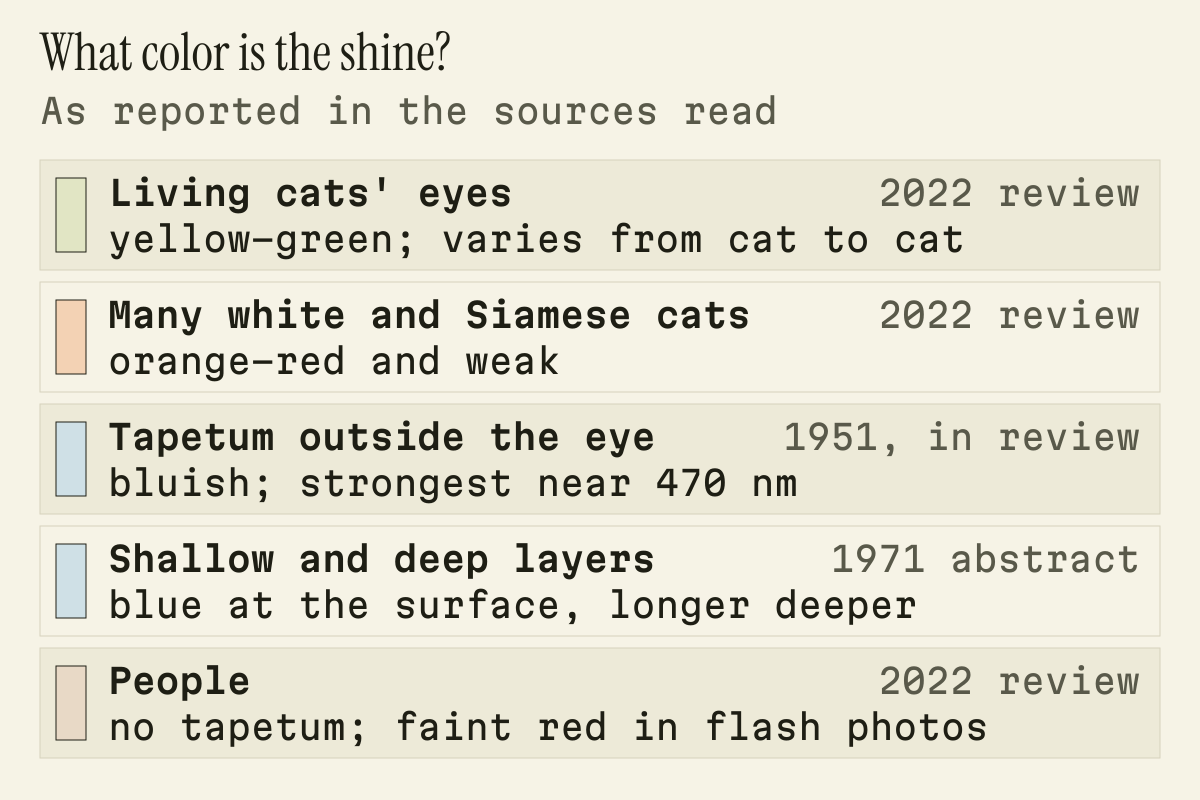
The color of a cat's eyeshine as each source reports it. The swatches only mark the rows; they are not measured colors.
Worked from Descriptions in the 2022 review by Zueva and colleagues (CC BY 4.0) and the Coles 1971 abstract; no values computed.
"The color of a cat's eyeshine, by source" by Sniff, Purr, Preen & Shoal, https://sniffpurrpreenandshoal.com/how-they-sense/cat-night-vision/, licensed under CC BY 4.0 (https://creativecommons.org/licenses/by/4.0/)
Data: Zueva et al. (2022), Journal of Biophotonics 15(6):e202200002, doi:10.1002/jbio.202200002, CC BY 4.0; Coles (1971), Journal of Physiology 212:393, doi:10.1113/jphysiol.1971.sp009331 (abstract)
| Eye or sample | Shine as reported | Source, as read |
|---|---|---|
| Living cats' eyes | yellow-green, varying from cat to cat | 2022 review, full text |
| Many white (albino) and Siamese cats | orange-red and weak; little or no working tapetum | 2022 review, full text |
| Tapetum taken out of the eye | bluish, strongest near 470 nm | 1951 study as reported in the 2022 review |
| Shallow and deep layers | blue near the surface, longer wavelengths deeper | Coles 1971, abstract |
| People | no tapetum; a faint red from the choroid in flash photos | 2022 review, full text |
Download the cat eyeshine facts (CSV) (what the file holds) Data: Zueva et al. (2022), Journal of Biophotonics 15(6):e202200002, doi:10.1002/jbio.202200002, CC BY 4.0; Coles (1971), Journal of Physiology 212:393, doi:10.1113/jphysiol.1971.sp009331 (abstract)
Observers looking into living cats' eyes have called the shine yellowish green or green. The 2022 review adds that it varies considerably from cat to cat within that yellow-green range.
The review also suggests why a blue-green reflection would suit dim light. Light near those wavelengths is taken up better by rods, the retinal cells that work in dim light, than by cones, the cells behind color vision. It makes that point with figures from cattle and reports similar figures for cats.
Tapetum taken out of the eye behaves differently. In a 1951 study reported in the review, Gunter and colleagues found that isolated tissue looked bluish and reflected most strongly near 470 nanometers, a wavelength of blue light. The review does not say where the cats in these older studies came from, so no sample source can be assigned to them.
The same 1951 study, as the review reports, found that the isolated tissue reflected at most 15 to 24 percent of the light shone on it, less than a bare cover glass. Studies of living cats described the reflection as considerable, but the review notes that no number was put on it.
Why do some cats' eyes glow red?
Many white (albino) and Siamese cats have no working tapetum, according to a 1980 study summarized in the 2022 review. Seen in a living cat, the back of such an eye looks like a mass of red blood vessels, and the reflection is orange-red and not very efficient. The review says many such cats, not all.
Changes in how a cat's eyes look or shine are a question for a veterinarian; this page does not describe eye disease.
Do humans have a tapetum?
No. The 2022 review states that humans have no tapetum and that ordinary human eyes give only a faint red reflection from the choroid, the kind that shows up in flash photos. In a flash photo, the eyes of a cat with a working tapetum return light from a mirror layer, while a person's return it from tissue full of blood vessels.
Can cats see in complete darkness?
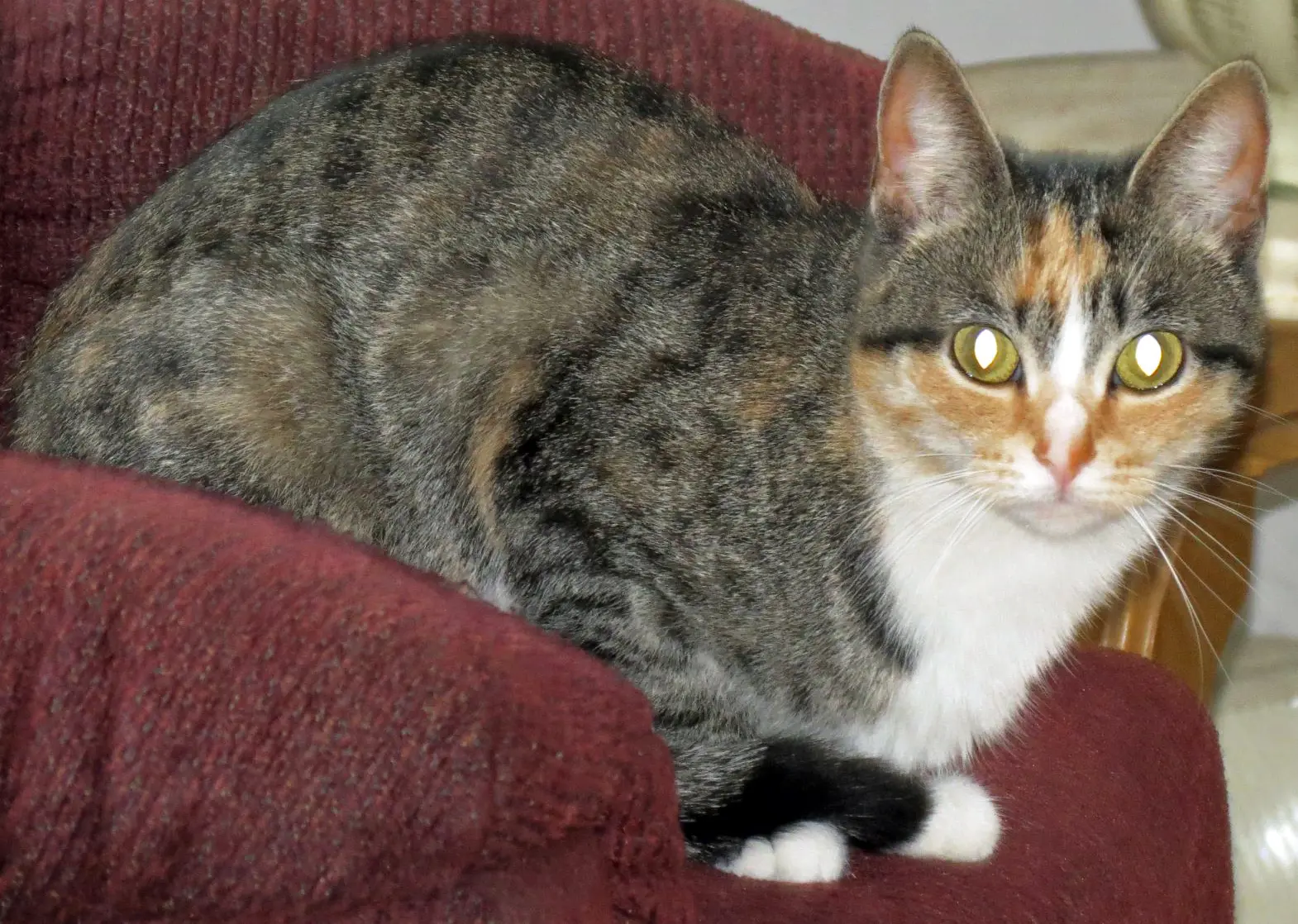
A tortoiseshell tabby and white cat on an armchair, its eyes lit by a camera flash. The light in the eyes came from the flash; the layer behind the retina sent it back.
"Eyeshine in Felis catus (domestic cat) 3" by James St. John — https://commons.wikimedia.org/wiki/File:Eyeshine_in_Felis_catus_(domestic_cat)_3.jpg — CC BY 2.0 (https://creativecommons.org/licenses/by/2.0/)
No source read for this page tested cats in a room with no light at all, so the answer here rests on how the eye works. Seeing starts when light reaches the light-sensing cells. By the 2022 review's description, the tapetum only sends back light that has already passed through the retina. With no light coming in, there is nothing for the mirror to return.
In dim light, the layer gives each bit of light a second chance at being caught. How much that helps is less clear than it sounds. The review reports that Gunter and colleagues, from their 1951 reflection readings, expected the layer to let cats detect somewhat fainter light, but that their tests in living cats did not bear this out.
The review also notes that most earlier authors treated the cat's tapetum as a scattering surface, not a mirror. It suggests that this assumption may have led to some of the contradictory results. One sign against the scattering view, by the review's account, is that light reflected from a cat's tapetum keeps its polarization, which an ordinary scattering surface would not do.
Sight is one sense among several on this site. Two others are the other sense a falling cat relies on and the cat's other touch-sensitive tool, and one bowl study.
The “times better” figure
The question in this page's title draws 10,000 to 100,000 searches a month in the United States, by the range Google gives advertisers as of November 2026.
Search results for it on 2026-11-20 included pages giving one fixed figure for how much better cats see in the dark than people, none of them a study. A figure like that is what this site calls the hand-me-down rule, a rule of thumb that travels without a source anyone can point to. It gets the same four steps as any other:
- Earliest source. None among the sources read for this page. A web search on 2026-11-20 led only to secondary pages and to the name of a behavioral study that was not read here, so no figure is given.
- Mechanism. The tapetum gives light a second pass at the retina, a real reason to expect better use of dim light, but the 2022 review puts no size on the gain.
- Counterexamples. The review reports that early tests in living cats did not show the gain the reflection readings predicted, and that the shine is weak in many white and Siamese cats.
- Verdict. Rewrite. “A cat's mirror layer helps it use dim light” fits the sources read; a single multiplier does not, until the study behind it is read.
Still unknown, among the sources read here, is how much the second pass lowers the faintest light a cat can detect, and whether that gain varies from cat to cat as much as the color of the shine does. The early figures came from tissue taken out of the eye, and the review itself says that many questions about the optics of eyes remain unexplained.
Sources
- Coles JA (1971). "Some reflective properties of the tapetum lucidum of the cat's eye." Journal of Physiology 212(2):393–409. doi.org/10.1113/jphysiol.1971.sp009331Read: Abstract only
- Zueva L, Zayas-Santiago A, Rojas L, Sanabria P, Alves J, Tsytsarev V, Inyushin M (2022). "Multilayer subwavelength gratings or sandwiches with periodic structure shape light reflection in the tapetum lucidum of taxonomically diverse vertebrate animals." Journal of Biophotonics 15(6):e202200002. doi.org/10.1002/jbio.202200002Read: Full text, open license; CC BY 4.0, author manuscriptText license: CC BY 4.0 (terms)
Cite this page
Sniff, Purr, Preen & Shoal. “Can Cats See in the Dark? Why Their Eyes Shine Back at You.” Published November 20, 2026. https://sniffpurrpreenandshoal.com/how-they-sense/cat-night-vision/. Accessed on the day you read it.
How studies are read and numbers recheckedMending basket: every correctionReport an error on this page (contact@sniffpurrpreenandshoal.com)
More from How They Sense the House
Sense Mechanism explainer
Can Dogs See Color? Yes, With Two Cone Types, Not Three
Picture credit
"A Golden Retriever lying on grass" by Barras — https://commons.wikimedia.org/wiki/File:A_Golden_Retriever-9_(Barras).JPG — CC BY 3.0 (https://creativecommons.org/licenses/by/3.0/)
Sense Mechanism explainer
Dog Sense of Smell: A 2010 Model Traces a Sniff’s Side Path
Picture credit
"Dog Pointing a Partridge, by Jean-Baptiste Oudry" by Jean-Baptiste Oudry; Hermitage Museum, Saint Petersburg (inv. 2528) — https://commons.wikimedia.org/wiki/File:Jean-Baptiste_Oudry_-_Dog_Pointing_a_Partridge_-_WGA16781.jpg — Public domain (EU: Jean-Baptiste Oudry died 1755, more than 70 years ago (life plus 70 years); US: published before 1931; faithful photographic reproduction of a two-dimensional work)
Sense Mechanism explainer
How Do Cats Land on Their Feet? Marey Photographed the Twist
Picture credit
"Falling cat, 1894" by Étienne-Jules Marey; Wikimedia Commons — https://commons.wikimedia.org/wiki/File:Falling_cat_1894.jpg — Public domain (EU: Étienne-Jules Marey died 1904, more than 70 years ago (life plus 70 years); US: published before 1931; the engraver who signed the print is not identified and the print's first publication is not traced)