Purr Research story
Cat Slow Blink: In Two Tests, Cats Narrowed Their Eyes Back
Sniff, Purr, Preen & Shoal Published
TL;DR
A cat slow blink is a run of half-blinks that ends with the eyes narrowed or closed. In two 2020 tests in cats’ own homes pet homes, cats did more of it when people slow blinked, and in the second scored a little higher for approaching a stranger’s hand. What it means to a cat is unknown so far.
Doorplate
- Animal
- Pet cats living indoors with outdoor access; estimated ages 0.45 to 16 years in test 1 and 1 to 17 years in test 2
- Study
- Humphrey et al. 2020, Scientific Reports
- n (analysed / excluded)
- 18 / 3 in test 1 (21 cats tested); 18 / 6 in test 2 (24 cats recruited)
- Couch sample
- pet homes owned cats tested in a familiar room of their own home; test 2 cats recruited through local online advertisements
- Limits
- Two tests in one paper; cats with eye problems not included; owners varied in how they slow blinked; the test 2 neutral face looked away from the cat
- Setup in one line
- Test 1: the owner slow blinks at the cat or does not interact; test 2: an unfamiliar experimenter slow blinks or holds a neutral face, then offers a hand
- Replicated?
- As of 2026-11-20, no independent repeat among the sources read
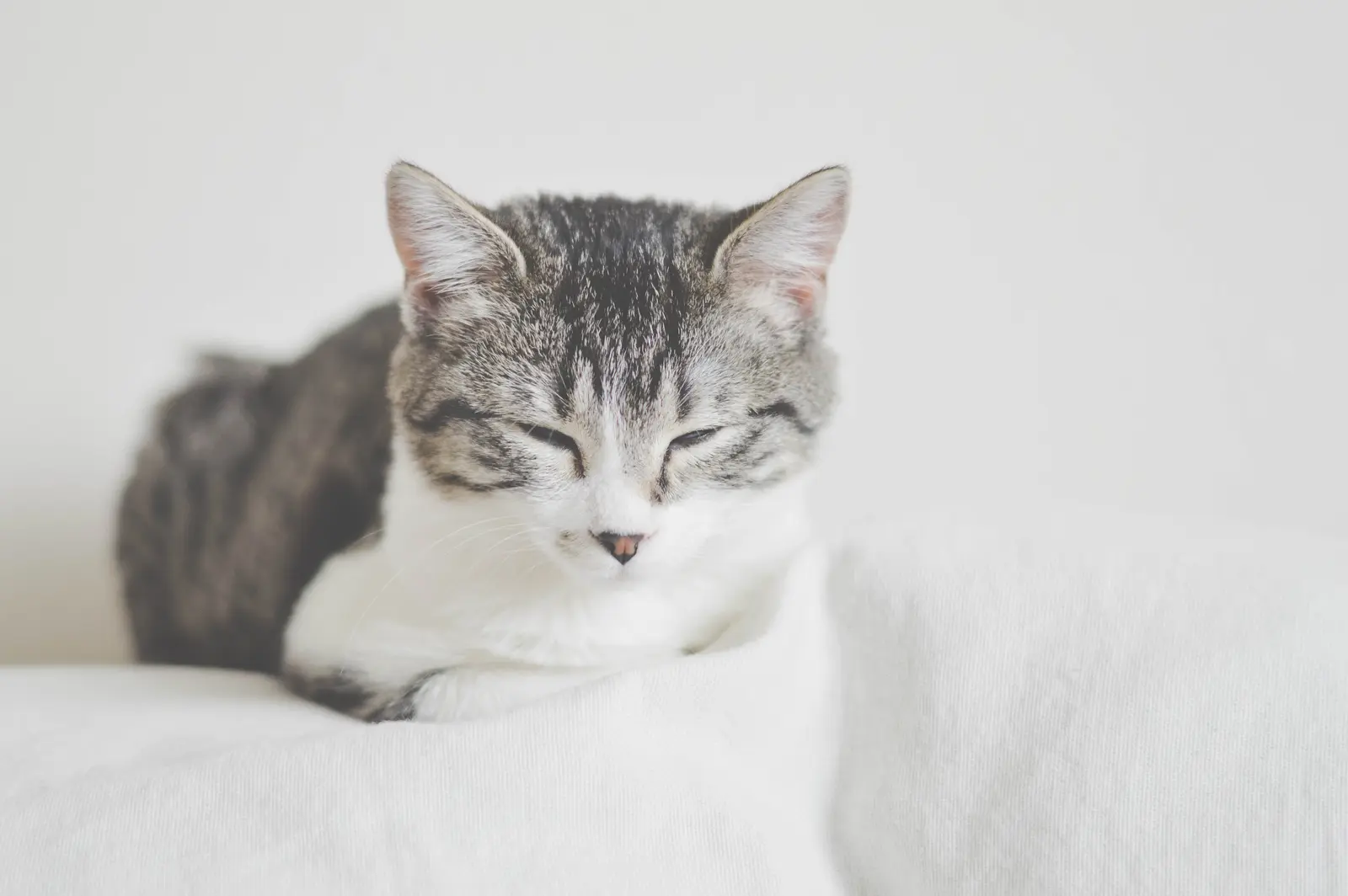
A tabby cat dozing on a white sofa, in a 2016 photo. One still picture cannot show whether a cat is slow blinking or simply drowsy.
"Sleepy tabby" by Chinda Sam afortunatefate (Unsplash) — https://commons.wikimedia.org/wiki/File:Sleepy_tabby_(Unsplash).jpg — CC0 1.0 (https://creativecommons.org/publicdomain/zero/1.0/)
Across the room, the cat half closes its eyes, then slowly opens them. A 2020 study from the University of Sussex tested that movement in 21 cats from 14 households pet homes, with each owner slow blinking from about 1 m away. While the owners slow blinked, the cats narrowed their eyes about twice as often per second as when the owners did not interact with them.
Tasmin Humphrey and colleagues describe the slow blink sequence as typically “a series of half-blinks followed by either a prolonged eye narrow or an eye closure.” A half-blink is a movement of the eyelids toward each other that never fully closes the eye. Both of their tests ran in the cats’ homes, and the second changed who did the blinking.
What did the first test measure?
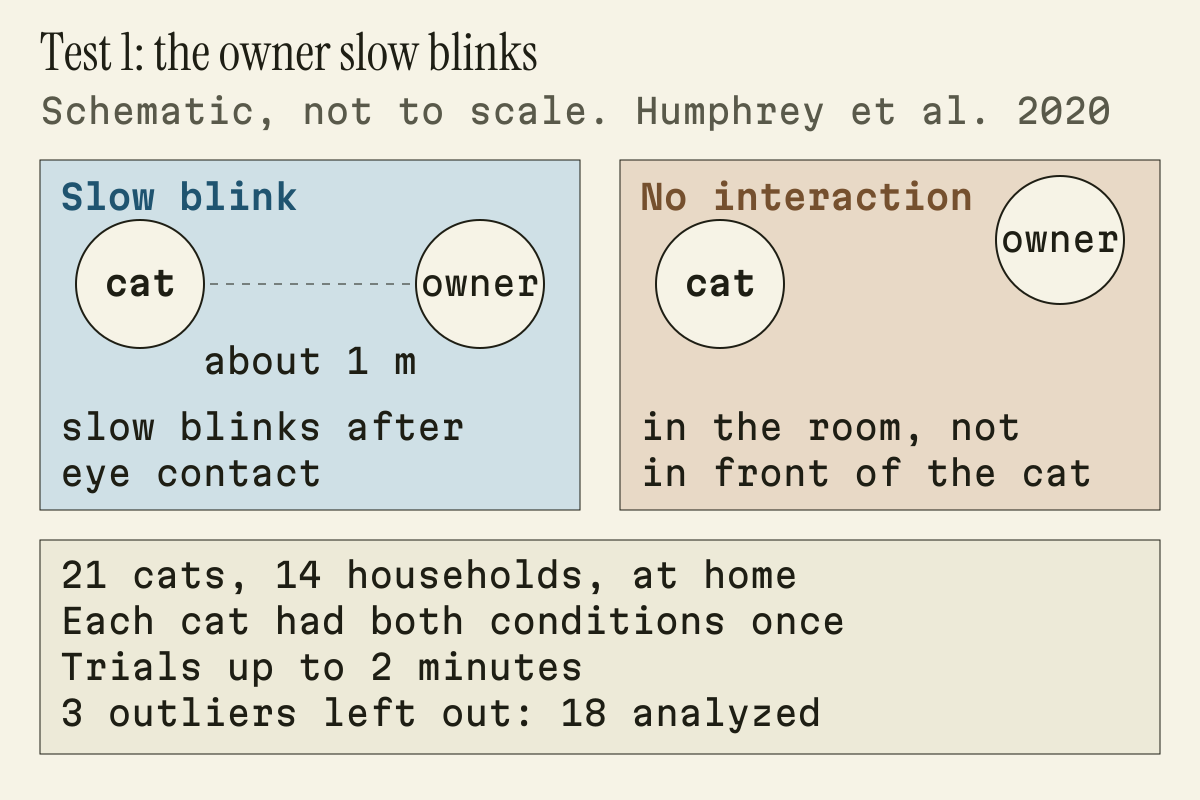
Schematic, not to scale: in the first test, each cat had one trial with its owner slow blinking about 1 m away and one with the owner in the room but not interacting.
Worked from The Methods of Humphrey et al. 2020, Experiment 1; drawn as plain shapes, not to scale.
"Design of the first slow blink test, Humphrey et al. 2020" by Sniff, Purr, Preen & Shoal, https://sniffpurrpreenandshoal.com/cats/cat-slow-blink/, licensed under CC BY 4.0 (https://creativecommons.org/licenses/by/4.0/)
Data: Humphrey et al. (2020), Scientific Reports 10:16503, CC BY 4.0
Each cat was tested in a familiar room of its own home. Once the cat had settled, the owner either sat about 1 m in front of it or stayed in the room without interacting. In the slow blink trial, the owner waited for eye contact and then made the movement, which the experimenters had shown and coached beforehand. Each cat had each kind of trial once, in counterbalanced order, and a trial ran for at most 2 minutes or until the cat walked away.
The cats were 10 males and 11 females, with estimated ages from 0.45 to 16 years. All lived indoors with outdoor access and had been with their owners for at least 3 months. Cats that were partly blind or had medical problems involving the eyes were not included.
Three of the 21 cats pet homes were left out of the analysis as outliers, more than 2 standard deviations from the mean. That leaves 18 cat and owner pairs in the results; 3 in 21 works out to 14.3%.
The video was coded with CatFACS, a system that names each facial movement by the muscles behind it. It comes from a 2017 paper by C. C. Caeiro and colleagues, Development and application of CatFACS; only that paper’s bibliographic record was consulted here. The team added one code of its own, eye narrowing, for eyelids held partly closed for at least 2 video frames, or 0.08 seconds.
The cats’ eye movements were scored blind to condition; the owners’ faces could not be, since the condition showed on them. A second certified coder, blind to condition, scored a random 25% of the videos, and the two agreed well (a Cronbach’s alpha of 0.9).
What did the cats do?
Because the trials differed in length, each cat’s movements were counted as a rate per second. During the owners’ slow blinks, the 18 analyzed cats narrowed their eyes at a mean rate of 0.06 a second, against 0.03 without interaction. Converted for this page, that is about 3.6 against 1.8 a minute, from means the paper rounds to two decimals.
Half-blinks rose too, from 0.15 to 0.21 a second. The rise was clear in males (0.13 to 0.30) and weak in females (0.10 to 0.13), though the paper’s pooled 0.15 sits above both of those comparison means, as printed. Ordinary blinks showed no significant effect of condition. Only 4 cats pet homes closed their eyes fully during the slow blink trials and 3 during the other trials, too few to analyze.
What did the second test add?
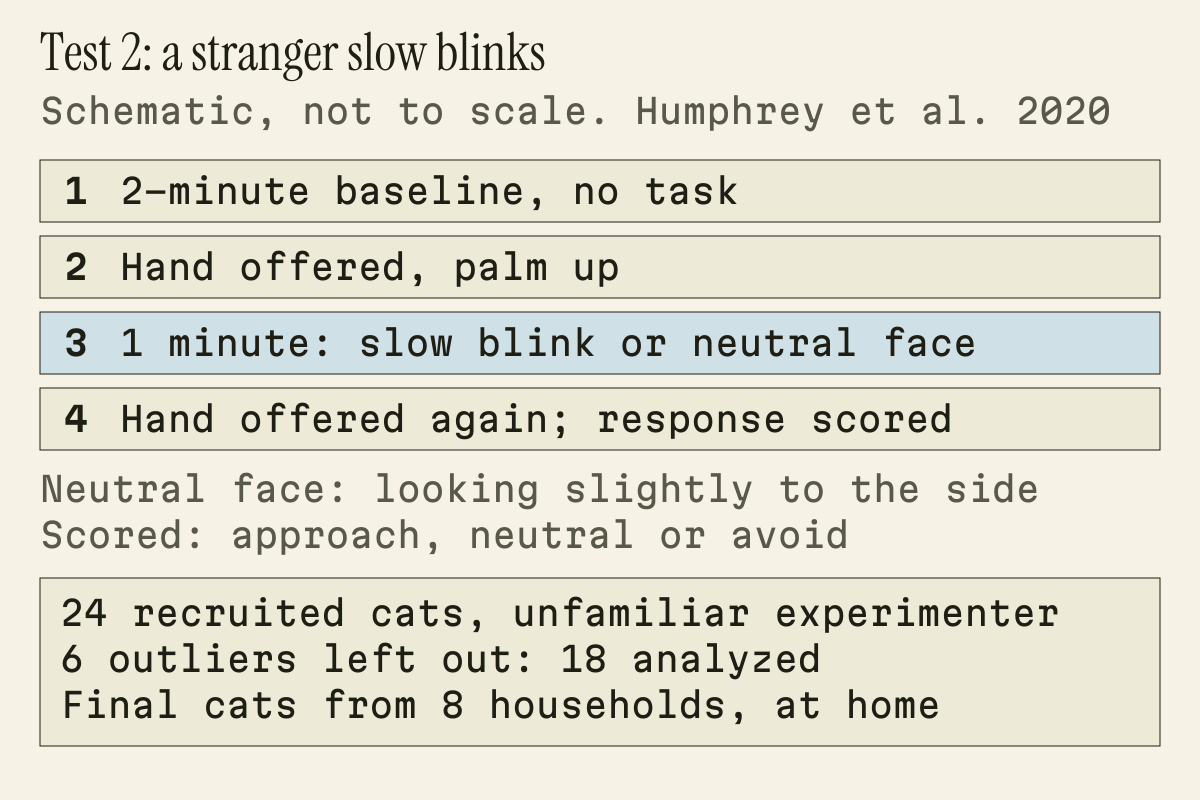
Schematic, not to scale: in the second test, a person the cats did not know offered a hand, then slow blinked or held a neutral face for a minute, then offered the hand again.
Worked from The Methods of Humphrey et al. 2020, Experiment 2; drawn as plain shapes, not to scale.
"Design of the second slow blink test, Humphrey et al. 2020" by Sniff, Purr, Preen & Shoal, https://sniffpurrpreenandshoal.com/cats/cat-slow-blink/, licensed under CC BY 4.0 (https://creativecommons.org/licenses/by/4.0/)
Data: Humphrey et al. (2020), Scientific Reports 10:16503, CC BY 4.0
The authors point out that owners varied in how they slow blinked, in how much they talked to the cat and even in whether they wore glasses. A second test used one experimenter for every cat, to make the stimulus more uniform. It also asked whether cats respond differently to a slow-blinking stranger.
In total 24 cats were recruited through local online advertisements pet homes, 12 males and 12 females with estimated ages from 1 to 17 years. None had been in the first test. Six cats were excluded as outliers, more than 2 standard deviations from the mean rate of eye movements, so 18 cats from 8 households were analyzed. That is 6 of the 24 recruited cats, or 25.0%.
The experimenter, Jemma Forman, avoided contact with each cat before the trials. Pilot trials had suggested that cats may read direct eye contact from a person as a threat, so the comparison face was changed: in the neutral trial, she held a neutral expression and looked slightly to the side of the cat.
Each session began with a 2-minute baseline. The experimenter then offered a flat hand, palm up, and called the cat’s name if it was not paying attention. Next came 1 minute of either slow blinking or the neutral face, and then the hand again, for an average of 3.71 seconds. The cat’s response was coded as approach, neutral or avoid, and the two trials were about 2 minutes apart.
What did the cats do this time?
Counts per 1-minute trial replaced rates, since every trial was the same length. During the stranger’s minute of slow blinking, cats made a mean of 5.33 half-blinks against 1.94 during the neutral face. They narrowed their eyes a mean of 2.78 times against 0.33. Older cats closed their eyes fully more often, whatever the condition.
On a scale where 1 meant avoid, 2 neutral and 3 approach, the cats’ approach scores toward the experimenter’s hand averaged 2.78 after her slow blinks and 2.39 after the neutral face. Read together, the authors write, the results “suggest that slow blink sequences may function as a form of positive emotional communication between cats and humans.”
What the tests did not measure
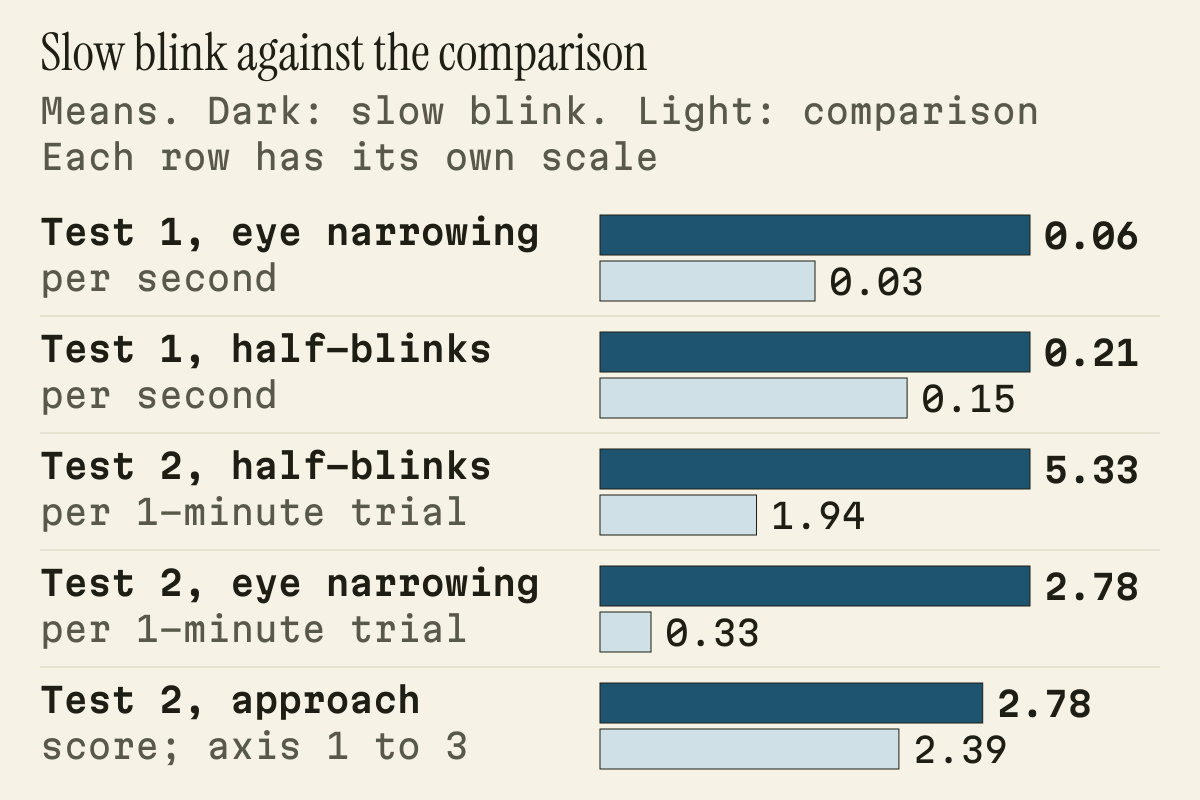
The two tests side by side, each row on its own scale: means in the slow blink condition against the comparison condition, from one 2020 study.
Worked from Means in the Results of Humphrey et al. 2020; ratios and differences computed for this page from those rounded means, so they are approximate.
"Results of the two slow blink tests, Humphrey et al. 2020" by Sniff, Purr, Preen & Shoal, https://sniffpurrpreenandshoal.com/cats/cat-slow-blink/, licensed under CC BY 4.0 (https://creativecommons.org/licenses/by/4.0/)
Data: Humphrey et al. (2020), Scientific Reports 10:16503, CC BY 4.0
| Measure | Slow blink | Comparison | Ratio or difference |
|---|---|---|---|
| Test 1, eye narrowing per second | 0.06 | 0.03 | 2.0 times |
| Test 1, half-blinks per second | 0.21 | 0.15 | 1.4 times |
| Test 2, half-blinks per 1-minute trial | 5.33 | 1.94 | 2.7 times |
| Test 2, eye narrowing per 1-minute trial | 2.78 | 0.33 | 8.4 times |
| Test 2, approach score, 1 to 3 | 2.78 | 2.39 | 0.39 points higher |
Download the results table (CSV) (what the file holds) Data: Humphrey et al. (2020), Scientific Reports 10:16503, CC BY 4.0
The comparisons are not the same in the two tests. In the first, the owner was not interacting; in the second, the experimenter held a neutral face while looking away. The authors note that because she made no eye contact in the neutral trials, her gaze or attention may have shaped the cats’ approach, not the slow blink alone.
Distance also varied. In the first test, how far the owner sat from the cat in the comparison trials could not be measured, and the cats rested wherever they had settled. The authors call the tests naturalistic and suggest repeating them in a lab.
Nothing here measured what a cat feels. The authors say more research “would be necessary before coming to firm conclusions about the emotional state” tied to slow blinking. How much of each source was read for this page is set out on Sniff test.
Why do cats slow blink?
The study did not test why, and the authors offer two possibilities. Cats may have been rewarded by owners for slow blinking back, an effect that using a stranger in the second test reduced, although cats may generalize from people they know. The movement may also have begun as a way to break off an unbroken stare, which can read as a threat, and then been shaped by selection and learning in homes. Neither idea was tested.
The authors add that narrowed eyes are part of displays read as positive in some other species, such as horses and cows being stroked, and in the Duchenne smile, which they describe as the genuine smile in humans. That is a comparison across species, not a test in cats.
Purring is another cat signal often read as contentment; cat purring covers what a purr does and does not tell you.
Should you slow blink back at your cat?
In these two tests, cats narrowed their eyes more when a person slow blinked, whether owner or stranger. The study did not test slow blinking as a way to calm a cat or change its behavior, and gives no advice on when or how often to do it. If a cat’s behavior is a worry, ask a veterinarian or a board-certified veterinary behaviorist; changes in how a cat’s eyes look are a question for a veterinarian. Whisker fatigue checks another popular cat claim against a study at the food bowl.
Do cats slow blink at other cats?
No source read for this page has measured it, and neither test looked at it. The authors list it as an open question: “It would be useful in future studies to explore the potential presence and function of this behaviour in conspecific communication,” meaning communication between cats.
Much is still unknown. As of 2026-11-20, no independent repeat of either test turned up among the sources read, and each test rests on 18 analyzed cats. Whether the slow blink is learned or inherited, what a cat feels while doing it, and whether cats use it with one another were not tested in either experiment.
Sources
- Humphrey T, Proops L, Forman J, Spooner R, McComb K (2020). “The role of cat eye narrowing movements in cat–human communication.” Scientific Reports 10:16503. doi.org/10.1038/s41598-020-73426-0Read: Full text, open license; CC BY 4.0Text license: CC BY 4.0 (terms)
- Caeiro CC, Burrows AM, Waller BM (2017). “Development and application of CatFACS: are human cat adopters influenced by cat facial expressions?” Applied Animal Behaviour Science 189:66–78. doi.org/10.1016/j.applanim.2017.01.005Read: Bibliographic record only
Cite this page
Sniff, Purr, Preen & Shoal. “Cat Slow Blink: In Two Tests, Cats Narrowed Their Eyes Back.” Published November 20, 2026. https://sniffpurrpreenandshoal.com/cats/cat-slow-blink/. Accessed on the day you read it.
How studies are read and numbers recheckedMending basket: every correctionReport an error on this page (contact@sniffpurrpreenandshoal.com)
More from Cat Minds
Purr Research story
How Do Cats Purr? A 2023 Abstract Points to the Larynx
Picture credit
"Domestic cat napping with three playful kittens and a saucer on the right (detail)" by Joseph Brodtmann (lithographer) after Gottfried Mind (artist); Library of Congress Prints and Photographs Division (pga.05433) — https://commons.wikimedia.org/wiki/File:Domestic_cat_napping_with_three_playful_kittens_and_a_saucer_on_the_right_LCCN2012645542.jpg — Public domain (EU: Gottfried Mind died 1814 and Joseph Brodtmann died 1862, more than 70 years ago (life plus 70 years); US: published before 1931); modified: cropped to the cat, the three kittens, the ribbon and the saucer (columns 860 to 4,660 and rows 1,260 to 2,700 of the original's 5,324 x 3,934 px; the plate number, pencil marks and blank paper around the group are left out; 2026-11-20)
Purr Research story
Do Cats Love Their Owners? What Attachment Studies Found
Picture credit
"Poes met vijf spelende jongen (Cat with five playing kittens), etching by Petrus Johannes Arendzen after Henriëtte Ronner-Knip" by Petrus Johannes Arendzen (etcher) after Henriëtte Ronner-Knip (painter); Rijksmuseum (RP-P-1909-1552) — https://commons.wikimedia.org/wiki/File:Poes_met_vijf_spelende_jongen,_RP-P-1909-1552.jpg — CC0 1.0 (https://creativecommons.org/publicdomain/zero/1.0/)
Purr Research story
Why Do Cats Make Biscuits? Two Old Books Point to Nursing
Picture credit
"Four Cats in Different Poses (detail), from the series Tatoe-zukushi no uchi, by Utagawa Kuniyoshi" by Utagawa Kuniyoshi; Wikimedia Commons (source: visipix) — https://commons.wikimedia.org/wiki/File:Kuniyoshi_Utagawa,_For_cats_in_different_poses.jpg — Public domain (EU: Utagawa Kuniyoshi died 1861, more than 70 years ago (life plus 70 years); US: published before 1931; faithful reproduction of a two-dimensional print); modified: cropped to the lower half of the sheet (full width, rows 1,530 to 3,117: 1,587 of 3,117 px of the original's height; top edge moved down 2026-11-20 so the pink object above the two cats is left out)