Purr Research story
Why Do Cats Make Biscuits? Two Old Books Point to Nursing
Sniff, Purr, Preen & Shoal Published
TL;DR
Cats knead, or make biscuits, by pressing each front paw in turn, and books from 1794 and 1872 trace the habit to how kittens suck. Both describe adult kneading as a leftover sucking movement tied to pleasure. Neither book tested it, and why adult cats knead remains unknown in the sources read, as of November 2026.
Doorplate
- Animal
- Domestic cats, young and old, of the common and Persian breeds (the book's wording)
- Study
- Charles Darwin 1872, The Expression of the Emotions in Man and Animals, pp. 46-47, 127 and 226
- n (analysed / excluded)
- not stated / not stated: a general description with no count, plus one old cat as a single case
- Couch sample
- cannot be assigned: the book describes cats in general and does not say where they lived
- Limits
- A description, not an experiment; no counts, ages or setting; the explanation is offered, not tested
- Setup in one line
- None: cats lying on a warm shawl or other soft surface, as the book describes them
- Replicated?
- No experiment on why adult cats knead among the sources read, as of 2026-11-20; Erasmus Darwin gave a shorter account in 1794
This doorplate as data (CSV) what the file holds
Data: Charles Darwin (1872), The Expression of the Emotions in Man and Animals, public domain; Erasmus Darwin (1794), Zoonomia, vol. 1, public domain
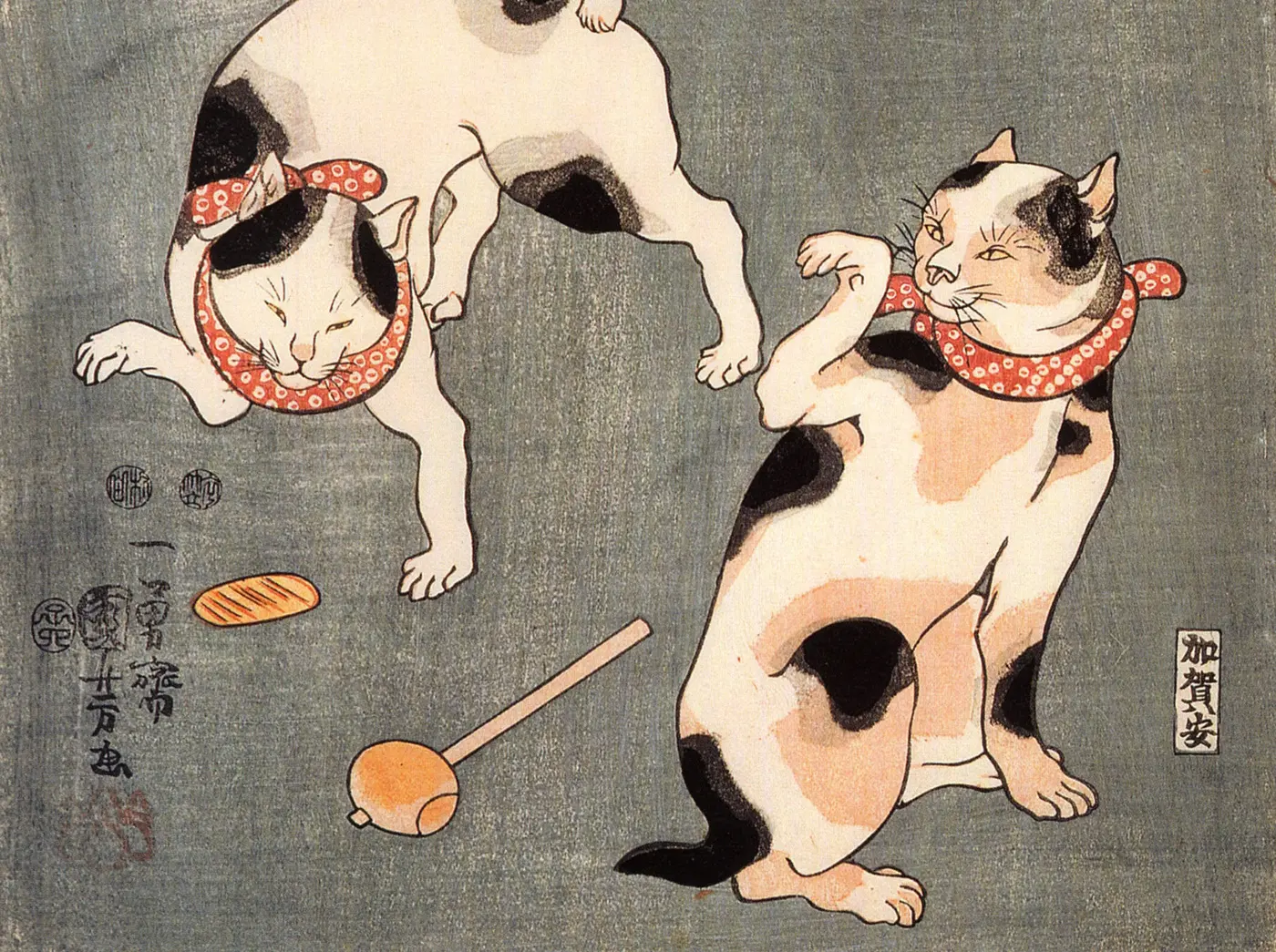
Two of the four cats in Utagawa Kuniyoshi's 1852 woodblock print, one reaching out a front paw and one lifting both; the whole sheet appears further down.
“Four Cats in Different Poses (detail), from the series Tatoe-zukushi no uchi, by Utagawa Kuniyoshi”, Utagawa Kuniyoshi; Wikimedia Commons (source: visipix); public domain.
Full credit
"Four Cats in Different Poses (detail), from the series Tatoe-zukushi no uchi, by Utagawa Kuniyoshi" by Utagawa Kuniyoshi; Wikimedia Commons (source: visipix) — https://commons.wikimedia.org/wiki/File:Kuniyoshi_Utagawa,_For_cats_in_different_poses.jpg — Public domain (EU: Utagawa Kuniyoshi died 1861, more than 70 years ago (life plus 70 years); US: published before 1931; faithful reproduction of a two-dimensional print); modified: cropped to the lower half of the sheet (full width, rows 1,530 to 3,117: 1,587 of 3,117 px of the original's height; top edge moved down 2026-11-20 so the pink object above the two cats is left out)
The cat climbs onto the blanket and presses down with one front paw, then the other. In 1872 Charles Darwin gave that movement a purpose in kittens, writing that they push with their front feet against their mother's mammary glands “to excite a freer secretion of milk, or to make it flow” (page 46). His book gives no count of cats, so no couch-sample marker can be assigned to it.
Kneading in grown cats is the harder question. For every explanation, this page looked for the person who proposed it, the kind of evidence behind it and any later test. Only two accounts could be traced to a named source that was read in the original, and both appear in public-domain books written by members of one family.
What do kittens do while nursing?
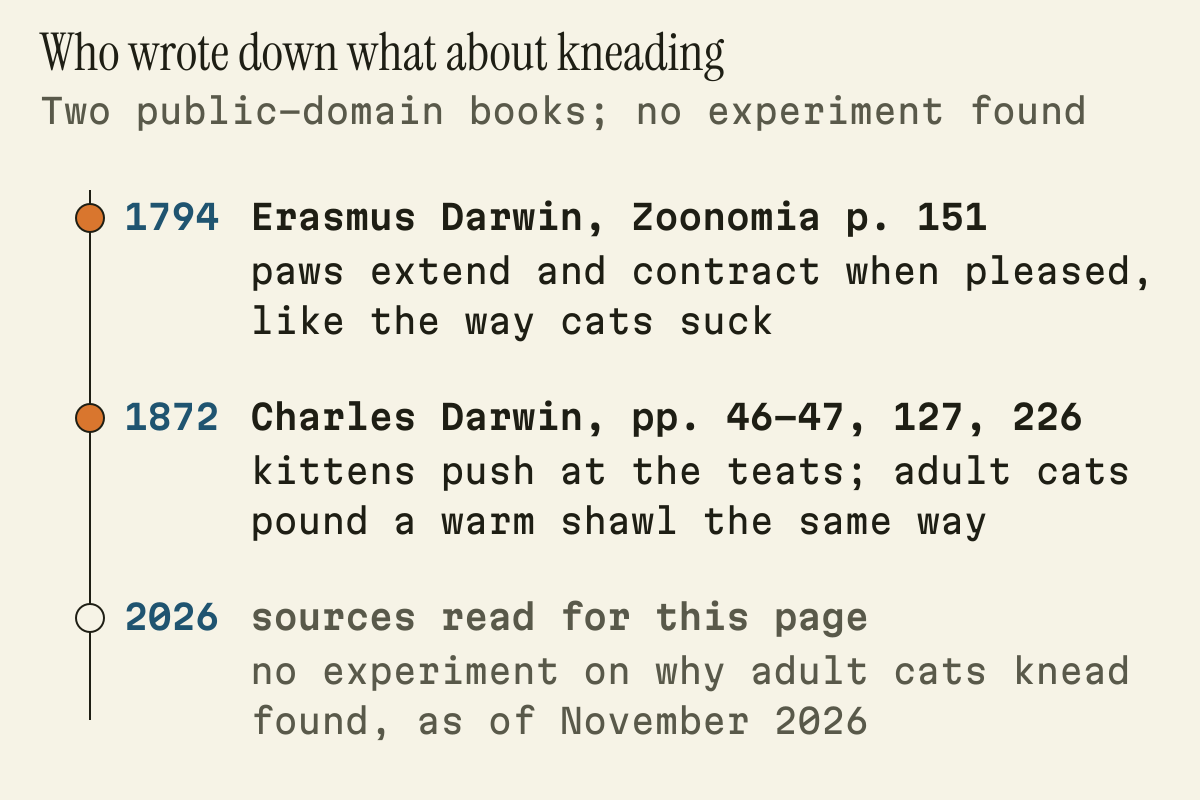
Who wrote down what about kneading, from 1794 to the sources read for this page in 2026.
Worked from Zoonomia (1794), page 151, and The Expression of the Emotions in Man and Animals (1872), pages 46, 47, 127 and 226, read as public-domain originals.
This figure in words
the timeline, entry by entry.
- 1794, Erasmus Darwin, Zoonomia, page 151: cats extend and contract their paws when pleased, like their way of sucking.
- 1872, Charles Darwin, The Expression of the Emotions in Man and Animals, pages 46, 47, 127 and 226: kittens push at the teats, and adult cats pound a warm shawl the same way.
- 2026, the sources read for this page: no experiment on why adult cats knead was found, as of November 2026.
"Who wrote down what about kneading, 1794 to 2026" by Sniff, Purr, Preen & Shoal, https://sniffpurrpreenandshoal.com/cats/cat-kneading/, licensed under CC BY 4.0 (https://creativecommons.org/licenses/by/4.0/)
Data: Erasmus Darwin (1794), Zoonomia, vol. 1, p. 151, public domain; Charles Darwin (1872), The Expression of the Emotions in Man and Animals, pp. 46-47, 127 and 226, public domain
The 1794 account
The first named account found for this page is a single sentence in Zoonomia, a long work on how living bodies function that Erasmus Darwin published in 1794. His grandson Charles Darwin later pointed to it in a footnote. The sentence sits in a section headed “Of Instinct,” directly after a similar claim about lambs.
Lambs, Erasmus Darwin wrote, “shake or wriggle their tails, at the time when they first suck,” and the movement afterward becomes “a mark of pleasure in them, and in dogs.” Cats came next, on page 151 (the old long s is printed here as s): “But cats gently extend and contract their paws when they are pleased, and purr by drawing in their breath, both which resemble their manner of sucking, and thus become their language of pleasure.”
That sentence already contains the whole later argument, in which a movement made while sucking turns into a sign of pleasure. The same sentence continues that cats, having collarbones, “use their paws like hands when they suck, which dogs and sheep do not”. That anatomical point was not checked against any other source for this page.
The 1872 account
Charles Darwin developed the idea in 1872, in a chapter on what he called serviceable associated habits. “Kittens, puppies, young pigs and probably many other young animals, alternately push with their fore-feet against the mammary glands of their mothers,” he wrote on page 46, before turning to grown cats.
The habit is “very common with young cats, and not at all rare with old cats of the common and Persian breeds,” he continued, when they lie “on a warm shawl or other soft substance, to pound it quietly and alternately with their fore-feet; their toes being spread out and claws slightly protruded, precisely as when sucking their mother.”
Neither book gives a count of cats, a measured frequency, or a description of where the cats lived. Both are descriptions. The 1872 book states the push-for-milk purpose without demonstrating it.
Why do adult cats knead?
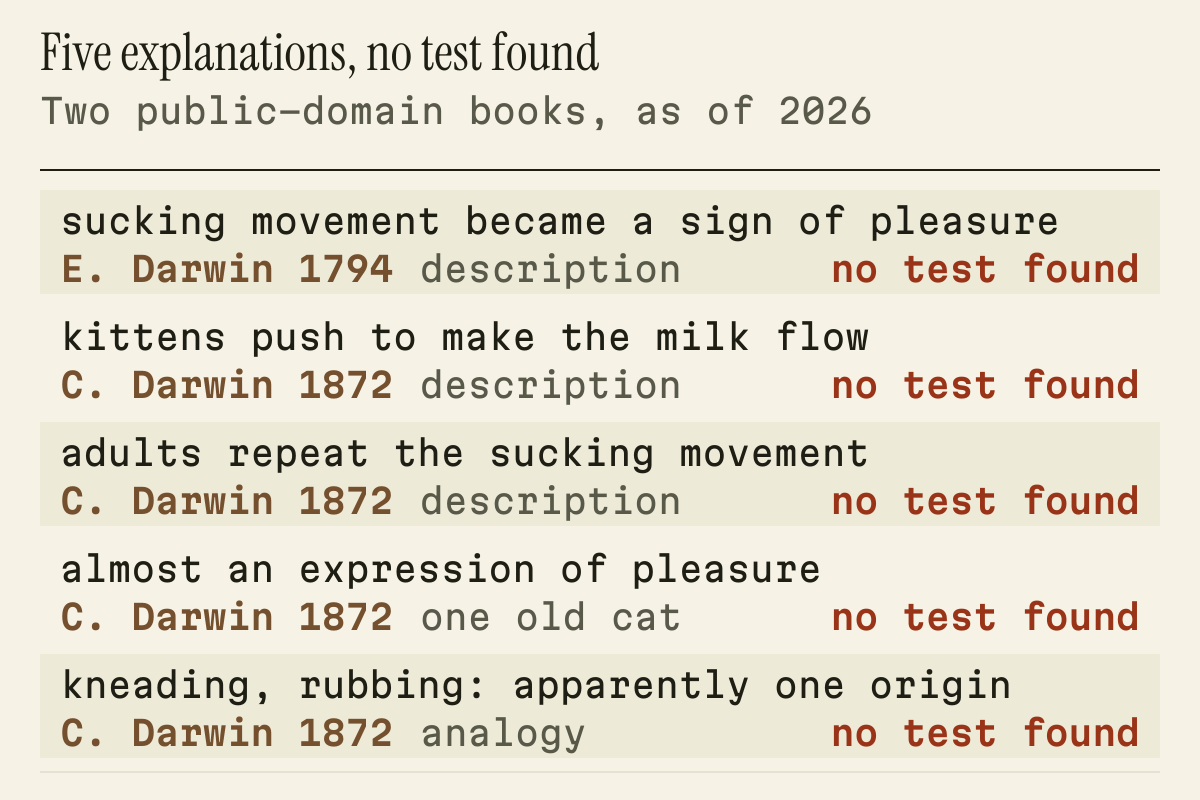
Five explanations of kneading, who gave each and what it rests on; no test of any of them was found in the sources read.
Worked from Zoonomia (1794), page 151, and The Expression of the Emotions in Man and Animals (1872), pages 46, 47, 127 and 226, read as public-domain originals.
"Five explanations of kneading and whether each was tested" by Sniff, Purr, Preen & Shoal, https://sniffpurrpreenandshoal.com/cats/cat-kneading/, licensed under CC BY 4.0 (https://creativecommons.org/licenses/by/4.0/)
Data: Erasmus Darwin (1794), Zoonomia, vol. 1, p. 151, public domain; Charles Darwin (1872), The Expression of the Emotions in Man and Animals, pp. 46-47, 127 and 226, public domain
| Explanation | Who, year | What it rests on | Test found |
|---|---|---|---|
| The paw movement of sucking became a sign of pleasure | Erasmus Darwin, 1794 | Description, no counts | None in the sources read |
| Kittens push at the teats to make the milk flow | Charles Darwin, 1872 | Description, no counts | None in the sources read |
| Adult cats kneading a soft warm surface repeat the sucking movement | Charles Darwin, 1872 | Description; cats sucking the cloth at the same time | None in the sources read |
| The movement has almost become an expression of pleasure | Charles Darwin, 1872 | One old cat | None in the sources read |
| Kneading and rubbing against things apparently share an origin in the nursing period | Charles Darwin, 1872 | Analogy | None in the sources read |
Download the explanations table (CSV) (what the file holds) Data: Erasmus Darwin (1794), Zoonomia, vol. 1, public domain; Charles Darwin (1872), The Expression of the Emotions in Man and Animals, public domain
Charles Darwin's case that adult kneading repeats the sucking movement rests on one detail. Cats kneading a shawl, he wrote, often take “a bit of the shawl into their mouths” at the same time and suck it, “generally closing their eyes and purring from delight” (pages 46–47). He grouped the habit with other movements that he considered habitual and purposeless.
He returned to the subject twice. In the pages on cats in Chapter V, he connected kneading to a second habit, rubbing against people, chair legs and door-posts, and concluded that “both apparently are derived from actions performed during the nursing period” (page 127).
The plainest version appears in a chapter on reflection and frowning, where cats serve as an example for human expression. Darwin wrote that “full-grown cats, when feeling warm and comfortable, often retain the habit of alternately protruding their fore-feet with extended toes, which habit they practised for a definite purpose whilst sucking their mothers” (page 226).
The important word is retain. In this account, adult kneading is not a new behavior with its own function but a leftover. That leftover idea is the explanation the two Darwins share. It also makes a prediction that a study could check: the adult movement and the kitten movement should then match in form.
Neither Darwin wrote about attachment as later studies define it; how attachment has been tested in cats is described on the cat attachment studies page.
Explanations that could not be traced to a named source read for this page are left out of the table.
Why do cats knead blankets?
Charles Darwin's answer concerned the surface. He wrote that the movement “is commonly excited only in association with the sensation of a warm soft surface” (page 47), a description that would fit a blanket, a cushion or a lap.
That statement describes the circumstances of kneading, not a measured preference. No study read for this page compared different fabrics, temperatures or laps.
Is kneading a sign of happiness?
Both Darwins connected kneading to pleasure. Erasmus Darwin counted the paw movement and the purr as part of cats' “language of pleasure,” and Charles Darwin wrote that the action “has almost become the expression of a pleasurable sensation” (page 47). His evidence for that final step was a single old cat that pounded the air with its feet while its back was being scratched.
One cat is a starting point, not a result. Neither book measured anything about a cat while it was kneading, and no later test of the pleasure explanation was found among the sources read. Darwin's kneading cats generally closed their eyes. What open eyes manage in a dim room is covered on the cat night vision page.
What has not been tested?
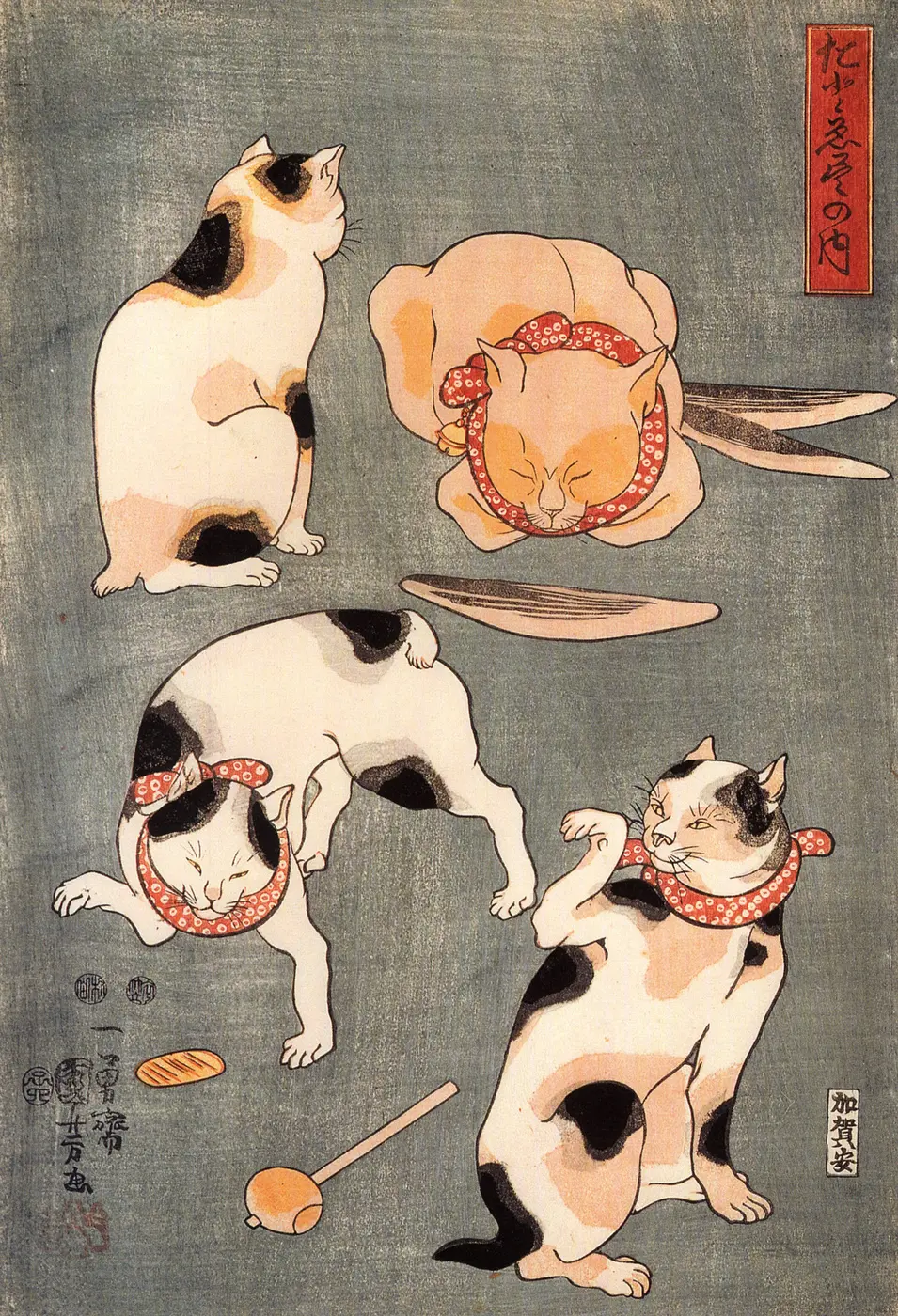
Utagawa Kuniyoshi's 1852 woodblock print of four cats in different poses, the right sheet of a triptych illustrating Japanese proverbs; none of the four is kneading.
"Four Cats in Different Poses, from the series Tatoe-zukushi no uchi, by Utagawa Kuniyoshi" by Utagawa Kuniyoshi; Wikimedia Commons (source: visipix) — https://commons.wikimedia.org/wiki/File:Kuniyoshi_Utagawa,_For_cats_in_different_poses.jpg — Public domain (EU: Utagawa Kuniyoshi died 1861, more than 70 years ago (life plus 70 years); US: published before 1931; faithful reproduction of a two-dimensional print)
The gap sits between kittens and grown cats. The 1872 account of kittens pushing for milk is a description, and the account of adults is an inference drawn from how similar the two movements appear. No experiment on why adult cats knead, how many of them do it, or what changes in the body while they do was found in the sources read for this page.
Why do cats knead and bite?
Charles Darwin wrote about cats sucking a bit of the shawl while they knead (pages 46–47), but he said nothing about biting, and no study read for this page examined kneading together with biting or chewing. Kneading with sucking or chewing on fabric can have health or behavior causes; if it worries you, ask a veterinarian or a board-certified veterinary behaviorist.
Do all cats knead?
No proportion is known from the sources read. Darwin wrote only that the habit is “very common with young cats, and not at all rare with old cats,” with no count behind either phrase, and neither book discusses cats that never knead.
What remains unknown is nearly everything an experiment would answer: how many adult cats knead, whether kneading accompanies pleasure, stress or something else, and whether the adult movement matches the movement a kitten makes at the teat. Until a readable study measures any of that, the 1794 and 1872 descriptions are the only explanations with a named source found for this page, and they are explanations rather than findings.
Sources
- Darwin C (1872). The Expression of the Emotions in Man and Animals. London: John Murray. archive.org/details/expressionofemot1872darwRead: Public-domain original; pages 46, 47, 127 and 226 read on the page images
- Darwin E (1794). Zoonomia; or, The Laws of Organic Life, vol. 1. London: J. Johnson. archive.org/details/zoonomiaorlawsof1794darwRead: Public-domain original; page 151 read on the page image
Cite this page
Sniff, Purr, Preen & Shoal. “Why Do Cats Make Biscuits? Two Old Books Point to Nursing.” Published November 20, 2026. https://sniffpurrpreenandshoal.com/cats/cat-kneading/. Accessed on the day you read it.
How studies are read and numbers recheckedMending basket: every correctionReport an error on this page (contact@sniffpurrpreenandshoal.com)
More from Cat Minds
Purr Research story
How Do Cats Purr? A 2023 Abstract Points to the Larynx
Picture credit
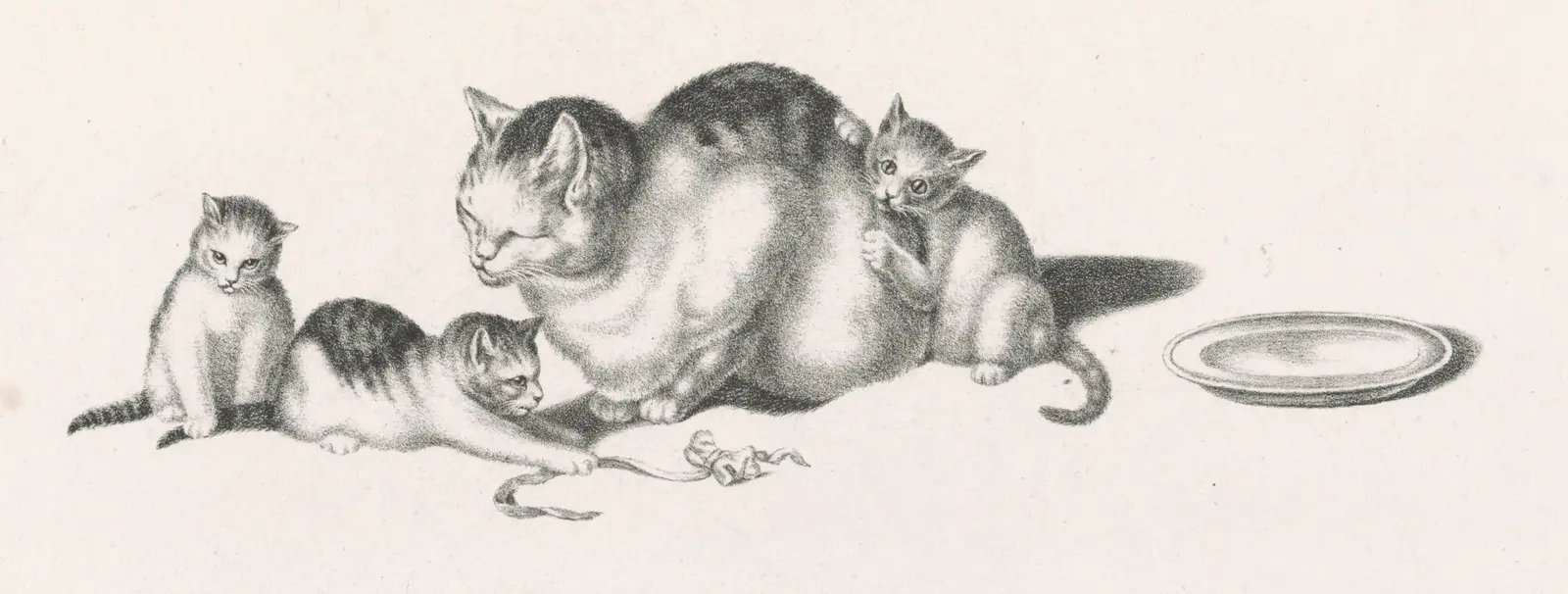
"Domestic cat napping with three playful kittens and a saucer on the right (detail)" by Joseph Brodtmann (lithographer) after Gottfried Mind (artist); Library of Congress Prints and Photographs Division (pga.05433) — https://commons.wikimedia.org/wiki/File:Domestic_cat_napping_with_three_playful_kittens_and_a_saucer_on_the_right_LCCN2012645542.jpg — Public domain (EU: Gottfried Mind died 1814 and Joseph Brodtmann died 1862, more than 70 years ago (life plus 70 years); US: published before 1931); modified: cropped to the cat, the three kittens, the ribbon and the saucer (columns 860 to 4,660 and rows 1,260 to 2,700 of the original's 5,324 x 3,934 px; the plate number, pencil marks and blank paper around the group are left out; 2026-11-20)
Purr Research story
Do Cats Love Their Owners? What Attachment Studies Found
Picture credit
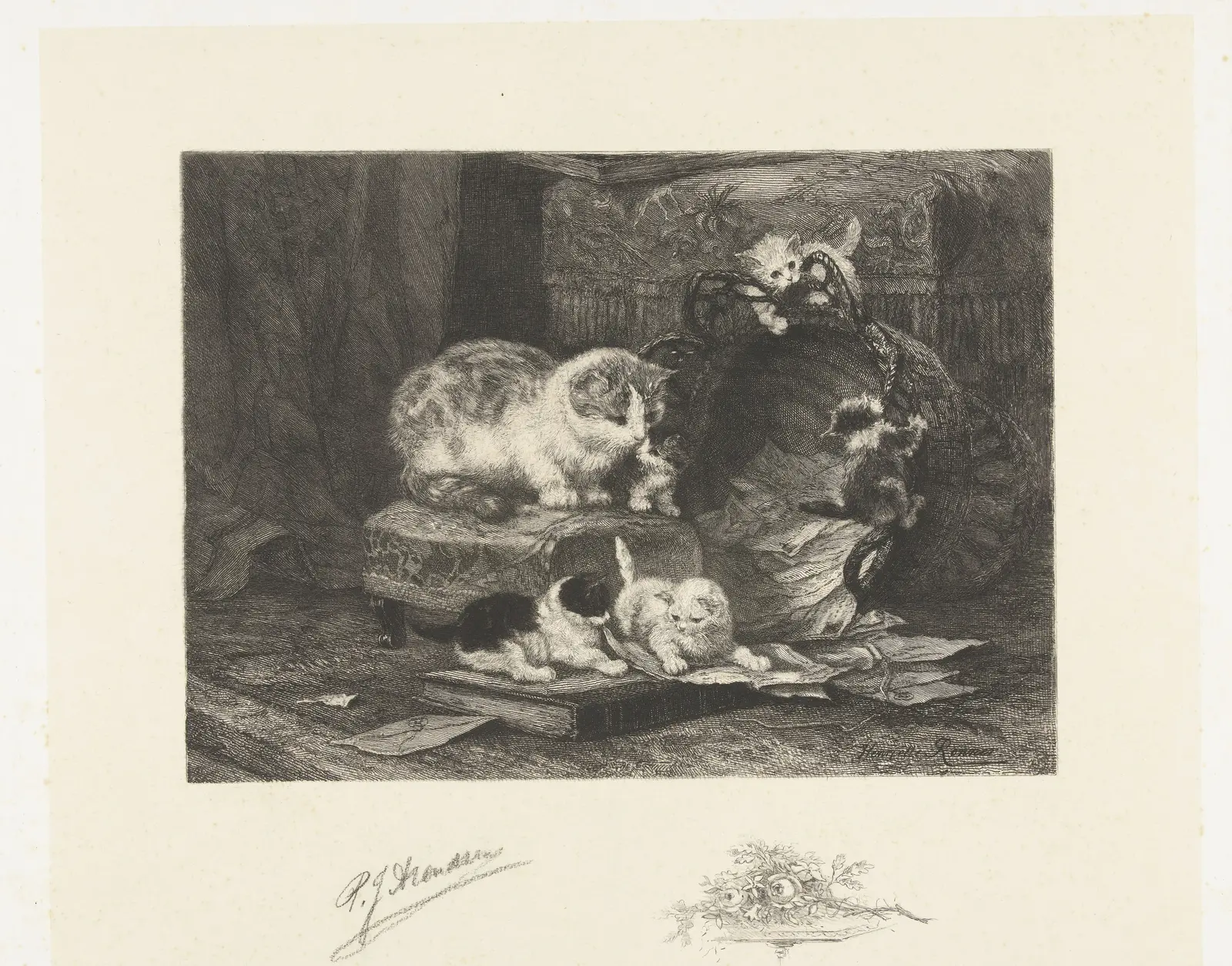
"Poes met vijf spelende jongen (Cat with five playing kittens), etching by Petrus Johannes Arendzen after Henriëtte Ronner-Knip" by Petrus Johannes Arendzen (etcher) after Henriëtte Ronner-Knip (painter); Rijksmuseum (RP-P-1909-1552) — https://commons.wikimedia.org/wiki/File:Poes_met_vijf_spelende_jongen,_RP-P-1909-1552.jpg — CC0 1.0 (https://creativecommons.org/publicdomain/zero/1.0/)
Purr Research story
Cat Slow Blink: In Two Tests, Cats Narrowed Their Eyes Back
Picture credit
"Sleepy tabby" by Chinda Sam afortunatefate (Unsplash) — https://commons.wikimedia.org/wiki/File:Sleepy_tabby_(Unsplash).jpg — CC0 1.0 (https://creativecommons.org/publicdomain/zero/1.0/)