Purr Research story
How Do Cats Purr? A 2023 Abstract Points to the Larynx
Sniff, Purr, Preen & Shoal Published
TL;DR
Cats do not purr only in calm moments: a 2001 abstract states that cats also purr when badly hurt or frightened. The sound comes from the larynx; in a 2023 study read in abstract, eight excised cat larynges vibrated at purring rates, 25 to 30 Hz, without nerve input. Still unknown: how much a living cat's nerves time each purr.
Doorplate
- Animal
- domestic cat (Felis silvestris catus), excised larynges
- Study
- Herbst et al., 2023, Current Biology
- n (analysed / excluded)
- 8 larynges investigated / exclusions not in the abstract read
- Couch sample
- cannot be assigned: the abstract does not say where the cats came from
- Limits
- not in the abstract read
- Setup in one line
- excised larynges on a bench, not living cats; airflow with no nerve input or muscle contraction
- Replicated?
- no independent repeat among the sources read, as of 2026-11-20
This doorplate as data (CSV) what the file holds
Data: Herbst et al. (2023), Current Biology, doi:10.1016/j.cub.2023.09.014 (abstract)
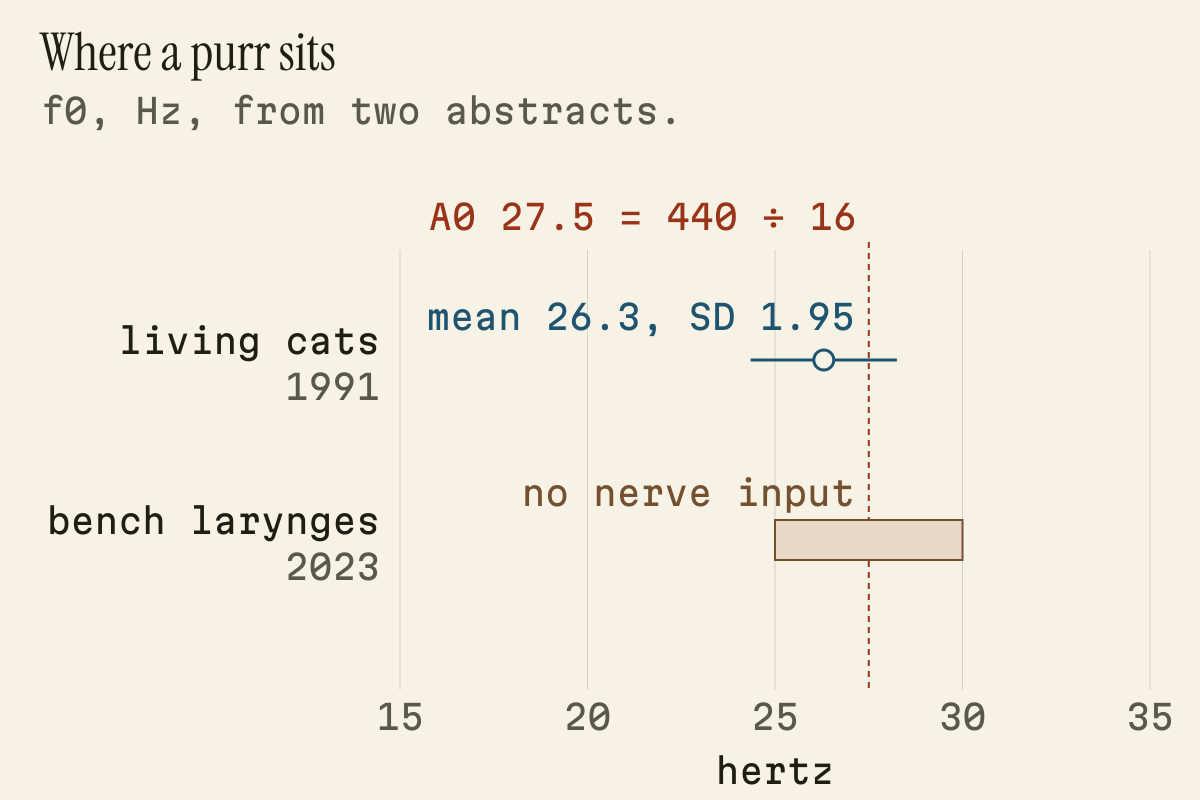
Purr pitch from two abstracts: living cats in a 1991 study, 26.3 Hz on average, and the 25 to 30 Hz band from the 2023 bench test, beside A0 at 27.5 Hz. The band comes from excised larynges, not living cats.
Worked from The living-cat mean and SD from the Frazer Sissom et al. 1991 abstract; the bench range from the Herbst et al. 2023 abstract; 27.5 Hz is 440 ÷ 16.
"Where a purr sits on the frequency scale" by Sniff, Purr, Preen & Shoal, https://sniffpurrpreenandshoal.com/cats/cat-purring/, licensed under CC BY 4.0 (https://creativecommons.org/licenses/by/4.0/)
Data: Herbst et al. (2023), Current Biology, doi:10.1016/j.cub.2023.09.014 (abstract); Frazer Sissom, Rice & Peters (1991), Journal of Zoology, doi:10.1111/j.1469-7998.1991.tb04749.x (abstract)
The cat settles onto your lap, and a low rumble starts before your hand finds its back. A 1991 study of unrestrained animals, read in abstract, reported that domestic cats purr at 26.3 Hz. That is about 26 vibrations each second. The abstract does not give the number of cats or say where they lived, so the couch sample, the label for where the animals in a study came from, cannot be assigned.
That label has four values: a lab colony, a shelter, pet homes, or a mix of these. It sorts studies rather than grading them. For every purr study on this page, the part that was read leaves the question open.
Next comes the question of why cats purr. The sources read here explain how the sound is made far better than why a cat makes it. Purring turns up in calm moments on a lap, but the 2001 abstract also places it in badly hurt and frightened cats.
Is a purring cat a happy cat?
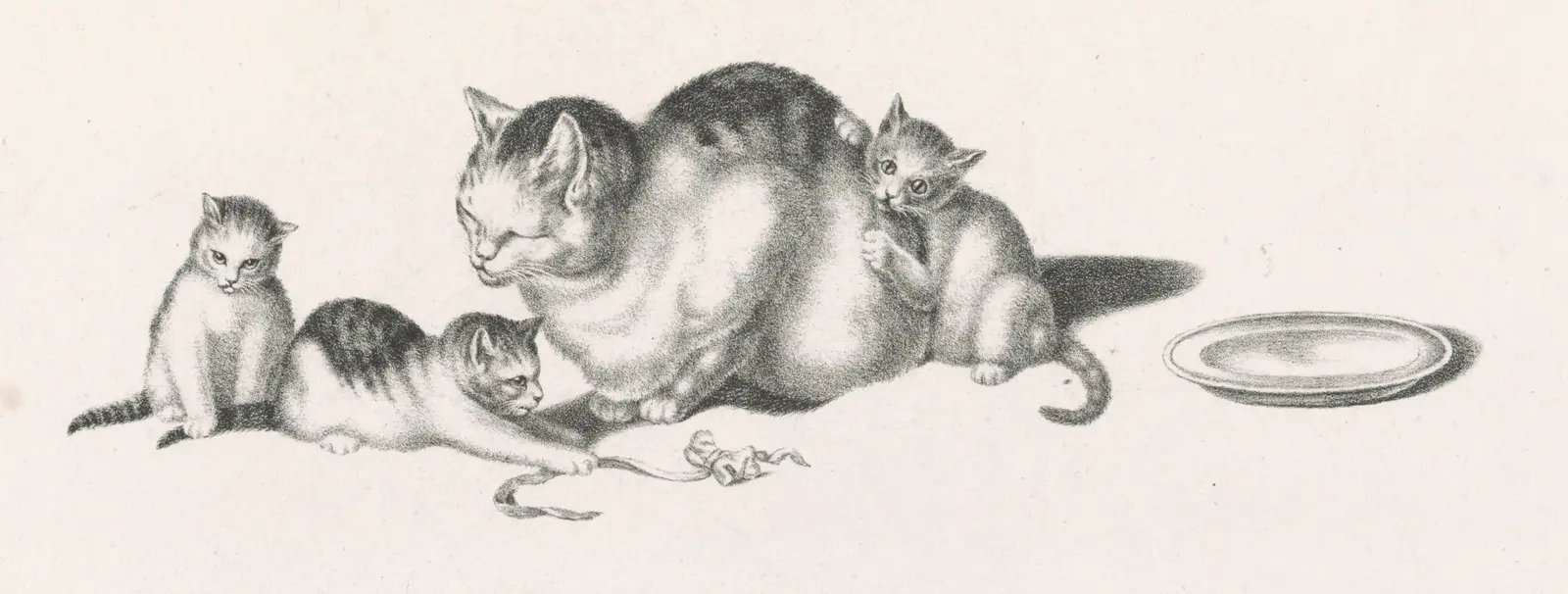
A mother cat dozes while three kittens play, in a lithograph by Joseph Brodtmann after Gottfried Mind, printed between 1820 and 1860. A picture can show a calm cat, but not whether it purrs.
“Domestic cat napping with three playful kittens and a saucer on the right (detail)”, Joseph Brodtmann (lithographer) after Gottfried Mind (artist); Library of Congress Prints and Photographs Division (pga.05433); Public Domain Mark.
Full credit
"Domestic cat napping with three playful kittens and a saucer on the right (detail)" by Joseph Brodtmann (lithographer) after Gottfried Mind (artist); Library of Congress Prints and Photographs Division (pga.05433) — https://commons.wikimedia.org/wiki/File:Domestic_cat_napping_with_three_playful_kittens_and_a_saucer_on_the_right_LCCN2012645542.jpg — Public domain (EU: Gottfried Mind died 1814 and Joseph Brodtmann died 1862, more than 70 years ago (life plus 70 years); US: published before 1931); modified: cropped to the cat, the three kittens, the ribbon and the saucer (columns 860 to 4,660 and rows 1,260 to 2,700 of the original's 5,324 x 3,934 px; the plate number, pencil marks and blank paper around the group are left out; 2026-11-20)
The belief that a purr means a contented cat fits the hand-me-down rule: a rule of thumb that passes from owner to owner without a source anyone can point to. Each such rule gets four checks in the same order: earliest source, mechanism, counterexamples and verdict.
- Earliest source: the oldest dated statement of the idea among the sources read is Elizabeth von Muggenthaler's 2001 conference abstract, which calls it a current hypothesis, not a finding. No earlier named origin turned up.
- Mechanism: none of the sources read proposes a way that purring would be tied to contentment alone. The 2023 larynx study, read in abstract, is about how the sound is produced, not what it signals.
- Counterexamples: the same 2001 abstract states that cats purr when badly hurt or frightened. It is one abstract. It does not say how that was observed.
- Verdict: rewrite, for now. A purr can come with calm contact, but on its own it does not show how a cat feels. With a single counterexample from one abstract, this verdict may change as more evidence is read.
That rewrite matters for health. A purring cat can still be ill or in pain; questions about a cat's health belong with a veterinarian.
In indoor-weather terms, a purr is one barometer reading. Read it next to everything else in the room: the hour, the food bowl, the lap.
A 2009 paper on purring by Karen McComb and colleagues in Current Biology is also listed in the sources, but only its bibliographic record was read, so none of its findings are reported here and its couch sample cannot be assigned. Two other cat behaviors get the same look at what was actually recorded: cat kneading and the cat slow blink.
How do cats purr?
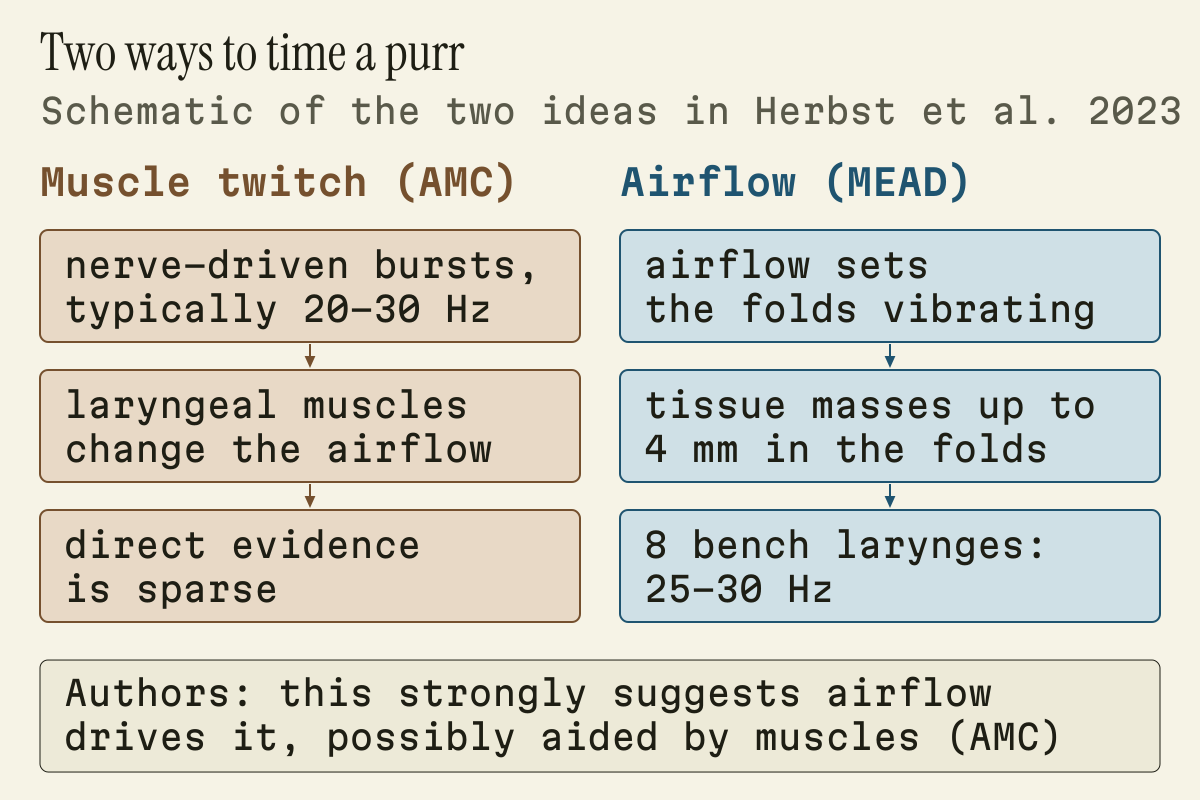
Schematic of the two explanations set out in the 2023 abstract: nerve-timed muscle twitches on the left, airflow-driven vibration on the right, and the authors' conclusion at the bottom.
Worked from The Herbst et al. 2023 abstract only.
"Two explanations for how a cat times each purr cycle" by Sniff, Purr, Preen & Shoal, https://sniffpurrpreenandshoal.com/cats/cat-purring/, licensed under CC BY 4.0 (https://creativecommons.org/licenses/by/4.0/)
Data: Herbst et al. (2023), Current Biology, doi:10.1016/j.cub.2023.09.014 (abstract)
A purr is made in the larynx, the voice box at the top of the windpipe. Cats have long been thought to purr by active muscle contraction, or AMC. As Christian Herbst and colleagues summarize it in the abstract of their 2023 paper, nerve-driven bursts of muscle activity, typically at 20 to 30 Hz, make the small muscles inside the larynx change the flow of breath. The abstract does not say where its cats came from, so their couch sample cannot be assigned.
Older work pointed the same way. The 1991 study by Dawn Frazer Sissom, D. A. Rice and G. Peters, read in abstract, measured purring in unrestrained pumas, domestic cats and one other wild cat species; their couch sample cannot be assigned. It concluded that the sound comes mainly from the larynx changing the airflow of breathing, driven from the central nervous system. The diaphragm and other muscles, it adds, seem needed only to keep the animal breathing.
Most mammals, the 2023 abstract notes, make their calls another way: under the myoelastic-aerodynamic principle, or MEAD, air moving through the larynx keeps its tissues vibrating on their own, with no separate nerve signal for each cycle. The abstract also calls direct evidence for the muscle-twitch account sparse.
Which animals purr at all is a separate question. A 2002 review by G. Peters, read in abstract, argues that the word purr should be kept for calls that share an origin with the purr of the cat family. By that standard, true purring had been established only in the cat family (Felidae) and the civet and genet family (Viverridae).
What did the 2023 larynx experiment find?
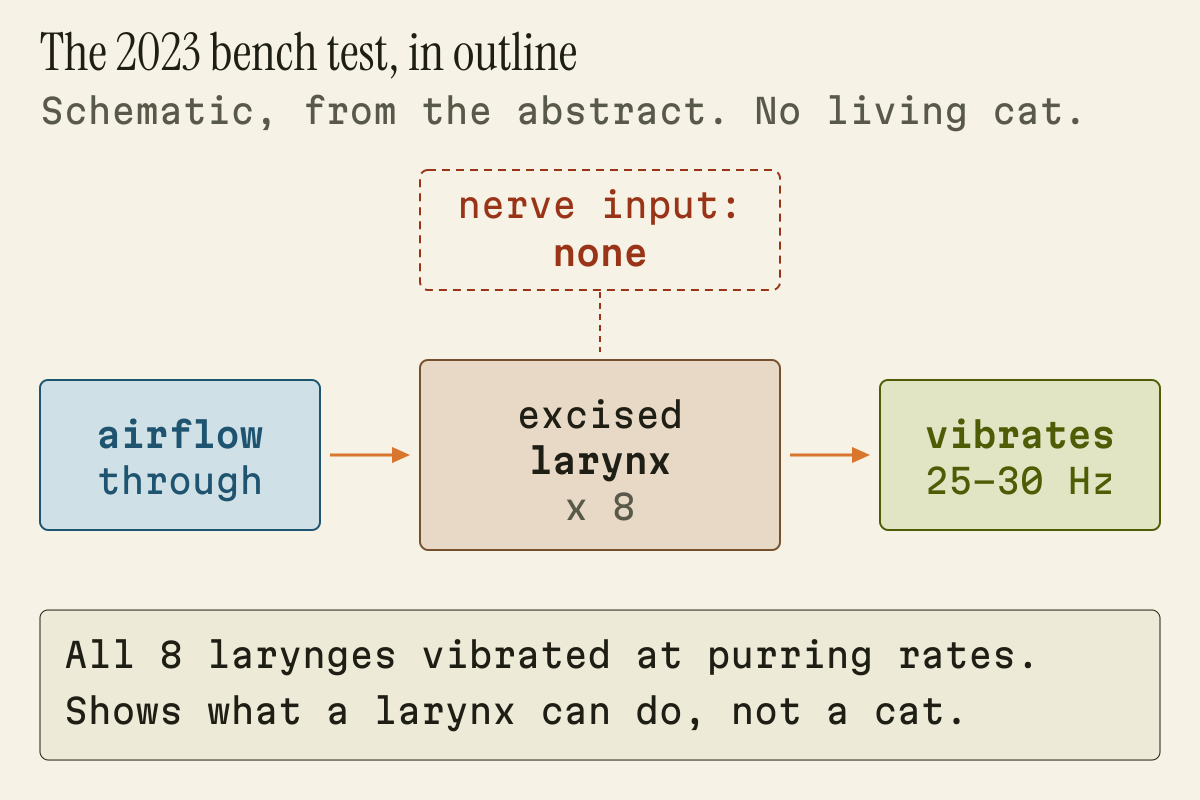
Schematic of the 2023 bench test as the abstract describes it: airflow through an excised larynx with no nerve input. It shows what a larynx can do, not what a living cat does.
Worked from The Herbst et al. 2023 abstract only.
"The 2023 excised-larynx test, in outline" by Sniff, Purr, Preen & Shoal, https://sniffpurrpreenandshoal.com/cats/cat-purring/, licensed under CC BY 4.0 (https://creativecommons.org/licenses/by/4.0/)
Data: Herbst et al. (2023), Current Biology, doi:10.1016/j.cub.2023.09.014 (abstract)
The muscle-twitch account makes a clear prediction. If every purr pulse needs a nerve signal, a larynx cut off from its nerves should not purr. Herbst's team tested that prediction with the larynges of eight domestic cats in an excised larynx setup, where the larynx is removed from the body and studied on a bench. The abstract does not say where the cats came from, so the couch sample cannot be assigned.
The result, by the abstract's own account, was a surprise. All eight excised larynges produced self-sustained vibration at typical cat purring rates. The authors report that cat larynges can easily produce sounds in the purr range, 25 to 30 Hz, without nerve input or muscle contraction.
The tissue may explain how a small animal reaches such a low pitch. Microscope work on cat larynges, which the abstract cites, found masses of connective tissue up to 4 mm across inside the vocal folds, the paired flaps of tissue that vibrate to make sound. The authors suggest that this feature allows the unusually low frequencies of purring.
Does that mean the brain plays no part?
No. The authors state that their data do not fully reject the muscle-twitch account. They write that this strongly suggests purring rests on the same airflow-driven mechanism as a meow and most other vertebrate calls, potentially augmented by nerve-driven muscle activity.
The experiment showed what a cat's larynx can do. It did not show what a living cat does.
How low is a cat's purr?
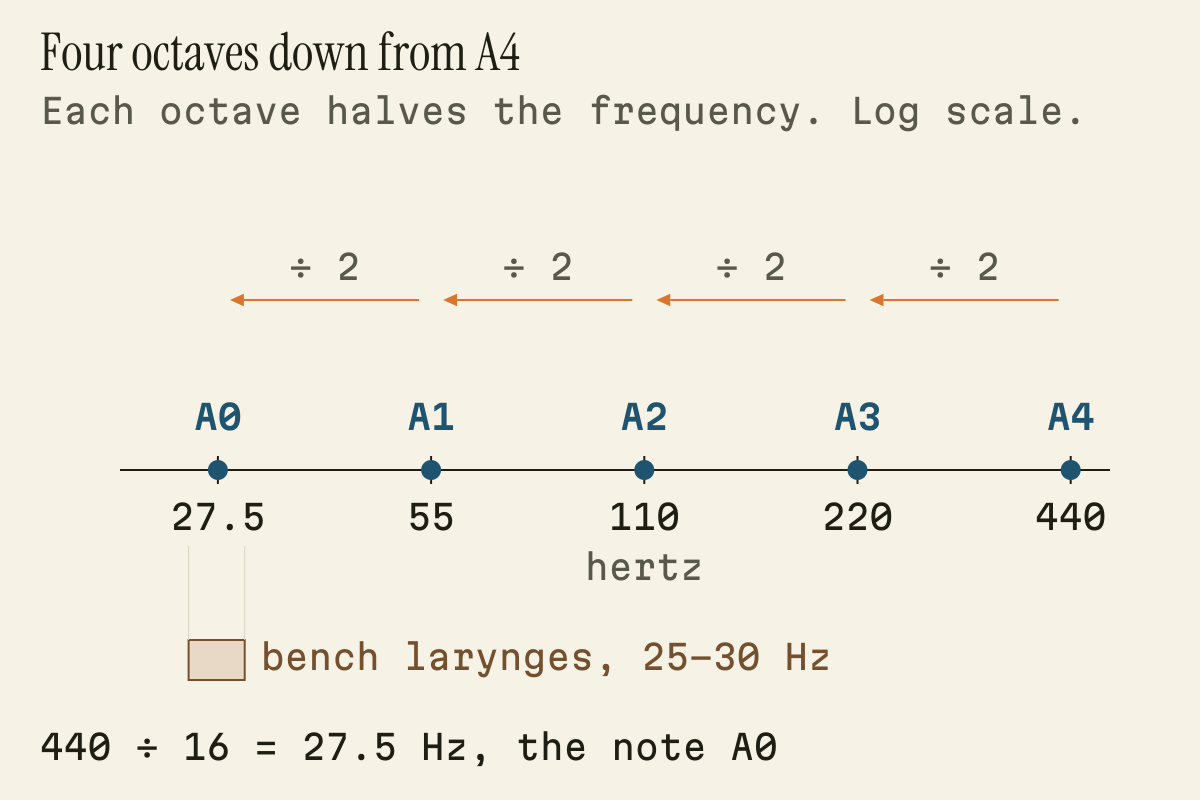
Halving 440 Hz four times reaches 27.5 Hz, the note A0. The band marks the 25 to 30 Hz purr range from the 2023 bench test, read in abstract.
Worked from Octaves computed by halving 440 Hz four times; the purr band from the Herbst et al. 2023 abstract.
"Halving 440 Hz four times reaches 27.5 Hz" by Sniff, Purr, Preen & Shoal, https://sniffpurrpreenandshoal.com/cats/cat-purring/, licensed under CC BY 4.0 (https://creativecommons.org/licenses/by/4.0/)
Data: Herbst et al. (2023), Current Biology, doi:10.1016/j.cub.2023.09.014 (abstract); ISO 16:1975 (A4 = 440 Hz), cited only
By the standards of music, very low. The tuning standard ISO 16 sets the note A4 at 440 Hz, and each octave down halves the frequency. Four octaves down, 440 ÷ 16 gives 27.5 Hz, the note A0.
Purr measurements sit around that note. The 1991 abstract gives 26.3 Hz for domestic cats, with a standard deviation of 1.95 Hz, just under A0. The 2023 bench larynges, read in abstract, produced purr-range sounds of 25 to 30 Hz. Neither abstract says where its cats came from, so the couch sample cannot be assigned for either.
The breath matters too. In the 1991 abstract, purring in the middle of breathing out ran 2.4 Hz higher than in the middle of breathing in, and each cat's own purring frequency did not change with age. The same abstract notes that a cat can purr while making another call at the same time.
| Measure | Value | Source and reading level |
|---|---|---|
| Domestic cats, average purr | 26.3 Hz (SD 1.95) | Frazer Sissom et al. 1991, abstract |
| Mid-breath out minus mid-breath in | 2.4 Hz (SD 1.3) | Frazer Sissom et al. 1991, abstract |
| Eight excised larynges on a bench | 25 to 30 Hz | Herbst et al. 2023, abstract |
| A0, four octaves below A4 | 27.5 Hz | 440 ÷ 16, computed |
Download the purr frequency data (CSV) (what the file holds) Data: Herbst et al. (2023), Current Biology, doi:10.1016/j.cub.2023.09.014 (abstract); Frazer Sissom, Rice & Peters (1991), Journal of Zoology, doi:10.1111/j.1469-7998.1991.tb04749.x (abstract)
These are small, partial numbers. Two abstracts and one calculation cannot show how purr pitch varies across cats, ages or breeds.
Does purring heal bones?
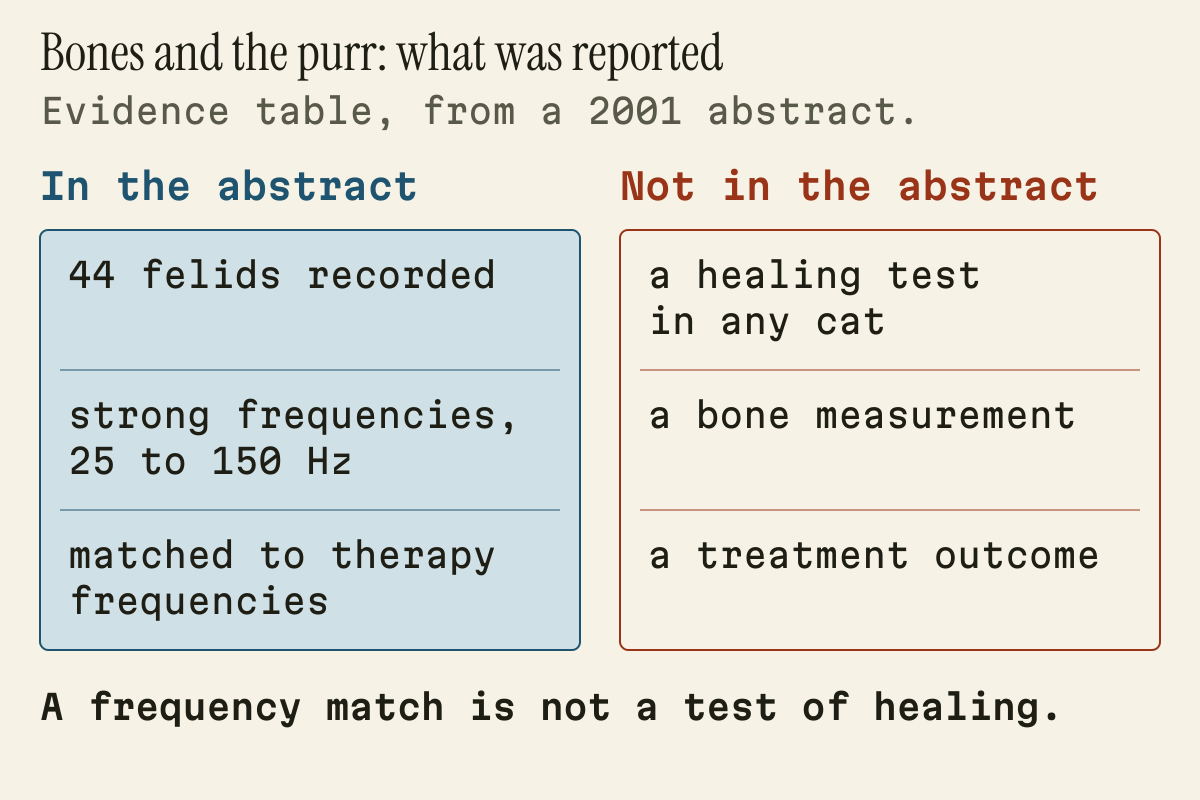
What the 2001 abstract reports beside what it does not: a frequency match, with no healing test reported in any cat.
Worked from The von Muggenthaler 2001 abstract only.
This figure in words
the evidence table, column by column.
- Reported in the abstract: 44 felids recorded.
- Reported in the abstract: strong frequencies between 25 and 150 Hz in every felid.
- Reported in the abstract: those frequencies matched to frequencies used in therapy.
- Not in the abstract: a healing test in any cat, a bone measurement, or a treatment outcome.
"What the 2001 felid purr abstract did and did not report" by Sniff, Purr, Preen & Shoal, https://sniffpurrpreenandshoal.com/cats/cat-purring/, licensed under CC BY 4.0 (https://creativecommons.org/licenses/by/4.0/)
Data: von Muggenthaler (2001), The Journal of the Acoustical Society of America, doi:10.1121/1.4777098 (abstract)
The idea starts from a frequency match. Von Muggenthaler's 2001 abstract in The Journal of the Acoustical Society of America reports recordings of 44 felids, among them domestic cats, servals, ocelots and pumas. Every felid in the study, the abstract says, produced strong frequencies between 25 and 150 Hz. The abstract does not say where the animals lived, so the couch sample cannot be assigned.
The abstract then lines those numbers up with vibration frequencies used in therapy for bone growth, fractures and wounds. It cites a 1994 study for 25 and 50 Hz as the two low frequencies that best promote bone healing, and it proposes that an internal healing mechanism would help a resting cat.
That is frequency matching, not a measurement of healing. The abstract reports no test of healing in any cat, and none of the other sources read for this page reports one either. The healing idea remains a hypothesis, and a purring cat that is injured or in pain still needs a veterinarian.
Much is still unknown, starting with the living cat. The 2023 bench work, read in abstract, left open how much a living cat's nervous system times each purr pulse, and the authors kept muscle activity in their conclusion. Why cats purr when hurt or frightened has no tested explanation in these sources; none of them reports a test of whether purring helps a cat heal, and every purr frequency on this page comes from an abstract.
Sources
- von Muggenthaler E (2001). "The felid purr: A healing mechanism?" The Journal of the Acoustical Society of America 110(5_Supplement):2666. doi.org/10.1121/1.4777098Read: Abstract only; meeting abstract
- Herbst CT, Prigge T, Garcia M, Hampala V, Hofer R, Weissengruber GE, Švec JG, Fitch WT (2023). "Domestic cat larynges can produce purring frequencies without neural input." Current Biology 33(21):4727–4732.e4. doi.org/10.1016/j.cub.2023.09.014Read: Abstract only
- Frazer Sissom DE, Rice DA, Peters G (1991). "How cats purr." Journal of Zoology 223(1):67–78. doi.org/10.1111/j.1469-7998.1991.tb04749.xRead: Abstract only
- McComb K, Taylor AM, Wilson C, Charlton BD (2009). "The cry embedded within the purr." Current Biology 19(13):R507–R508. doi.org/10.1016/j.cub.2009.05.033Read: Bibliographic record only
- Peters G (2002). "Purring and similar vocalizations in mammals." Mammal Review 32(4):245–271. doi.org/10.1046/j.1365-2907.2002.00113.xRead: Abstract only
- International Organization for Standardization (1975). ISO 16:1975, Acoustics — Standard tuning frequency (Standard musical pitch). www.iso.org/standard/3601.htmlRead: Bibliographic record only
Cite this page
Sniff, Purr, Preen & Shoal. “How Do Cats Purr? A 2023 Abstract Points to the Larynx.” Published November 20, 2026. https://sniffpurrpreenandshoal.com/cats/cat-purring/. Accessed on the day you read it.
How studies are read and numbers recheckedMending basket: every correctionReport an error on this page (contact@sniffpurrpreenandshoal.com)
More from Cat Minds
Purr Research story
Do Cats Love Their Owners? What Attachment Studies Found
Picture credit
"Poes met vijf spelende jongen (Cat with five playing kittens), etching by Petrus Johannes Arendzen after Henriëtte Ronner-Knip" by Petrus Johannes Arendzen (etcher) after Henriëtte Ronner-Knip (painter); Rijksmuseum (RP-P-1909-1552) — https://commons.wikimedia.org/wiki/File:Poes_met_vijf_spelende_jongen,_RP-P-1909-1552.jpg — CC0 1.0 (https://creativecommons.org/publicdomain/zero/1.0/)

Purr Research story
Why Do Cats Make Biscuits? Two Old Books Point to Nursing
Picture credit
"Four Cats in Different Poses (detail), from the series Tatoe-zukushi no uchi, by Utagawa Kuniyoshi" by Utagawa Kuniyoshi; Wikimedia Commons (source: visipix) — https://commons.wikimedia.org/wiki/File:Kuniyoshi_Utagawa,_For_cats_in_different_poses.jpg — Public domain (EU: Utagawa Kuniyoshi died 1861, more than 70 years ago (life plus 70 years); US: published before 1931; faithful reproduction of a two-dimensional print); modified: cropped to the lower half of the sheet (full width, rows 1,530 to 3,117: 1,587 of 3,117 px of the original's height; top edge moved down 2026-11-20 so the pink object above the two cats is left out)
Purr Research story
Cat Slow Blink: In Two Tests, Cats Narrowed Their Eyes Back
Picture credit
"Sleepy tabby" by Chinda Sam afortunatefate (Unsplash) — https://commons.wikimedia.org/wiki/File:Sleepy_tabby_(Unsplash).jpg — CC0 1.0 (https://creativecommons.org/publicdomain/zero/1.0/)