Purr Research story
Do Cats Love Their Owners? What Attachment Studies Found
Sniff, Purr, Preen & Shoal Published
TL;DR
Two attachment studies of cats and their people disagree, and neither measured love. A 2015 test found no sign that 18 adult cats pet homes used their owners as a source of safety, while a 2019 study, read in abstract, reported distinct attachment styles toward caregivers. The abstract cannot show why: the 2019 sample and procedure are not in it.
Doorplate
- Animal
- Domestic cats, adults aged 1 to 9 years, tested with their owners
- Study
- Potter & Mills 2015, PLOS ONE
- n (analysed / excluded)
- 18 cat and owner pairs analyzed / 2 excluded (hid through a whole test)
- Couch sample
- pet homes convenience sample recruited through personal contact and local pet-business advertisements
- Limits
- Adult cats only; 2 pedigree British Shorthairs and 18 domestic shorthairs or longhairs recruited; owners within 5 miles of the test area; tested in unfamiliar rooms, not at home; one adapted attachment test
- Setup in one line
- Nine 3-minute episodes with the owner, a stranger, both or nobody, run twice with the order reversed
- Replicated?
- No repeat of this counterbalanced test among the sources read, as of 2026-11-20; a 2019 study, read in abstract, reported distinct attachment styles
This doorplate as data (CSV) what the file holds
Data: Potter & Mills (2015), PLOS ONE, Creative Commons Attribution License, version not stated on the article page
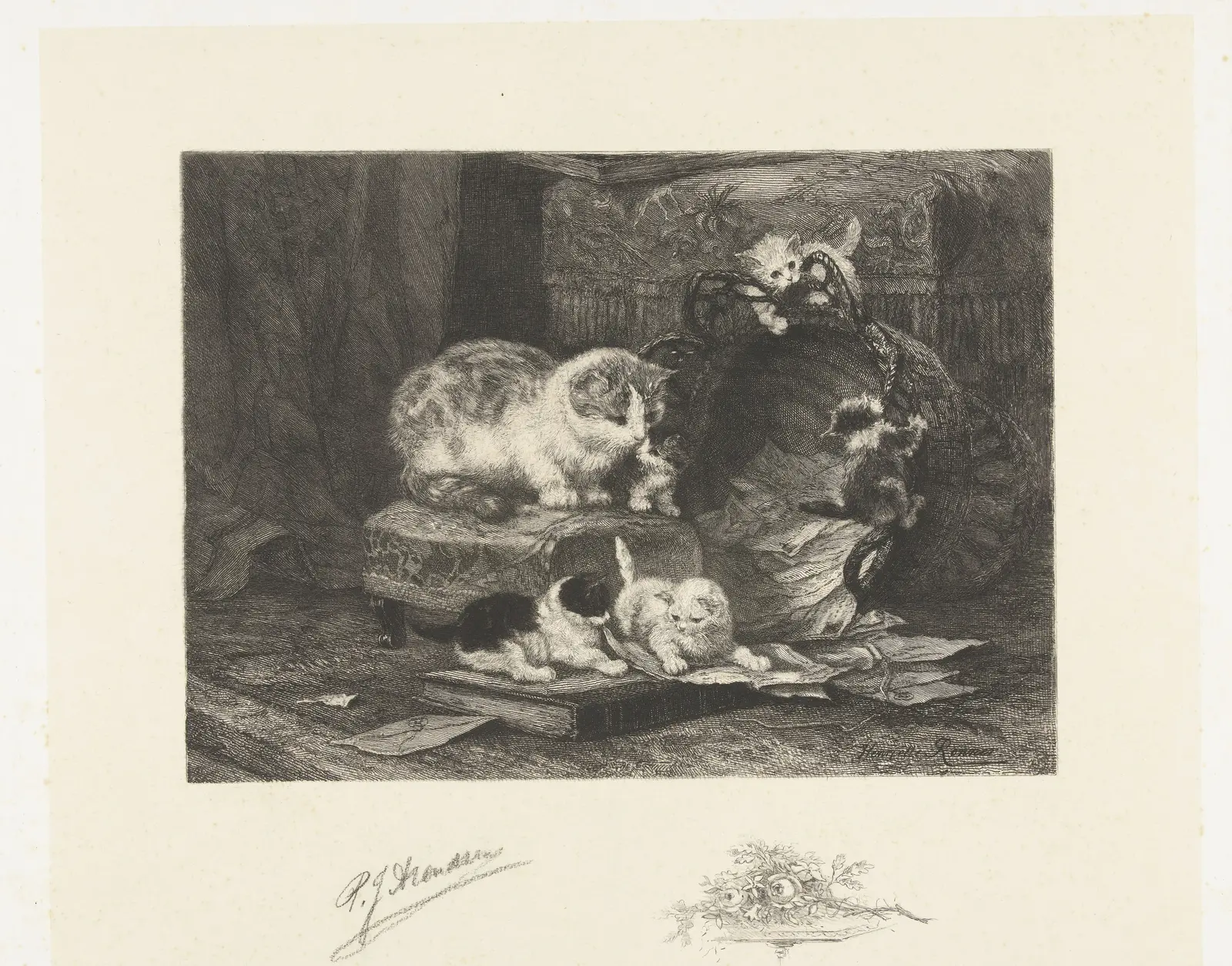
A mother cat and five playing kittens, in an etching by Petrus Johannes Arendzen after a painting by Henriëtte Ronner-Knip.
"Poes met vijf spelende jongen (Cat with five playing kittens), etching by Petrus Johannes Arendzen after Henriëtte Ronner-Knip" by Petrus Johannes Arendzen (etcher) after Henriëtte Ronner-Knip (painter); Rijksmuseum (RP-P-1909-1552) — https://commons.wikimedia.org/wiki/File:Poes_met_vijf_spelende_jongen,_RP-P-1909-1552.jpg — CC0 1.0 (https://creativecommons.org/publicdomain/zero/1.0/)
The minute after you walk through the door is the moment one cat study was built around. In 2012, Alice Potter and Daniel Mills at the University of Lincoln put 20 cat and owner pairs pet homes through a series of short separations and reunions in an unfamiliar room. The results came out in 2015. After two cats were removed, 18 pairs were analyzed, and the cats showed no sign of secure attachment to their owners.
A 2019 study by Kristyn Vitale, Alexandra Behnke and Monique Udell, read in abstract, reported a different kind of result: distinct attachment styles toward human caregivers. Where its cats came from, the couch sample, cannot be assigned from the abstract. Neither study, as read here, measured love.
What did the adult-cat test do?
Potter and Mills started from the Ainsworth Strange Situation Test (SST), a procedure first built to study how human infants respond to their mothers. In their paper, attachment in this sense “has a precise operational definition relating to the provision of safety and security, and is not simply an affectionate bond.” An attached animal stays near its carer, is upset when separated, and treats the carer as a secure base: a safe starting point from which it moves off to explore a strange place.
The adult-cat version had nine episodes of three minutes each. In each one the cat was with its owner, with a stranger, with both, or alone, in a plain room it had never seen. Each pair went through the test twice, at least two weeks apart: once in order A and once in order B, which swapped the owner's and the stranger's turns.
The swap is the point of the design. If a cat acted differently with its owner, the difference could not simply come from where an episode fell in the test.
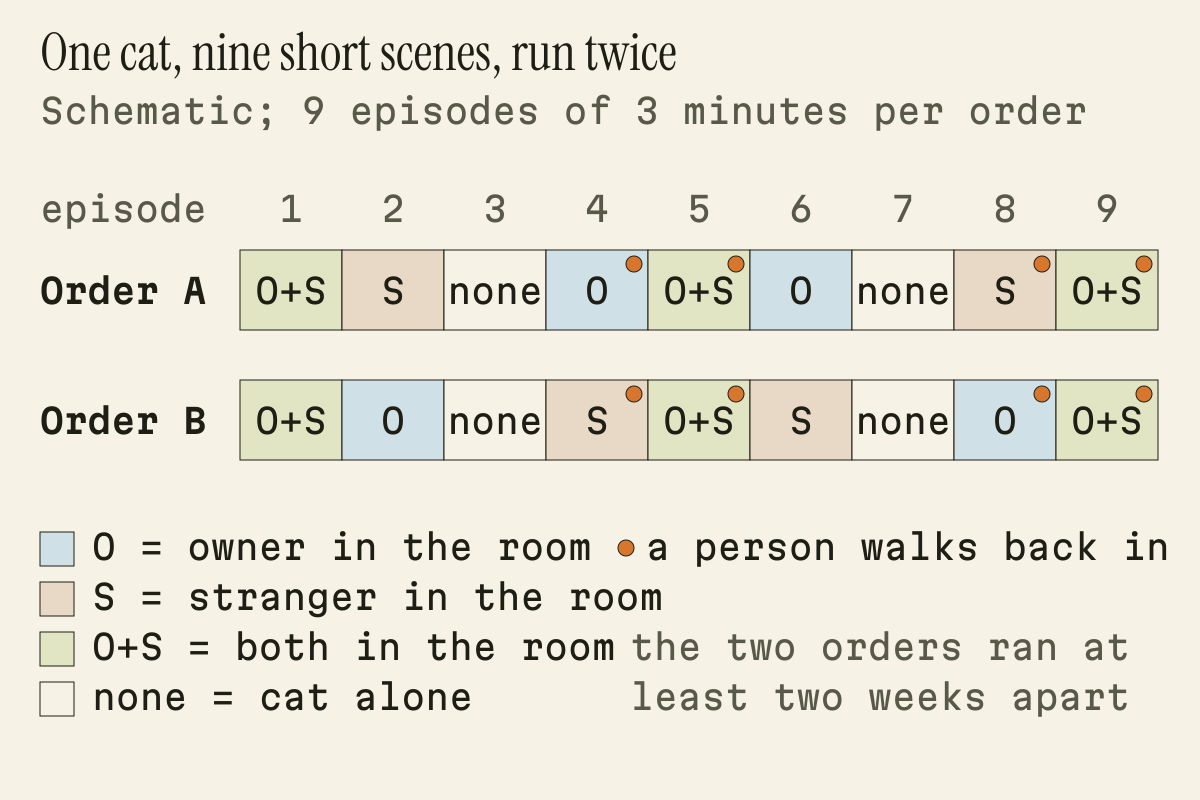
Schematic of the nine 3-minute episodes in each order of the 2015 test; a dot marks an episode that begins with a person walking back in.
Worked from Table 1 of Potter & Mills 2015 (full text, open license); the 27 minutes per order and the swap between orders are computed for this page.
This figure in words
who was in the room with the cat, episode by episode (owner, stranger, both or nobody).
| Episode | Order A | Order B |
|---|---|---|
| 1 | owner and stranger | owner and stranger |
| 2 | stranger (owner has left) | owner (stranger has left) |
| 3 | cat alone | cat alone |
| 4 | owner walks back in | stranger walks back in |
| 5 | stranger walks back in; both present | owner walks back in; both present |
| 6 | owner (stranger has left) | stranger (owner has left) |
| 7 | cat alone | cat alone |
| 8 | stranger walks back in | owner walks back in |
| 9 | owner walks back in; both present | stranger walks back in; both present |
"The nine episodes of the 2015 adult-cat attachment test, in both orders" by Sniff, Purr, Preen & Shoal, https://sniffpurrpreenandshoal.com/cats/cat-attachment-studies/, licensed under CC BY 4.0 (https://creativecommons.org/licenses/by/4.0/)
Data: Potter & Mills (2015), PLOS ONE, Table 1, Creative Commons Attribution License, version not stated on the article page
Who the cats were
The 20 cats pet homes were a convenience sample, recruited through personal contact and advertisements in local pet businesses, and their owners lived within 5 miles (8 km) of the test area. There were 13 males and 7 females, aged 1 to 9 years; 2 were pedigree British Shorthairs and 18 were domestic shorthairs or longhairs. Nineteen of them had regular access to the outdoors.
Two cats hid for an entire test and were removed from the analysis, which left 18 pairs pet homes. That is the whole of the couch sample here: pet cats living with their owners, tested away from home, every one of them an adult. The marker says where the cats came from, not how typical they are.
What did the adult cats do?
Before testing for attachment, Potter and Mills checked which behaviors held steady between the two runs of the test. Many did not. Time spent near a person, touching a person, facing the door and vigilance all shifted with the order of the test or of the episodes, so those measures were dropped.
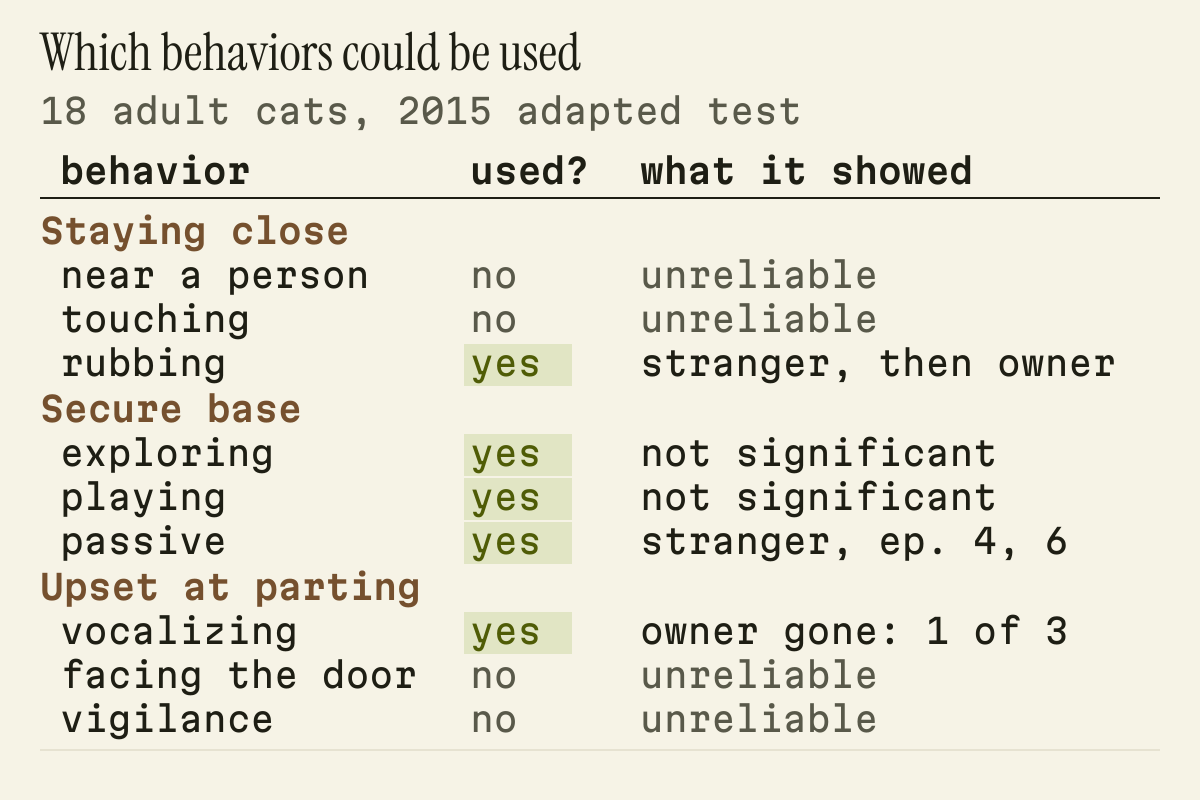
Which behaviors could serve as attachment measures in the 2015 test of 18 adult cats, and what the usable ones showed.
Worked from Tables 2 and 3 and the Results text of Potter & Mills 2015 (full text, open license); the 1 of 3 vocalizing comparisons is tallied from Table 3.
This figure in words
the nine behaviors, grouped by the part of attachment each was meant to show.
- Staying close: being near a person and touching a person were too unreliable to use; rubbing against a person was usable and, by the Results text, went to the stranger more early in the test and to the owner more in episode 8, though the medians printed in Table 3 point the other way.
- Secure base: exploring and playing showed no significant difference between owner and stranger; passive behavior lasted longer with the stranger in the middle episodes.
- Upset at parting: vocalizing was higher after the owner left than after the stranger left in 1 of 3 comparisons; facing the door and vigilance were too unreliable to use.
"Which cat behaviors could be used as attachment measures in the 2015 test" by Sniff, Purr, Preen & Shoal, https://sniffpurrpreenandshoal.com/cats/cat-attachment-studies/, licensed under CC BY 4.0 (https://creativecommons.org/licenses/by/4.0/)
Data: Potter & Mills (2015), PLOS ONE, Tables 2 and 3, Creative Commons Attribution License, version not stated on the article page
The usable measures pointed away from a secure base. Exploring and play showed no significant difference between stranger and owner, and play with the stranger did not drop significantly when the owner was gone. In the authors' account, rubbing shifted from the stranger to the owner as the test went on, which they read as a cat getting used to a new person rather than as attachment.
The one result that favored the owner
In one comparison, cats vocalized more after the owner left than after the stranger left, though a pooled comparison of four episodes showed no significant difference. Potter and Mills judged that this alone could not show secure attachment and suggested it might reflect frustration at the owner leaving. Their summary was that the results “are consistent with the view that adult cats are typically quite autonomous, even in their social relationships.”
The paper is careful about what it does not claim. The authors wrote that they did not mean to imply that cats lack “some form of affectionate social relationship or bond with their owners,” and added that cats “do seem to have a preference for their owner over an unfamiliar individual.” They also raised a plainer possibility: the adapted SST might not be the right instrument for cats.
What did the 2019 study report?
The 2019 paper by Vitale, Behnke and Udell in Current Biology could be read here only as its abstract, so where its cats came from cannot be assigned. The abstract states that, “using behavioral criteria established in the human infant literature,” cats display distinct attachment styles toward human caregivers. The same abstract argues that if cats share social traits once credited only to dogs and humans, broader explanations of attachment across species may be needed.
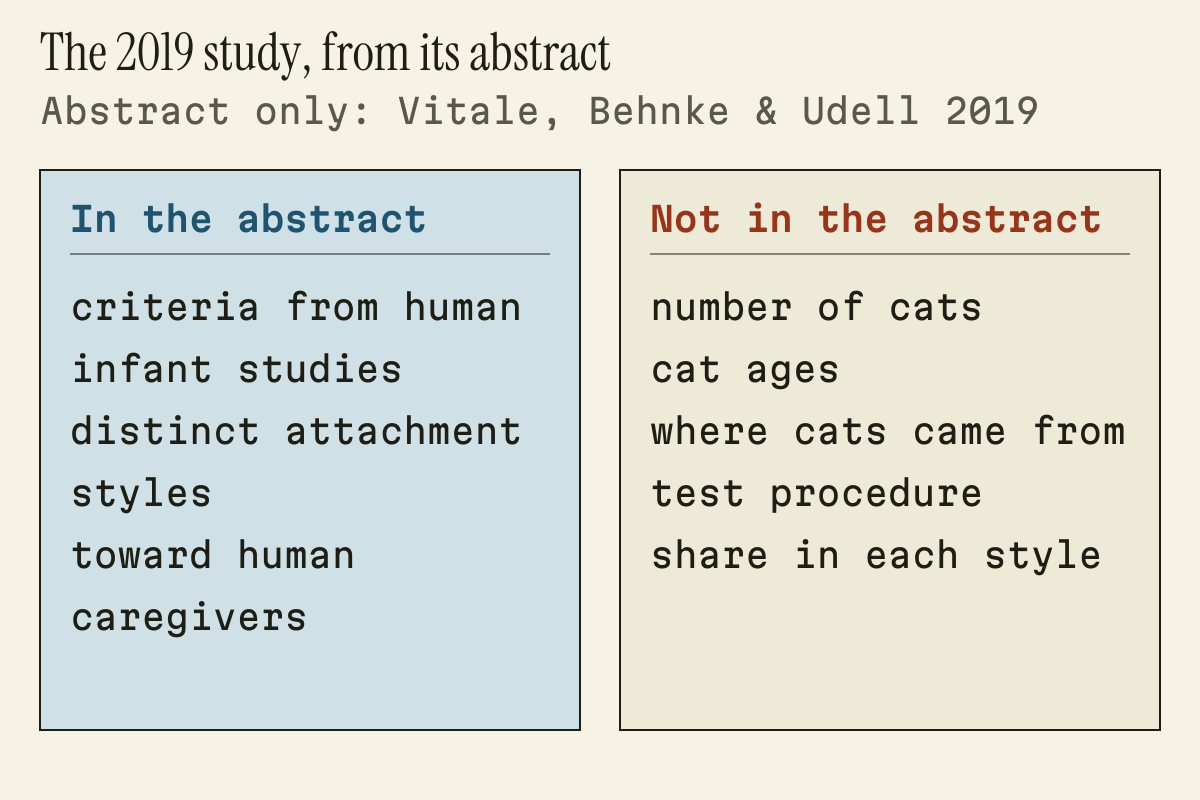
What the 2019 abstract states and what it leaves out, drawn from the abstract only.
Worked from The abstract of Vitale, Behnke & Udell 2019 only.
This figure in words
the 2019 study as its abstract describes it.
- Stated in the abstract: cats were judged with behavioral criteria from studies of human infants; cats display distinct attachment styles; the styles are toward human caregivers.
- Not in the abstract read: the number of cats, their ages, where they came from, the test procedure, and the share of cats in each style.
"What the 2019 cat attachment abstract states and leaves out" by Sniff, Purr, Preen & Shoal, https://sniffpurrpreenandshoal.com/cats/cat-attachment-studies/, licensed under CC BY 4.0 (https://creativecommons.org/licenses/by/4.0/)
Data: Vitale, Behnke & Udell (2019), Current Biology, abstract only
Those gaps are why this page reports no numbers for the 2019 study, as read in its abstract. Without the cats' source, no couch-sample marker can be assigned to it either. A search in November 2026 for a publisher's open copy or a repository copy of the full paper found none that could be read.
Potter and Mills defined a secure base as a carer the animal treats as a safe starting point, and the 2015 test looked for one through exploring and play. The 2019 abstract does not say whether its criteria worked the same way.
Why can two studies disagree?
Set side by side, the two studies can be compared on only a few columns, because the 2019 abstract leaves most of them blank. The 2015 SST used adult cats, unfamiliar rooms and a counterbalanced design that threw out unsteady measures, while the 2019 study, read in abstract, names criteria from infant research, and its abstract gives no sample details at all.
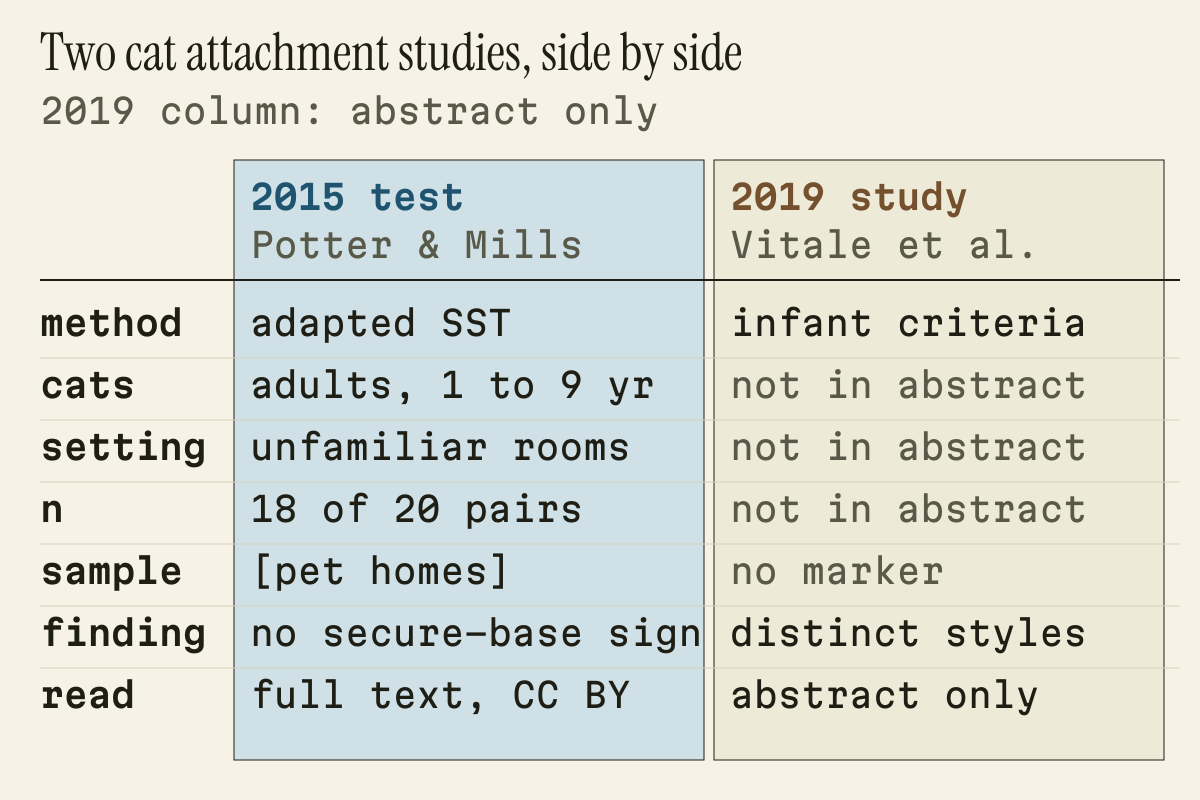
Evidence table of the 2015 and 2019 cat attachment studies; the 2019 column comes from the abstract only.
Worked from Potter & Mills 2015 (full text, open license) and the abstract of Vitale, Behnke & Udell 2019; no figure in the 2019 column comes from outside the abstract.
"Evidence table: the 2015 and 2019 cat attachment studies" by Sniff, Purr, Preen & Shoal, https://sniffpurrpreenandshoal.com/cats/cat-attachment-studies/, licensed under CC BY 4.0 (https://creativecommons.org/licenses/by/4.0/)
Data: Potter & Mills (2015), PLOS ONE, Creative Commons Attribution License, version not stated on the article page; Vitale, Behnke & Udell (2019), Current Biology, abstract only
| Study | Method | Cats | Analyzed (excluded) | Couch sample | Where tested | Finding | Read |
|---|---|---|---|---|---|---|---|
| Potter & Mills 2015 | Adapted SST, two counterbalanced orders | Adults, 1 to 9 years | 18 pairs (2) | pet homes | Unfamiliar rooms | No evidence of secure attachment | Full text, open license |
| Vitale, Behnke & Udell 2019 | Criteria from human infant studies (abstract wording) | Not in the abstract read | Not in the abstract read | Cannot be assigned | Not in the abstract read | Distinct attachment styles toward caregivers | Abstract only |
Download the two-study table (CSV) (what the file holds) Data: Potter & Mills (2015), PLOS ONE, Creative Commons Attribution License, version not stated on the article page; Vitale, Behnke & Udell (2019), Current Biology, abstract only
The 2015 authors raised one of these problems themselves. They noted that the SST suits dogs because it copies situations dogs meet in daily life, while most cats rarely meet them. Their answer was that, for cats who spend most of their time at home, an unfamiliar room should be a strong enough challenge to bring out attachment behavior if it existed. They also noted that cats used to traveling to new places might take a strange room in stride, which could produce a false negative.
So the gap could come from the cats' ages, the setting, the scoring, the definition of attachment, or chance. From the 2019 abstract alone there is no way to tell which. The same care with samples runs through the catnip page, where the cats that did not respond count as much as the cats that did.
Why do cats seem aloof?
Low contact does not settle the question in either direction. The 2015 SST measured how adult cats behaved in a strange room, not how often they seek contact at home, and the 2019 study, by its abstract, reported attachment styles rather than affection. Calling a cat aloof because it rarely comes over skips both of those steps. A purr is no shortcut either; the cat purring page covers what a purr does and does not tell you.
Are cats as attached as dogs?
Potter and Mills wrote that the same kind of test has produced strong evidence of secure attachment in dogs, and concluded that cats “do not appear to attach to owners as a focus of safety and security in the same way that dogs do.”
The 2019 abstract frames the comparison the other way: it notes that a tendency to form attachment bonds has been described as part of what makes dogs unique, and reports attachment styles in cats too. Neither study, as read here, put cats and dogs through the same test side by side.
Do cats miss their owners?
No study read for this page measured missing. The closest result is the 2015 finding that cats vocalized more after the owner left in one comparison, which Potter and Mills thought might reflect frustration at the owner leaving rather than a need for the owner's comfort.
They also cited reports that some cats show separation-related problems. A cat that seems distressed when left alone, or any change in behavior that worries an owner, is a question for a veterinarian or a board-certified veterinary behaviorist; neither study offers a way to judge one cat at home.
The sources read here leave open how the two findings fit together. Until the 2019 sample and procedure can be read, they cannot show whether the difference comes from the cats, the test or the scoring. No repeat of the counterbalanced 2015 design appears among the sources read for this page, as of November 2026. And neither study asked the question in this page's title: whether cats love the people they live with.
Sources
- Potter A, Mills DS (2015). "Domestic Cats (Felis silvestris catus) Do Not Show Signs of Secure Attachment to Their Owners." PLOS ONE 10(9):e0135109. doi.org/10.1371/journal.pone.0135109Read: Full text, open license; Creative Commons Attribution License, version not stated on the article page
- Vitale KR, Behnke AC, Udell MAR (2019). "Attachment bonds between domestic cats and humans." Current Biology 29(18):R864-R865. doi.org/10.1016/j.cub.2019.08.036Read: Abstract only
Cite this page
Sniff, Purr, Preen & Shoal. “Do Cats Love Their Owners? What Attachment Studies Found.” Published November 20, 2026. https://sniffpurrpreenandshoal.com/cats/cat-attachment-studies/. Accessed on the day you read it.
How studies are read and numbers recheckedMending basket: every correctionReport an error on this page (contact@sniffpurrpreenandshoal.com)
More from Cat Minds
Purr Research story
How Do Cats Purr? A 2023 Abstract Points to the Larynx
Picture credit
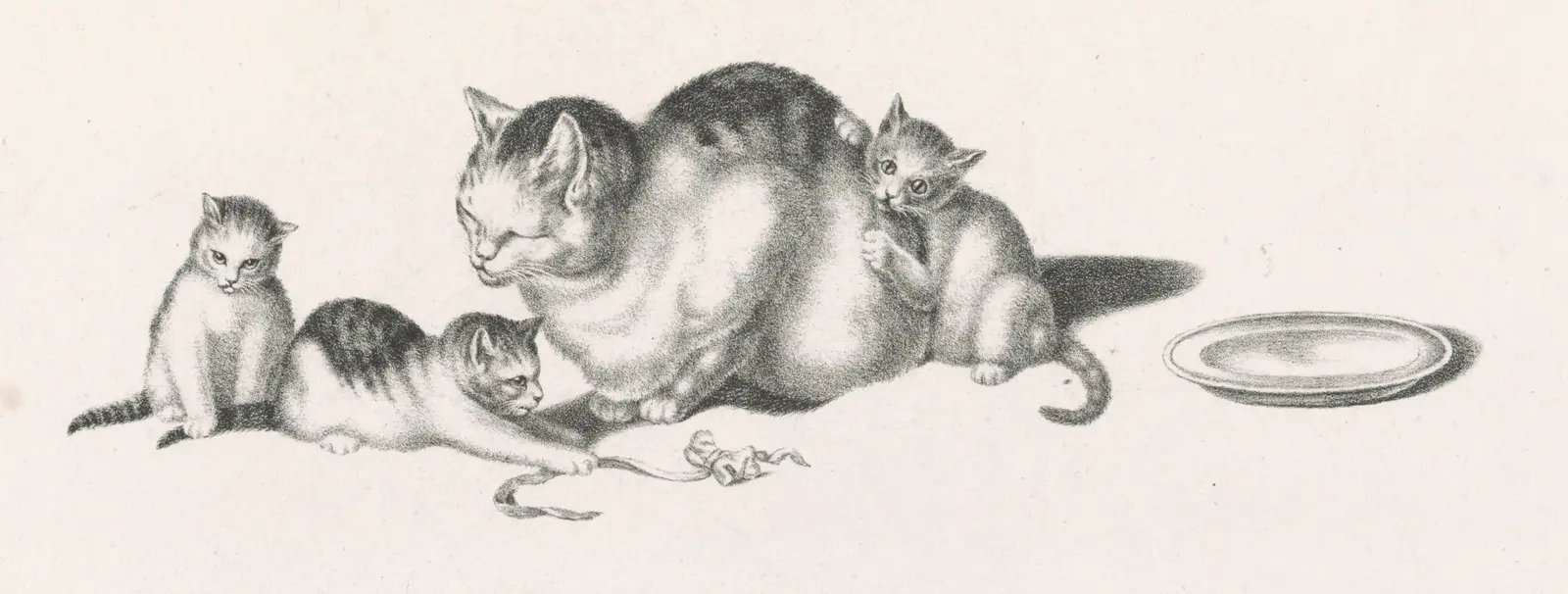
"Domestic cat napping with three playful kittens and a saucer on the right (detail)" by Joseph Brodtmann (lithographer) after Gottfried Mind (artist); Library of Congress Prints and Photographs Division (pga.05433) — https://commons.wikimedia.org/wiki/File:Domestic_cat_napping_with_three_playful_kittens_and_a_saucer_on_the_right_LCCN2012645542.jpg — Public domain (EU: Gottfried Mind died 1814 and Joseph Brodtmann died 1862, more than 70 years ago (life plus 70 years); US: published before 1931); modified: cropped to the cat, the three kittens, the ribbon and the saucer (columns 860 to 4,660 and rows 1,260 to 2,700 of the original's 5,324 x 3,934 px; the plate number, pencil marks and blank paper around the group are left out; 2026-11-20)

Purr Research story
Why Do Cats Make Biscuits? Two Old Books Point to Nursing
Picture credit
"Four Cats in Different Poses (detail), from the series Tatoe-zukushi no uchi, by Utagawa Kuniyoshi" by Utagawa Kuniyoshi; Wikimedia Commons (source: visipix) — https://commons.wikimedia.org/wiki/File:Kuniyoshi_Utagawa,_For_cats_in_different_poses.jpg — Public domain (EU: Utagawa Kuniyoshi died 1861, more than 70 years ago (life plus 70 years); US: published before 1931; faithful reproduction of a two-dimensional print); modified: cropped to the lower half of the sheet (full width, rows 1,530 to 3,117: 1,587 of 3,117 px of the original's height; top edge moved down 2026-11-20 so the pink object above the two cats is left out)
Purr Research story
Cat Slow Blink: In Two Tests, Cats Narrowed Their Eyes Back
Picture credit
"Sleepy tabby" by Chinda Sam afortunatefate (Unsplash) — https://commons.wikimedia.org/wiki/File:Sleepy_tabby_(Unsplash).jpg — CC0 1.0 (https://creativecommons.org/publicdomain/zero/1.0/)