Purr Research story
Why Do Cats Like Catnip? One Study: 32 of 99 Didn’t Respond
Sniff, Purr, Preen & Shoal Published
TL;DR
Cats respond to catnip’s smell, rich in a compound called nepetalactone, by sniffing, licking, rubbing and rolling. In one 2017 study, though, 32 of 99 cats mixed did not respond to catnip, while 79 of 100 responded to silver vine, a plant with little nepetalactone. The study did not test why, or which compounds set off which cats.
Doorplate
- Animal
- Domestic cats six months or older, mostly domestic short-haired; nine tigers and five bobcats tested separately
- Study
- Bol et al. 2017, BMC Veterinary Research
- n (analysed / excluded)
- 100 cats; 99 with a catnip result, 100 with silver vine, 95 with all four plants / cats in isolation or with respiratory signs left out, number not given; some adopted mid-study
- Couch sample
- mixed 62 cats in a sanctuary, 20 in a shelter, 12 in homes and 6 at a cat clinic, each tested where it lived
- Limits
- One scorer who knew which plant was offered; mostly domestic short-haired cats; plants offered in different amounts; counts for two of the four plants not given in the article text
- Setup in one line
- Each plant offered in a sock or on carpet at least twice, with empty controls; responses scored from set behaviors
- Replicated?
- As of 2026-11-20: the catnip non-responder share is in line with three earlier studies the paper pools; no independent repeat of the four-plant comparison among the sources read
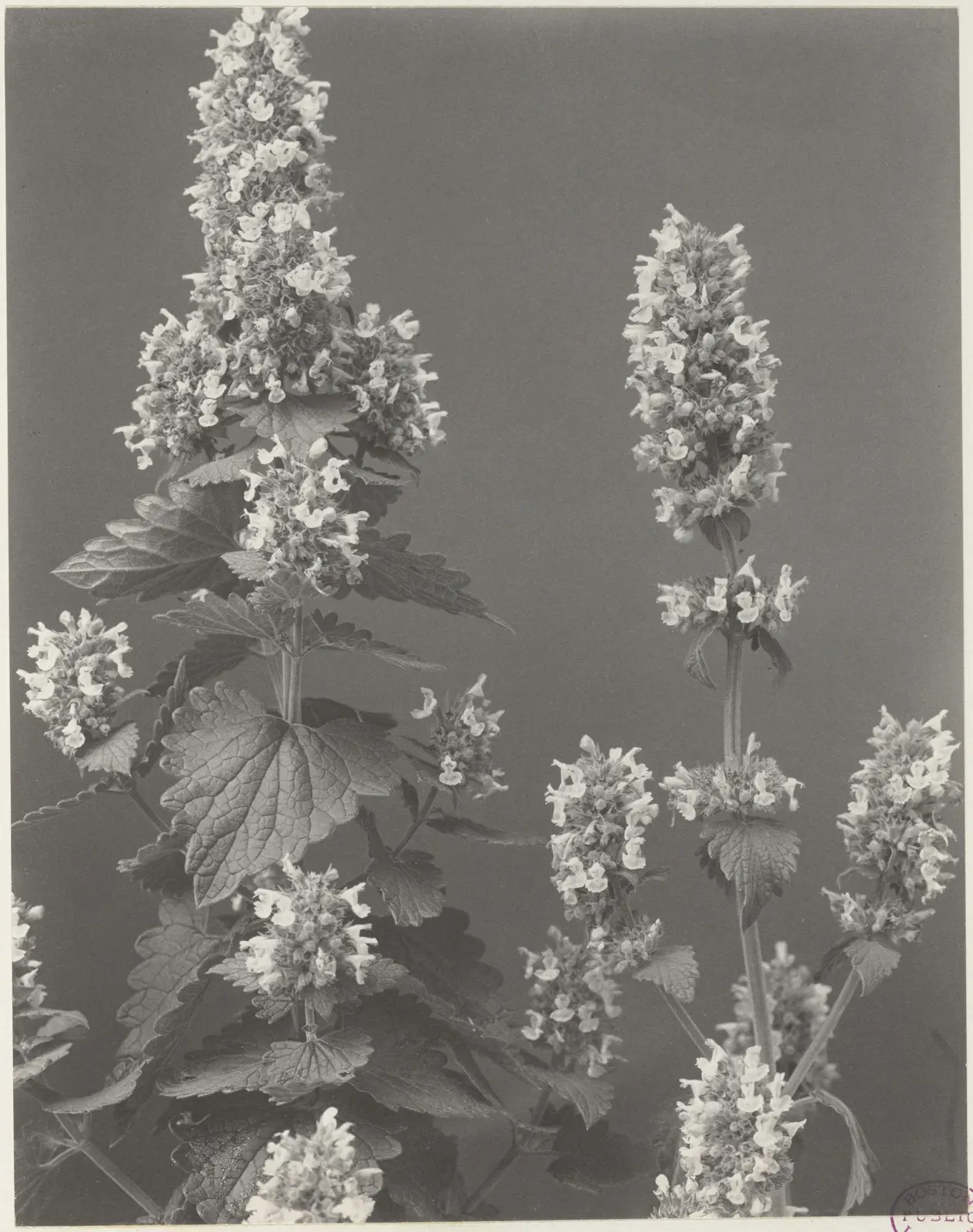
Flowering catnip, Nepeta cataria, in a 1911 plate from Wild Flowers of New England. The 2017 study offered cats dried catnip leaves and flowers.
"176. Nepeta cataria, catnip, catmint" by Edwin Hale Lincoln; Boston Public Library, via DPLA (Wild flowers of New England, 1911) — https://commons.wikimedia.org/wiki/File:176._Nepeta_cataria,_catnip,_catmint_-_DPLA_-_58ff424ab4a8dc41ff34a423cf0f63fa.jpg — Public domain (EU: Edwin Hale Lincoln died 1938, more than 70 years ago (life plus 70 years); US: published before 1931)
The cat rolls on the floor beside a chewed catnip toy. A 2017 study led by Sebastiaan Bol offered catnip and three other plants to 100 domestic cats living in a sanctuary, a shelter, private homes and a cat clinic in Riverside, California mixed, and 32 of the 99 cats with a catnip result did not respond to it. The paper reports that as 32%; recomputed from the counts it is 32.3%.
That share was no surprise to the authors. They write that it is “in line with findings from previous studies,” and pool three earlier studies to get 53 non-responders among 170 cats, or 31%. The pooled figure is given without saying where those cats lived, so a sample marker cannot be assigned to it. What the 2017 study added was the other plants: silver vine, Tatarian honeysuckle and valerian root.
How many cats responded?
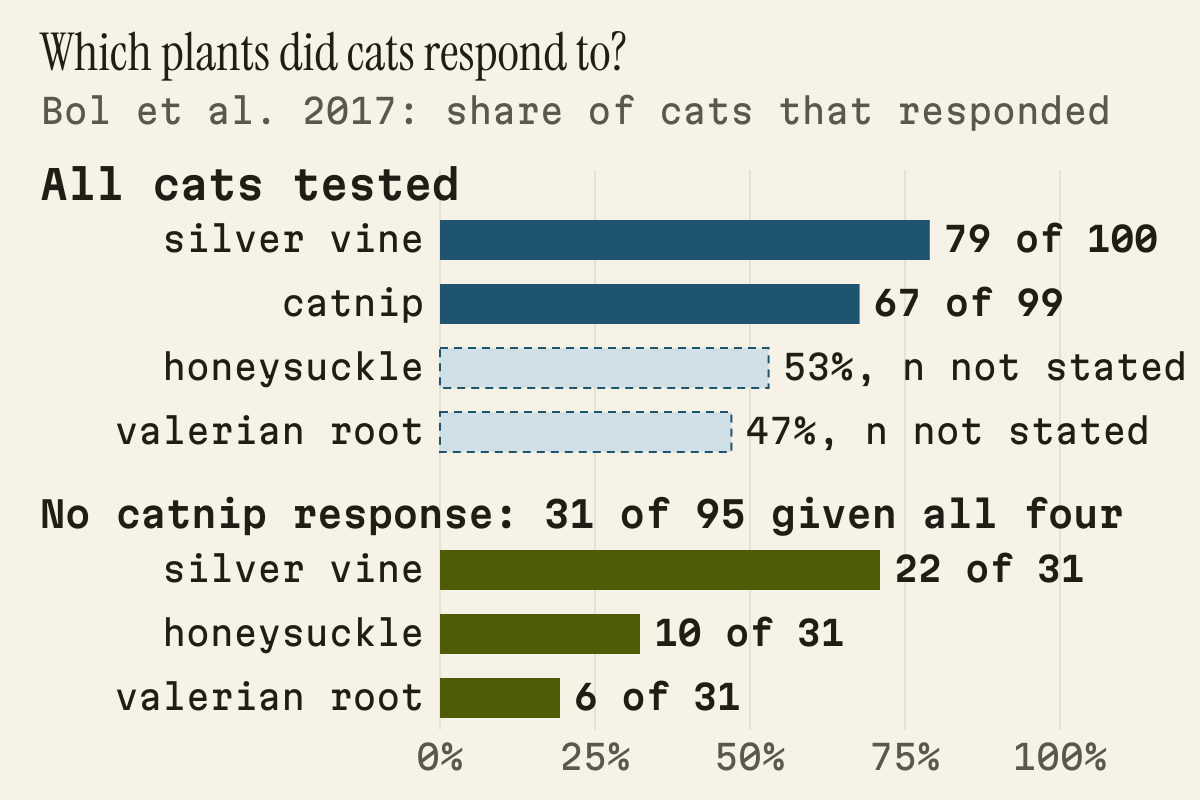
In one 2017 study, the share of cats that responded to each plant. The lower bars are a separate group: the 31 cats, among 95 offered all four plants, that did not respond to catnip.
Worked from Counts in Bol et al. 2017 (Results, Discussion and Fig. 5b caption); percentages recomputed from those counts, denominator 99 for catnip; honeysuckle and valerian bars use the reported percentages, as no counts are given.
"Cats that responded to each plant, from Bol et al. 2017" by Sniff, Purr, Preen & Shoal, https://sniffpurrpreenandshoal.com/cats/catnip/, licensed under CC BY 4.0 (https://creativecommons.org/licenses/by/4.0/)
Data: Bol et al. (2017), BMC Veterinary Research 13:70, CC BY 4.0
The cats were at least six months old and chosen at random: 62 from the sanctuary, 20 from a shelter, 12 from homes and 6 from a cat clinic. Every cat was tested in its normal living environment. Cats kept in isolation areas or showing respiratory signs were left out, and the paper does not give that number.
Each cat was to be offered all four plants and an empty control, usually on three different days and at different times of day. The plant went into a thin sock set on the floor within a meter of the cat’s head, or was spread on a square of carpet in the middle of the room. Nothing was forced on a cat or moved after it walked away.
The order of the plants was random, with at least five minutes between them. Once a cat gave a full response, that plant was taken away, so tiredness would not blunt the next one. A cat counted as not responding to a plant only when at least two exposures brought no response.
| Plant | Cats that responded | Share reported | Recomputed from counts |
|---|---|---|---|
| Silver vine | 79 of 100 | 79% | 79.0% |
| Catnip | 67 of 99 | 68% | 67.7% |
| Tatarian honeysuckle | count not given in the text | 53% | not computed |
| Valerian root | count not given in the text | 47% | not computed |
Download the response table (CSV) (what the file holds) Data: Bol et al. (2017), BMC Veterinary Research 13:70, CC BY 4.0
The article text gives counts only for silver vine and catnip. For the other two plants it gives percentages, and the counts sit in a raw-data file attached to the paper that could not be read for this page, so the table leaves them out.
Ninety-four of the 100 cats mixed responded to at least one plant, and 6 responded to none. None of the cats responded to the empty sock or carpet used as a control.
Catnip vs silver vine: which do more cats respond to?
In this sample, silver vine reached more cats than catnip, 79% against 68%. The authors’ statistics did not show that gap to be significant. They did find the response to silver vine “more intense” than the response to catnip. Both plants drew significantly more cats than honeysuckle or valerian.
Silver vine, Actinidia polygama, is a plant from East Asia, where it is also called matatabi. The paper notes it is commonly used as a cat stimulant in Japan, and that a 1906 letter in the journal Science described cats taking to it after the plant reached the Harvard arboretum from China.
The silver vine the cats responded to was mostly a powder made from fruit galls, deformed fruit formed when a gall midge larva grows inside. In a side test with nine cats from the same shelter, 8 of 9 responded to dried galls and none to normal dried fruit. Over several sessions with eight of the same cats, the leaves and a powder of normal fruit drew no responses, and wood chips drew one.
Why do some cats ignore catnip?
The study did not test why. It did look at who the non-responders were, and found no clear pattern. Male and female cats responded about equally, and cats in the younger half of the 89 with known ages (4 years 10 months or younger) responded to no more plants than the older half.
The study found no association between how shy or friendly a cat was and how it responded. One age difference did appear: among cats that responded to catnip, the older group showed more mild responses, 35% against 12% in the younger group.
Many of the cats that showed no response to catnip still responded to something else. Of the 95 cats tested with all four plants mixed, 31 did not respond to catnip. Among those 31, 22 responded to silver vine, 10 to Tatarian honeysuckle and 6 to valerian root.
That group of 31 is not the same as the full-sample count of catnip non-responders mixed given earlier. Five cats lacked results for at least one plant, some because they were adopted while the study ran, so the subset is smaller. Sniff test sets out keeping two groups from one paper apart as a standing rule.
What does a responding cat do?
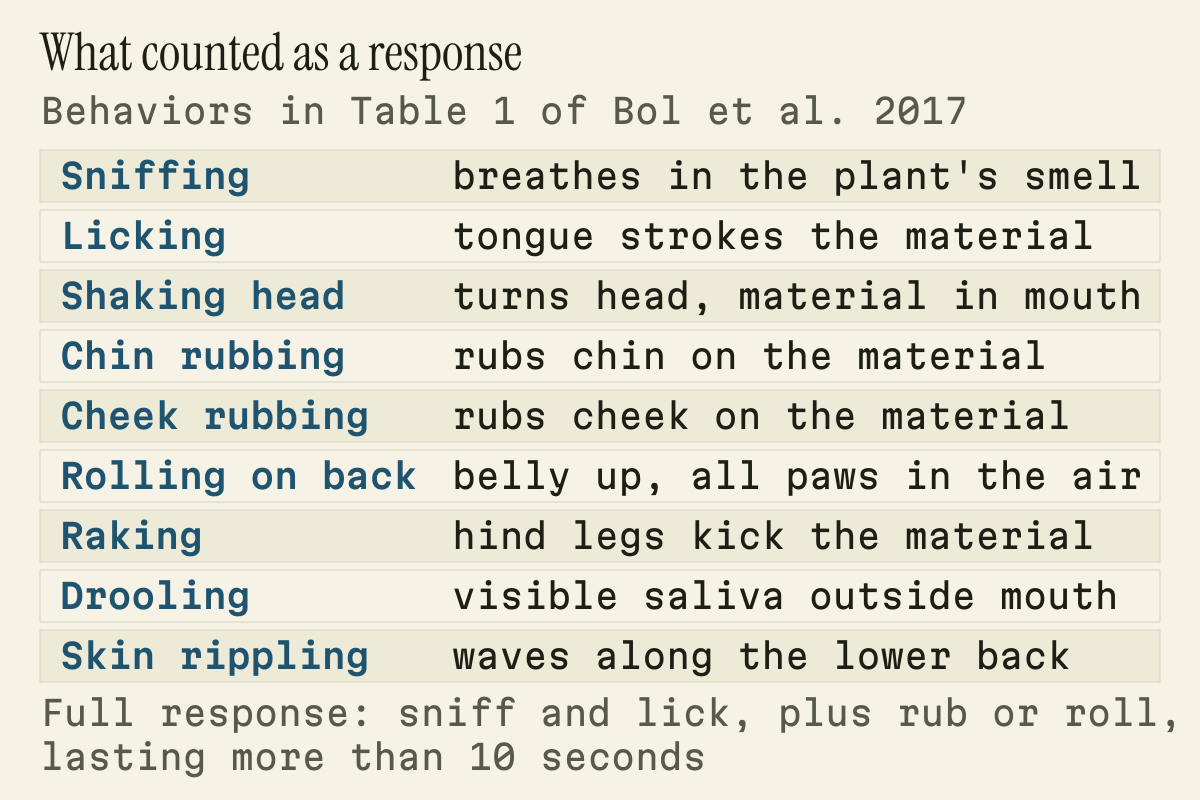
The behaviors listed in the 2017 study’s Table 1 as part of a positive response to any of the four plants.
Worked from Table 1 and the Scoring section of Bol et al. 2017; descriptions shortened for this page.
"Behaviors counted as a response, from Bol et al. 2017 Table 1" by Sniff, Purr, Preen & Shoal, https://sniffpurrpreenandshoal.com/cats/catnip/, licensed under CC BY 4.0 (https://creativecommons.org/licenses/by/4.0/)
Data: Bol et al. (2017), BMC Veterinary Research 13:70, CC BY 4.0
| Behavior | What the cat does |
|---|---|
| Sniffing | Breathes in the smell of the plant material |
| Licking | Strokes the material with its tongue |
| Shaking head | Turns its head side to side with the material in its mouth |
| Chin rubbing | Rubs its chin against the material |
| Cheek rubbing | Rubs its cheek against the material |
| Rolling on back | Rolls belly up with all paws in the air |
| Raking | Kicks the held material with one or both hind legs |
| Drooling | Produces saliva visible outside the mouth |
| Skin rippling | Skin along the lower back moves in waves |
The study scored two levels of response. A full response meant sniffing and licking plus chin or cheek rubbing or rolling over, lasting more than 10 seconds. A mild one meant sniffing and licking alone for more than 15 seconds without a break, or a full response that lasted under 10 seconds.
The rippling skin was new to the authors. They write that, to their knowledge, it had not been described before and that the waves “only lasted a few seconds.” They also note the response to all four plants looked like the catnip response described in earlier work.
There is a limit to keep in mind. One researcher scored 98 of the 100 cats mixed live, knowing which plant was being offered, and scored the other 2 from video. The plants also came in different forms and amounts, chosen so that each cat would get enough of the active compounds to respond.
The study tested big cats too. Of nine tigers, one gave a mild response to catnip and the other eight ignored it; five backed away from silver vine. Four bobcats offered silver vine and one offered catnip all responded, rolling and rubbing for several minutes.
How cats respond to a person’s face is a different question; cat slow blink covers a cat signal measured in cats’ own homes.
What is in the plant?
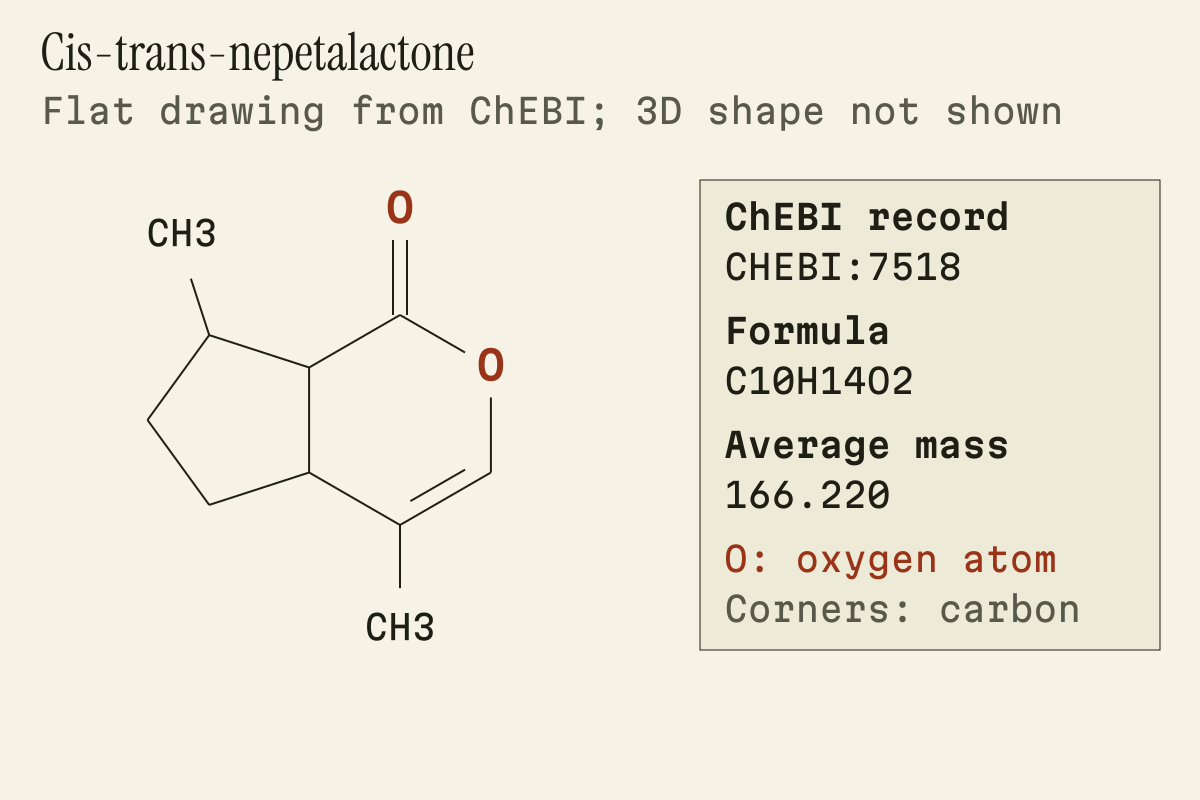
Cis-trans-nepetalactone, the compound the 2017 study measured most of in catnip, drawn flat from the ChEBI record; the 3D arrangement of the atoms is not shown.
Worked from The ChEBI record CHEBI:7518 (formula, mass and structure string); drawn flat for this page.
"Cis-trans-nepetalactone, drawn from ChEBI CHEBI:7518" by Sniff, Purr, Preen & Shoal, https://sniffpurrpreenandshoal.com/cats/catnip/, licensed under CC BY 4.0 (https://creativecommons.org/licenses/by/4.0/)
Data: ChEBI, CHEBI:7518 cis-trans-nepetalactone, CC BY 4.0
Citing earlier work, the 2017 paper says the catnip effect comes from the plant’s smell rather than its taste, and names nepetalactone as the compound identified in the early 1940s as its cause. ChEBI, a chemistry database run by the European Bioinformatics Institute, lists cis-trans-nepetalactone with the formula C10H14O2 and describes it as an iridoid monoterpenoid, one of a family of ten-carbon compounds, “isolated from several Nepeta plant species.” It also lists the compound as a cat attractant.
The study measured five compounds in each plant using gas chromatography with mass spectrometry, a lab method that separates and identifies the chemicals in an extract. Values are micrograms per gram of dried plant, from Table 3 of the paper:
| Compound | Catnip | Silver vine galls | Tatarian honeysuckle | Valerian root |
|---|---|---|---|---|
| cis-trans nepetalactone | 1,010 | 3 | 13 | 5 |
| trans-cis nepetalactone | 32 | 0 | 0 | 0 |
| actinidine | 11 | 290 | 108 | 172 |
| iridomyrmecin | 0 | 167 | 7 | 31 |
| isodihydronepetalactone | 55 | 164 | 7 | 0 |
The authors suggest cis-trans nepetalactone is the main, and possibly the only, compound in catnip that cats respond to. Silver vine galls held more of the other compounds, which may explain, in part, why some cats that did not respond to catnip still responded to them. The authors add that they could not identify every candidate compound, so others may be involved.
The direct evidence on single compounds is thin, by the paper’s own account. The early 1940s test that pointed to nepetalactone used seven adult lions, and it did not separate the two forms of the compound. Later studies on which form matters were, in the authors’ words, “of poor quality.”
Why a plant makes these chemicals at all has an answer that has nothing to do with cats. The paper describes them as substances a plant releases to fend off plant-eating insects, or to draw in the insects’ predators. Silver vine galls form after a midge lays eggs in the flower buds, and the authors suggest the plant raises these compounds in response. Cats, in this account, are a side effect.
Is silver vine safe?
The 2017 study measured which cats responded, not what the plants do to a cat’s health. Its authors note that no safety data specific to cats are available, but that all four plants in the study are generally regarded as safe, and as neither toxic nor addictive, for cats and people. This page gives no amounts or safety advice for any plant; questions about what a cat can safely eat or sniff belong with a veterinarian.
Other cat behaviors raise the same gap between tests and stories; cat attachment studies sets two attachment studies with different answers side by side.
Much is still unknown. As of 2026-11-20, no independent repeat of the four-plant comparison turned up among the sources read, and the 2017 authors call for well-controlled studies that expose cats to pure, isolated compounds. The 2017 study did not test which compound sets off which cat, why some cats ignore catnip, or why tigers turn away from silver vine.
Sources
- Bol S, Caspers J, Buckingham L, Anderson-Shelton GD, Ridgway C, Buffington CAT, Schulz S, Bunnik EM (2017). “Responsiveness of cats (Felidae) to silver vine (Actinidia polygama), Tatarian honeysuckle (Lonicera tatarica), valerian (Valeriana officinalis) and catnip (Nepeta cataria).” BMC Veterinary Research 13:70. doi.org/10.1186/s12917-017-0987-6Read: Full text, open license; CC BY 4.0Text license: CC BY 4.0 (terms)
- ChEBI (Chemical Entities of Biological Interest), European Bioinformatics Institute. “cis-trans-nepetalactone (CHEBI:7518).” www.ebi.ac.uk/chebi/CHEBI:7518Read: Full text, open license; CC BY 4.0, entry pageText license: CC BY 4.0 (terms)
Cite this page
Sniff, Purr, Preen & Shoal. “Why Do Cats Like Catnip? One Study: 32 of 99 Didn’t Respond.” Published November 20, 2026. https://sniffpurrpreenandshoal.com/cats/catnip/. Accessed on the day you read it.
How studies are read and numbers recheckedMending basket: every correctionReport an error on this page (contact@sniffpurrpreenandshoal.com)
More from Cat Minds
Purr Research story
How Do Cats Purr? A 2023 Abstract Points to the Larynx
Picture credit
"Domestic cat napping with three playful kittens and a saucer on the right (detail)" by Joseph Brodtmann (lithographer) after Gottfried Mind (artist); Library of Congress Prints and Photographs Division (pga.05433) — https://commons.wikimedia.org/wiki/File:Domestic_cat_napping_with_three_playful_kittens_and_a_saucer_on_the_right_LCCN2012645542.jpg — Public domain (EU: Gottfried Mind died 1814 and Joseph Brodtmann died 1862, more than 70 years ago (life plus 70 years); US: published before 1931); modified: cropped to the cat, the three kittens, the ribbon and the saucer (columns 860 to 4,660 and rows 1,260 to 2,700 of the original's 5,324 x 3,934 px; the plate number, pencil marks and blank paper around the group are left out; 2026-11-20)
Purr Research story
Do Cats Love Their Owners? What Attachment Studies Found
Picture credit
"Poes met vijf spelende jongen (Cat with five playing kittens), etching by Petrus Johannes Arendzen after Henriëtte Ronner-Knip" by Petrus Johannes Arendzen (etcher) after Henriëtte Ronner-Knip (painter); Rijksmuseum (RP-P-1909-1552) — https://commons.wikimedia.org/wiki/File:Poes_met_vijf_spelende_jongen,_RP-P-1909-1552.jpg — CC0 1.0 (https://creativecommons.org/publicdomain/zero/1.0/)
Purr Research story
Why Do Cats Make Biscuits? Two Old Books Point to Nursing
Picture credit
"Four Cats in Different Poses (detail), from the series Tatoe-zukushi no uchi, by Utagawa Kuniyoshi" by Utagawa Kuniyoshi; Wikimedia Commons (source: visipix) — https://commons.wikimedia.org/wiki/File:Kuniyoshi_Utagawa,_For_cats_in_different_poses.jpg — Public domain (EU: Utagawa Kuniyoshi died 1861, more than 70 years ago (life plus 70 years); US: published before 1931; faithful reproduction of a two-dimensional print); modified: cropped to the lower half of the sheet (full width, rows 1,530 to 3,117: 1,587 of 3,117 px of the original's height; top edge moved down 2026-11-20 so the pink object above the two cats is left out)