Sense Research story
Whisker Fatigue: One Bowl Study, No Clear Change in Eating
Sniff, Purr, Preen & Shoal Published
TL;DR
Whisker fatigue is the idea that touching or crowding a cat's whiskers distresses it. In one 2020 study of 38 cats pet homes, a wide, shallow dish did not significantly change time at the bowl, dropped food or intake in a filmed meal of up to 5 minutes, though 24 of 38 owners said the cat chose it. Longer meals and other dishes are untested in the sources read.
Doorplate
- Animal
- Indoor pet cats aged 1 to 12 years (median 7.5), presumed healthy and not on medication, eating dry food from a ceramic or stainless steel dish
- Study
- Slovak & Foster 2020, Journal of Feline Medicine and Surgery
- n (analysed / excluded)
- 38 / 2 (40 enrolled; 2 left out because their meals could not be filmed)
- Couch sample
- pet homes client-owned indoor cats, filmed by their owners at home
- Limits
- One study; owners knew which dish was in use; one filmed meal of up to 5 minutes after 12 hours without food; dish placement not controlled in the choice test; health not checked beyond a brief exam
- Setup in one line
- Each cat's usual dish, then 7 days on a wide, shallow whisker-friendly dish; time at the bowl, kibbles dropped and food eaten compared
- Replicated?
- As of 2026-11-20, no repeat among the sources read
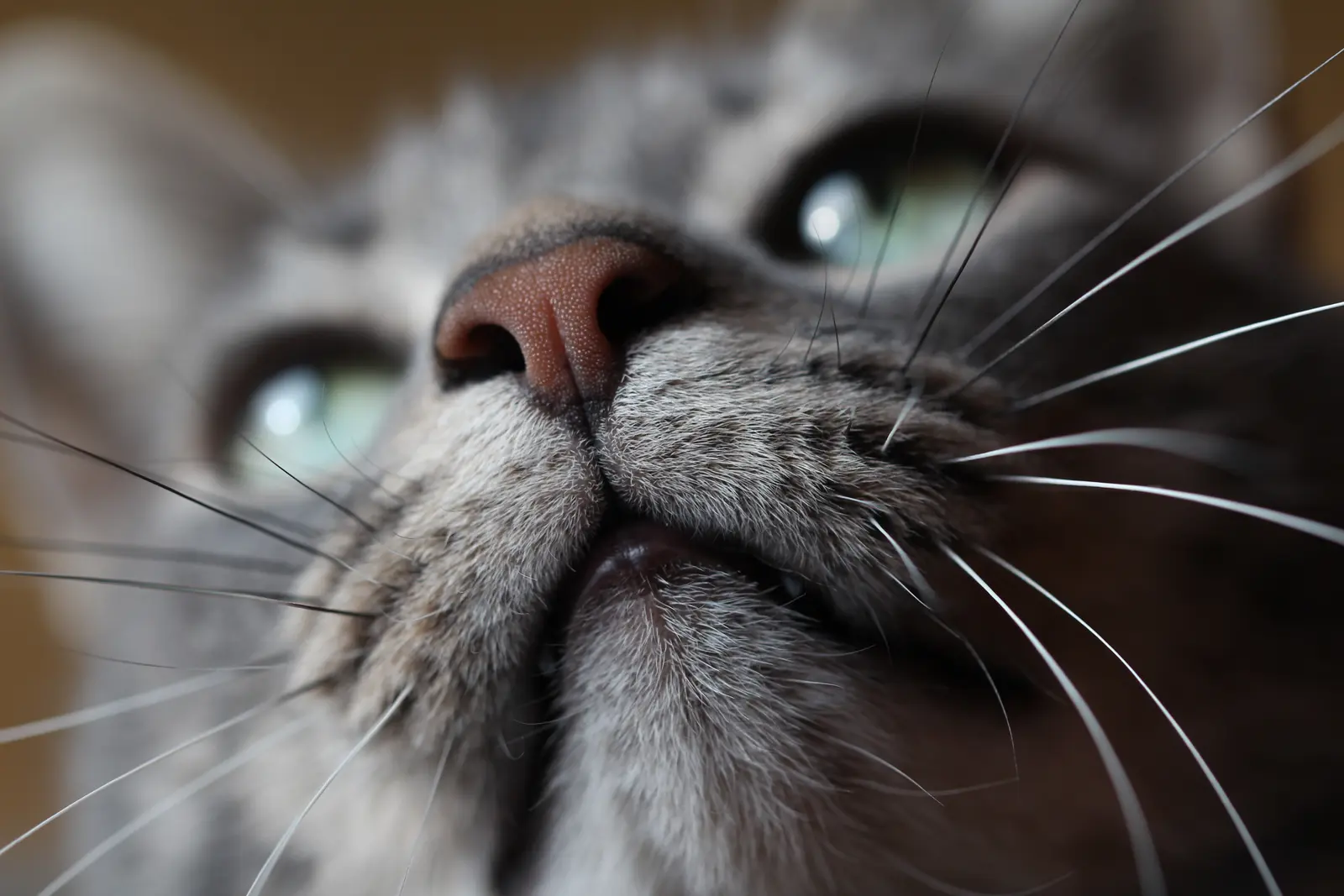
A gray tabby cat's muzzle seen from below, in a photo published in 2017. A still picture shows where the whiskers sit, not how a cat uses them at a meal.
"Whisker Face" by Kevin Knezic kknezic (Unsplash) — https://commons.wikimedia.org/wiki/File:Whisker_Face_(Unsplash).jpg — CC0 1.0 (https://creativecommons.org/publicdomain/zero/1.0/)
Your cat eats from the middle of the bowl and leaves a ring of kibble around the edge. Some dishes are advertised as easing whisker fatigue because they are shallow and wide. In a study published in 2020, Jennifer Slovak of The Animal Medical Center in New York and Taylor Foster of Washington State University enrolled 40 indoor cats pet homes, and 38 of them finished.
Their owners filmed a meal from the cat's usual dish, then a meal from a dish sold as whisker-friendly. The comparison covered three things a cat's eating can show: how long it stayed at the bowl, how much it dropped and how much it ate.
What is whisker fatigue said to be?
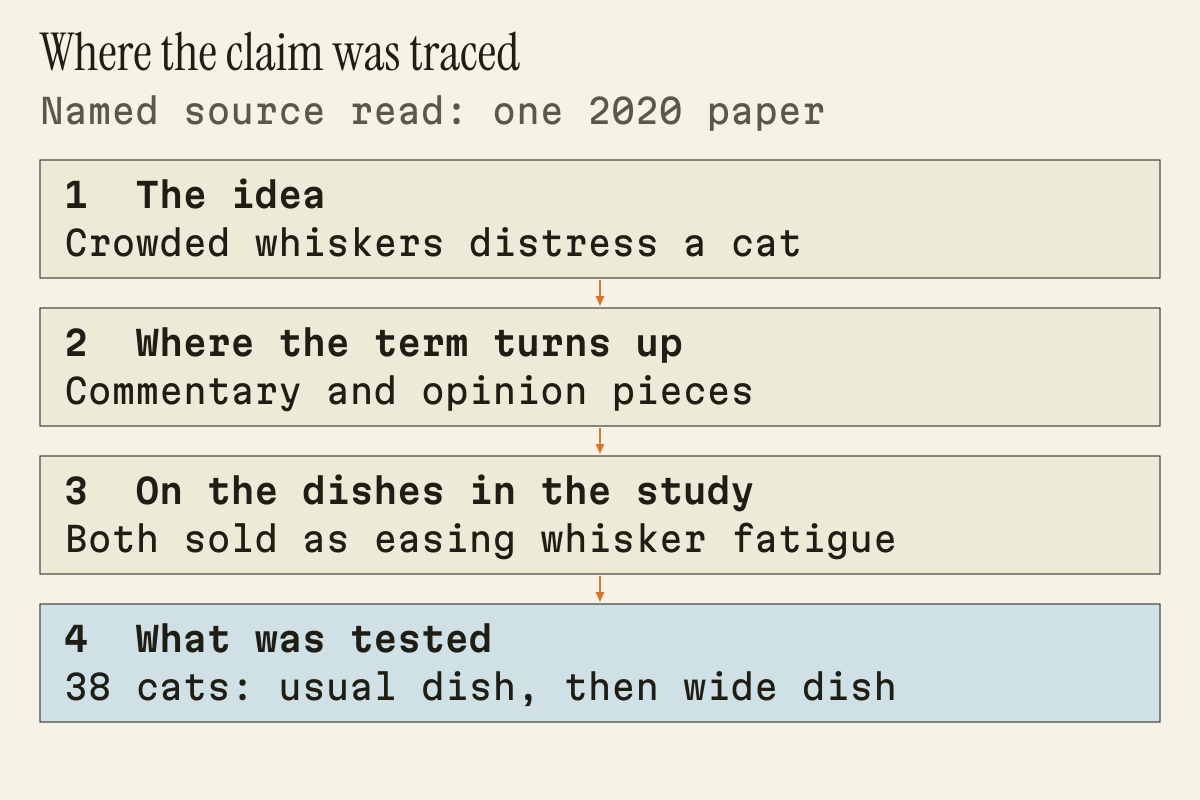
How the claim was traced on this page, from one named source: the 2020 bowl study's own introduction and its description of the dishes it used.
Worked from The introduction and the study-bowl section of Slovak & Foster 2020, read in full, no open license.
This figure in words
- The idea: touching or crowding a cat's whiskers distresses it; the paper treats whisker stress and whisker fatigue as two names for the same thing.
- Where the term turns up: by the authors' account, in commentary, perspective and opinion pieces, with very little clinical research behind it.
- On the dishes: both dishes used in the study were advertised as easing whisker fatigue because they were shallow and wide.
- What was tested: 38 cats eating from their usual dish and from a wide dish.
"Where the whisker fatigue claim was traced" by Sniff, Purr, Preen & Shoal, https://sniffpurrpreenandshoal.com/how-they-sense/whisker-fatigue/, licensed under CC BY 4.0 (https://creativecommons.org/licenses/by/4.0/)
Data: Slovak & Foster (2020), Journal of Feline Medicine and Surgery 23(4):389-392, facts restated
The 2020 paper describes the belief in its first lines: some animal behaviorists, scientists, veterinarians and owners hold that stimulating a cat's whiskers, or getting in their way, causes distress. The paper calls this whisker stress or whisker fatigue and uses the two names for one idea.
The authors also say where the term turns up in print. By their account, the name whisker stress is found only in commentary, perspective and opinion writing, and very little clinical research supports its existence or its effect on pet cats. The sources read for this page do not say where or when the phrase began, so this page makes no claim about its origin.
The study dishes carry the claim too. Both were commercially advertised as easing whisker fatigue because they were shallow and wide. The paper gives their sizes as 14 × 15 × 3.5 cm for the ceramic dish and 10 × 19 × 1 cm for the stainless steel one. Every cat's usual dish was narrower and deeper than the study dish it was matched with.
What are whiskers for?
The paper's introduction sums up earlier anatomy work, which was not read for this page. Whiskers, or vibrissae, are described there as specialized facial hairs. Each grows from a follicle–sinus complex, the name for the whisker root and the structures packed around it, with its own blood vessels and nerve fibers that carry sensory signals from the face to the brain.
In that summary, whiskers help a cat judge the space and objects around it, and a cat can sweep them forward and pull them back. A different question about how a cat handles space, how a falling cat turns in the air, is covered in the cat righting reflex.
None of that anatomy shows that a dish can tire or hurt whiskers. The authors call it plausible that unwanted contact could cause stress, then set out to test one form of the claim.
What did the bowl study do?
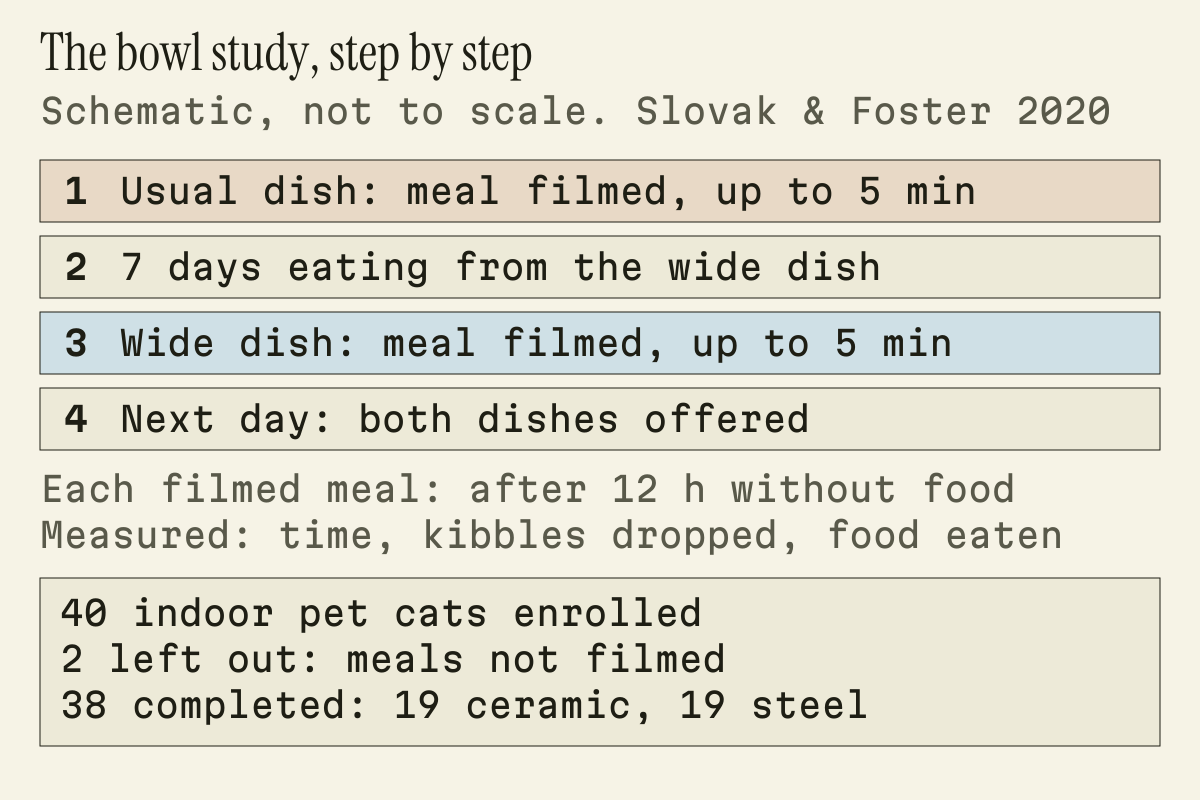
Schematic, not to scale: each cat ate a filmed meal from its usual dish, spent 7 days on the whisker-friendly dish, ate a second filmed meal, then was offered both dishes the next day.
Worked from The Materials and methods and the Results of Slovak & Foster 2020, read in full, no open license; drawn as plain shapes, not to scale.
"Design of the whisker-friendly dish study, Slovak & Foster 2020" by Sniff, Purr, Preen & Shoal, https://sniffpurrpreenandshoal.com/how-they-sense/whisker-fatigue/, licensed under CC BY 4.0 (https://creativecommons.org/licenses/by/4.0/)
Data: Slovak & Foster (2020), Journal of Feline Medicine and Surgery 23(4):389-392, facts restated
The cats were indoor pets aged 1 to 12 years, with a median of 7.5. They were presumed healthy, were on no medication and ate dry food from a stainless steel or ceramic dish. At a first visit to the hospital, each cat had a brief physical exam, its whiskers above the eyes and on the muzzle were measured, and the cat was photographed from the front and side.
Each cat then got a whisker-friendly dish of the same material as its own, so 19 cats pet homes had ceramic dishes and 19 had stainless steel. Matching the material was meant to keep a cat's liking for one surface out of the comparison.
How were the meals filmed?
The owners did the filming in the cats' own homes. The study protocol, set by the researchers with the owners' written consent, had each cat go 12 hours without food before a filmed meal; this was part of the research design, not a step for anyone to copy. The owner then served the usual measured dry food and filmed the cat for up to 5 minutes, or until it walked away, and noted how much it ate and how many kibbles it dropped.
After 7 days of meals from the new dish, the same filmed meal was repeated with it. The next day, the owners set both dishes down side by side, with no set left or right position, to see which one the cat chose. The second author watched every video to time each meal and check the dropped food. Food eaten was recorded in cups and dropped food as a count of kibbles, and the two dishes were compared in a linear statistical model.
Of the 40 cats enrolled pet homes, 2 were left out because their owners could not film them eating, so the results rest on 38 cats. There were 15 spayed females and 23 neutered males: 26 domestic shorthairs, 8 domestic longhairs, 2 domestic medium hairs and 2 Maine Coons.
Running the test at home kept each cat in its own setting, which the authors chose on purpose. The cost is control: owners filmed and counted, and they knew which dish was in use. A single test room can hold more of that fixed, as in the screen test behind dog color vision.
What did it find?
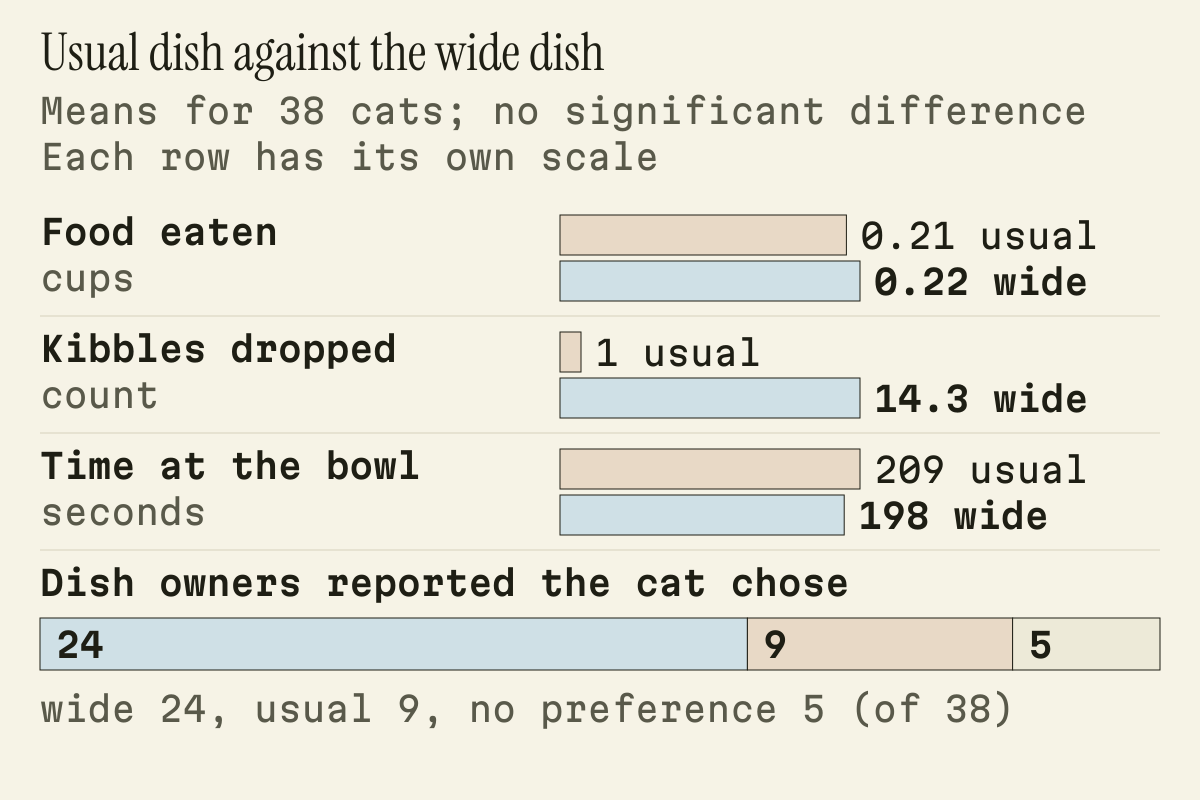
Means for the 38 cats in one 2020 study, each row on its own scale; the bottom bar shows which dish owners reported the cat chose when both were offered.
Worked from Means in Table 1 and the preference counts in the Results of Slovak & Foster 2020, read in full, no open license; the 24, 9 and 5 add up to 38, and 24 of 38 is 63%, as the paper reports.
"Results of the whisker-friendly dish study, Slovak & Foster 2020" by Sniff, Purr, Preen & Shoal, https://sniffpurrpreenandshoal.com/how-they-sense/whisker-fatigue/, licensed under CC BY 4.0 (https://creativecommons.org/licenses/by/4.0/)
Data: Slovak & Foster (2020), Journal of Feline Medicine and Surgery 23(4):389-392, numbers restated
| Measure, mean (SD), 38 cats | Usual dish | Whisker-friendly dish | Reported difference |
|---|---|---|---|
| Food eaten, cups | 0.21 (0.07) | 0.22 (0.07) | not significant, P = 0.7 |
| Kibbles dropped | 1 (2.2) | 14.3 (26.6) | not significant, P = 0.9 |
| Time at the bowl, seconds | 209 (68) | 198 (75) | not significant, P = 0.8 |
Download the study table (CSV) (what the file holds) Data: Slovak & Foster (2020), Journal of Feline Medicine and Surgery 23(4):389-392, facts and numbers only
With the whisker-friendly dish, the 38 cats pet homes did not spend significantly more time eating, drop significantly less food or eat significantly more in the 5-minute window, the three changes the whisker fatigue idea predicts. Food eaten edged up from 0.21 to 0.22 cups, a gap the authors found not significant.
The dropped-food row runs the other way on paper: a mean of 14.3 kibbles with the new dish against 1 with the usual one. The spread was wide, with a standard deviation of 26.6, and the authors found no significant difference. The study also could not separate food dropped from a cat's mouth from food pushed off the dish.
That P = 0.9, like the P = 0.8 for time at the bowl, is given as printed: a simple test on Table 1's means and SDs would not give values that high, and the paper does not detail its model.
Intake had little room to rise for many of the cats. Only 12 of the 38 ate more from the whisker-friendly dish, and 18 of the 38 ate their whole measured meal from both dishes, so their totals could not go up.
Do owners prefer wide bowls?
When both dishes were set down together, the owners of 24 of the 38 cats pet homes reported that the cat chose the whisker-friendly dish, or 63%. Nine cats chose their usual dish and 5 showed no preference. The authors' model put the estimated probability of choosing the new dish at 0.74.
The authors themselves urge caution. The cats had not been tested for a left or right preference, so the dish nearer the cat may have won some choices, and the new dish may have drawn cats simply because it was new. That choice was also reported by owners who knew which dish was which.
What the five-minute test could not show
The study watched one short meal, while cats usually eat several small meals a day. The authors chose 5 minutes to make filming easier for owners and to catch a cat's first drive to eat. They note that 12 hours without food may have made the cats hungry enough to ignore any unpleasant feeling at the whiskers, and may have shaped which dish they chose.
Health was not checked beyond the brief exam and what owners knew. Some cats could have been off their food or nauseated from an illness nobody had found. The authors also suggest that older cats may have grown used to whisker contact while eating, and that a study of younger cats could test that.
Is whisker fatigue real?
In this sample of 38 pet cats, switching to a wide, shallow dish did not significantly change eating in the ways the idea predicts, over one filmed meal of up to 5 minutes. The study measured eating, not distress, and it is one study. If a cat eats less, drops food or seems stressed at meals, ask a veterinarian; this page does not diagnose or recommend bowls.
Much is still unknown. As of 2026-11-20, no repeat of the study turned up among the sources read. Whether whisker contact bothers any cat over a full day of meals, without a 12-hour wait first, with other dish shapes or with younger cats was not measured in the sources read, and the authors call for more research. How much of each source was read for this page is set out on Sniff test.
Sources
- Slovak JE, Foster TE (2020). “Evaluation of whisker stress in cats.” Journal of Feline Medicine and Surgery 23(4):389–392. doi.org/10.1177/1098612X20930190Read: Full text, read only; facts restated, no text, tables or figures reproduced
Cite this page
Sniff, Purr, Preen & Shoal. “Whisker Fatigue: One Bowl Study, No Clear Change in Eating.” Published November 20, 2026. https://sniffpurrpreenandshoal.com/how-they-sense/whisker-fatigue/. Accessed on the day you read it.
How studies are read and numbers recheckedMending basket: every correctionReport an error on this page (contact@sniffpurrpreenandshoal.com)
More from How They Sense the House

Sense Mechanism explainer
Can Dogs See Color? Yes, With Two Cone Types, Not Three
Picture credit
"A Golden Retriever lying on grass" by Barras — https://commons.wikimedia.org/wiki/File:A_Golden_Retriever-9_(Barras).JPG — CC BY 3.0 (https://creativecommons.org/licenses/by/3.0/)

Sense Mechanism explainer
Dog Sense of Smell: A 2010 Model Traces a Sniff’s Side Path
Picture credit
"Dog Pointing a Partridge, by Jean-Baptiste Oudry" by Jean-Baptiste Oudry; Hermitage Museum, Saint Petersburg (inv. 2528) — https://commons.wikimedia.org/wiki/File:Jean-Baptiste_Oudry_-_Dog_Pointing_a_Partridge_-_WGA16781.jpg — Public domain (EU: Jean-Baptiste Oudry died 1755, more than 70 years ago (life plus 70 years); US: published before 1931; faithful photographic reproduction of a two-dimensional work)
Sense Mechanism explainer
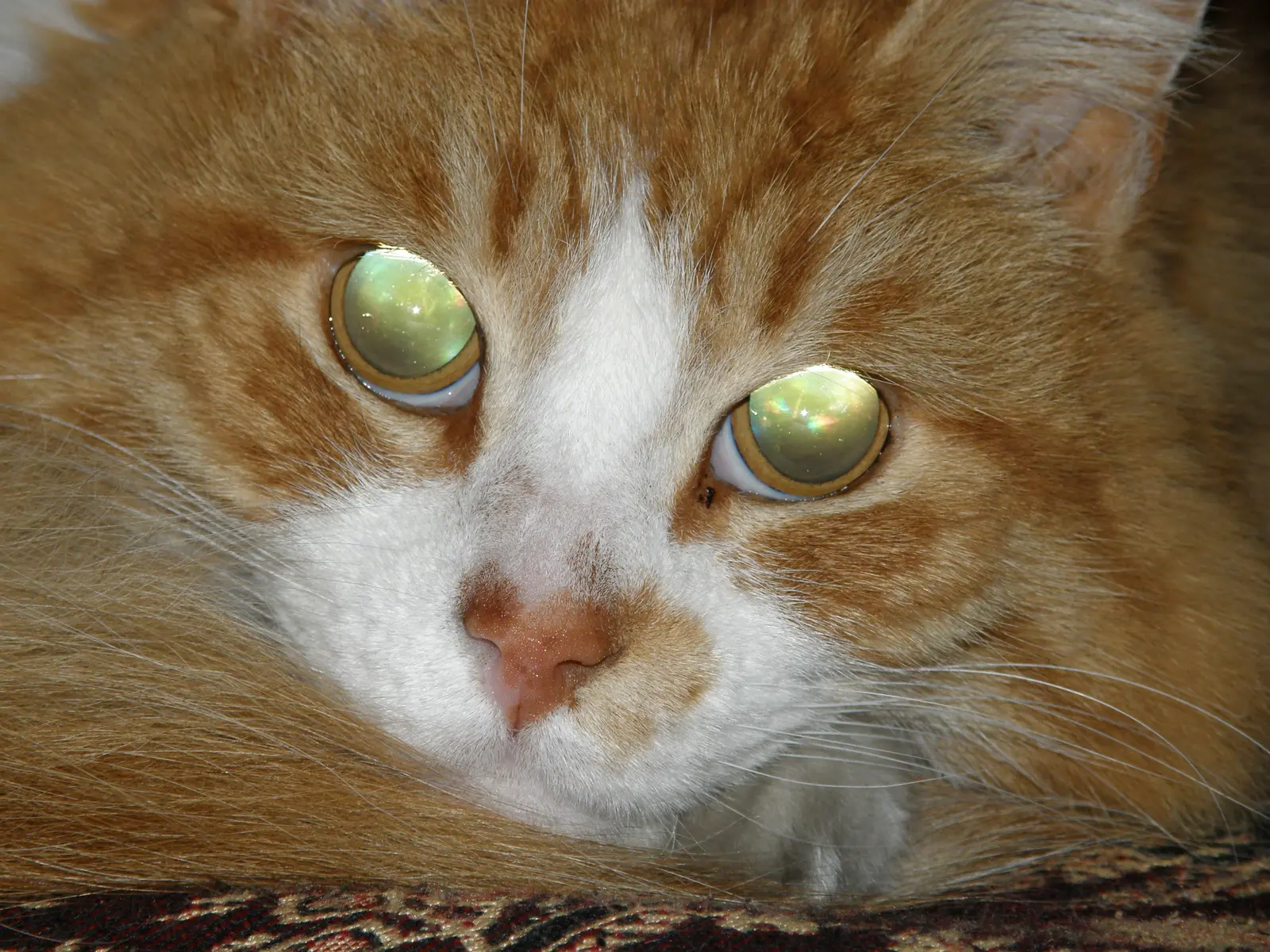
Can Cats See in the Dark? Why Their Eyes Shine Back at You
Picture credit
"Tapetum lucidum en gato" by Dropus — https://commons.wikimedia.org/wiki/File:Tapetum_lucidum_gato.jpg — CC BY 3.0 (https://creativecommons.org/licenses/by/3.0/)