Sense Mechanism explainer
How Do Cats Land on Their Feet? Marey Photographed the Twist
Sniff, Purr, Preen & Shoal Published
TL;DR
A falling cat can turn feet-down in midair with nothing to push against: Étienne-Jules Marey's 1894 photographs show the front half turning first, then the rear. He called “always on its feet” a popular saying; the photographs explain the turn, not whether falls end well. Unknown from the sources read here: how a falling cat senses which way is down.
Doorplate
- Animal
- Domestic cat; the note says the same turn was also seen in rabbits and dogs, with no numbers given
- Study
- Marey, 1894, Comptes rendus de l'Academie des sciences
- n (analysed / excluded)
- Not stated in the note; two photo series of a cat are printed, one from the side and one along the body
- Couch sample
- cannot be assigned: the note does not say where the cat came from
- Limits
- One short note; photographs only, with no measured angles or forces; number, age and origin of the animals not stated
- Setup in one line
- Rapid-series photographs of the fall, replayed in a zoetrope; the note's example: pictures taken at 60 a second and shown at 10 a second run six times slower
- Replicated?
- As of 2026-11-20: no later study of the falling cat was read in full or in abstract for this page
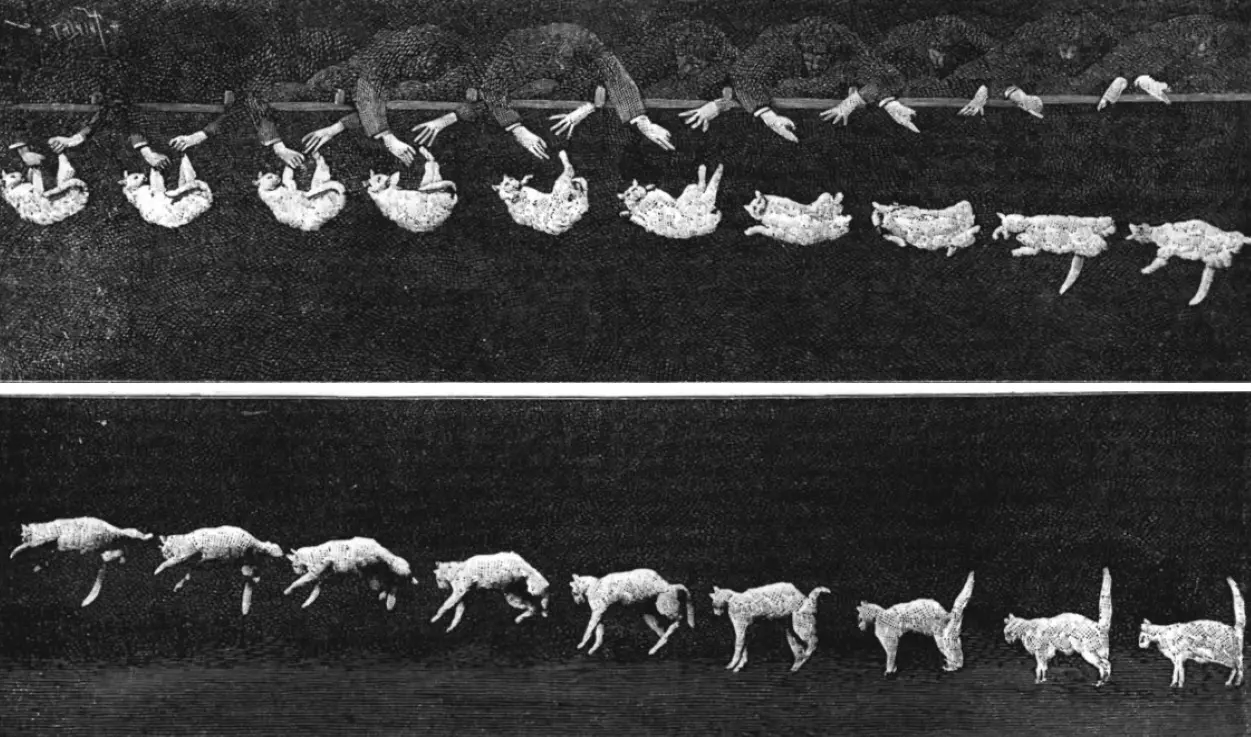
A print of the falling-cat sequence credited to Étienne-Jules Marey, 1894, read left to right: the cat starts upside down below the hands and ends standing. Where this print was first published has not been traced.
"Falling cat, 1894" by Étienne-Jules Marey; Wikimedia Commons — https://commons.wikimedia.org/wiki/File:Falling_cat_1894.jpg — Public domain (EU: Étienne-Jules Marey died 1904, more than 70 years ago (life plus 70 years); US: published before 1931; the engraver who signed the print is not identified and the print's first publication is not traced)
The cat drops from the bookshelf and lands on all four paws. In 1894 the French physiologist Étienne-Jules Marey photographed a falling cat in rapid series to discover how a landing like that comes about, and he reported the results in a four-page note in the Comptes rendus of the French Academy of Sciences. The note does not say where the cat came from, so a sample source cannot be assigned to it.
The note opens with the saying itself. Marey calls it “un dicton populaire d'après lequel un chat retomberait toujours sur ses pattes” (page 714; in this site's translation, a popular saying that a cat would always land on its feet). He then sets out to explain the mechanics of the turn, not to count successful landings.
What did Marey's photographs show?
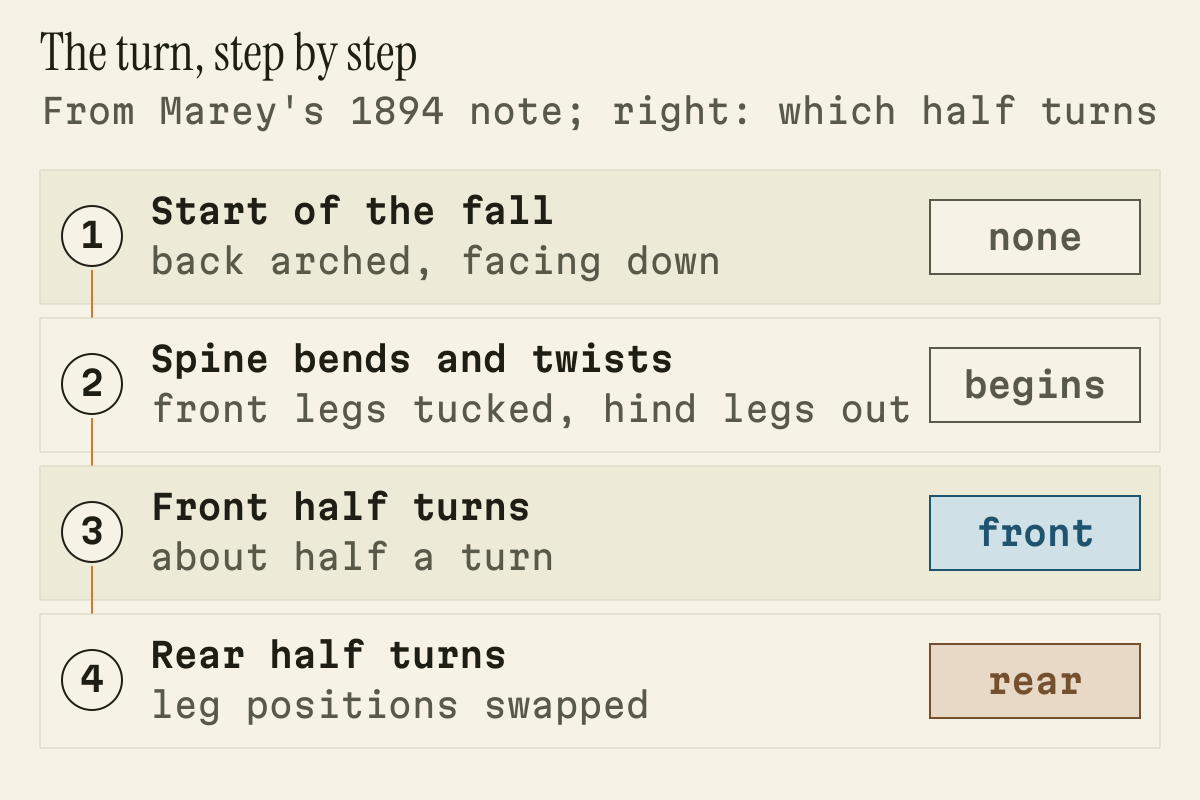
The order of the turn as Marey's 1894 note describes his photographs: the front half turns first, the rear half second. The note gives no timings, so the steps are not drawn to a time scale.
Worked from The description of the photographs in Marey 1894, Comptes rendus volume 119, pages 715 to 716; no values computed.
This figure in words
the four steps, in the order Marey describes them.
- Start of the fall: the back is arched, curving toward the ground, and the cat has not begun to turn.
- The spine straightens, bends the other way and twists, and the turn begins with the twist; the front legs are drawn in close to the neck and the hind legs are held out.
- The front half turns, almost on its own, until it has gone about half a turn.
- The rear half turns, with the leg positions swapped.
"Order of a falling cat's turn, from Marey's 1894 note" by Sniff, Purr, Preen & Shoal, https://sniffpurrpreenandshoal.com/how-they-sense/cat-righting-reflex/, licensed under CC BY 4.0 (https://creativecommons.org/licenses/by/4.0/)
Data: Marey (1894), Comptes rendus de l'Académie des sciences 119:714-717, public domain
How the camera slowed the fall
Marey worked at the Station physiologique, where he studied the locomotion of animals, and he writes that certain movements happen too quickly for the eye to follow, the turn of a falling animal among them. To capture the successive phases, he used chronophotography, a camera that records a rapid series of pictures on a single moving strip of film.
The note explains the gain with an example: if the photographs are taken at 60 images a second, they can be shown in a zoetrope, a spinning drum that plays a loop of pictures, at only 10 images a second. The motion still looks smooth but runs six times slower than in real life, and each turn of the drum shows the same fall again, so the details can be studied over and over.
The note prints two series of photographs of a cat: figure 1 shows the animal from the side, and figure 2 shows it seen along the length of its body. According to the text, the images read from right to left, each one a later stage of the fall and the turn, and the two views complement each other so that together they make the movement clear.
What the strips show
Marey describes the sequence in some detail. At first the cat's back is strongly arched, with the curve pointing toward the ground, and then the animal straightens its spine and bends it in the opposite direction. At the same moment the spine twists, and the muscular effort tends to rotate the front and the rear of the body in opposite directions.
The two halves do not rotate equally. In Marey's words, the turn “porte d'abord presque exclusivement sur l'avant-main” (page 716; this site's translation: at first it falls almost entirely on the forequarters), and only when the front half has completed about half a turn does the rear half follow.
The cat was not the only animal mentioned in the note. Marey writes that he had observed the same turn in other species, naming the rabbit and the dog as examples, so although the saying concerns cats, the turn, by his account, is not theirs alone.
Why not a push off the hands or the air?
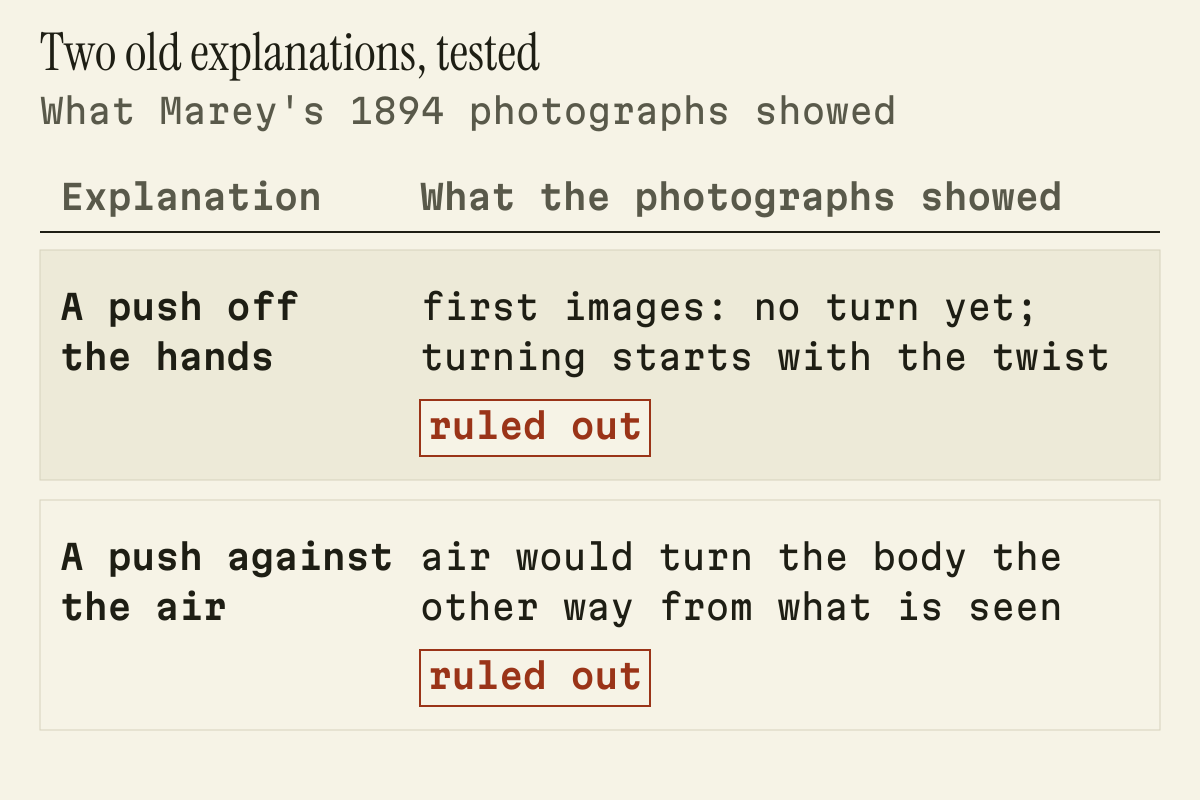
Two explanations that were offered before the photographs, and what Marey's 1894 note says the photographs showed about each.
Worked from Marey 1894, Comptes rendus volume 119, pages 714 to 716; no values computed.
This figure in words
the two explanations and Marey's answer.
| Explanation | What the photographs showed | Verdict in the note |
|---|---|---|
| The cat pushes off the hands that let it go | In the first images of both series, no turn has begun; turning starts with the twist of the lower back | Ruled out |
| The cat pushes against the air with quick movements | Given the way the cat moves, any real push from the air would turn it the opposite way from the turn seen | Ruled out |
"Two older explanations of the falling cat's turn and what Marey's photographs showed" by Sniff, Purr, Preen & Shoal, https://sniffpurrpreenandshoal.com/how-they-sense/cat-righting-reflex/, licensed under CC BY 4.0 (https://creativecommons.org/licenses/by/4.0/)
Data: Marey (1894), Comptes rendus de l'Académie des sciences 119:714-717, public domain
To a scientist of 1894, the turn looked like a contradiction. Marey calls it “quelque chose de paradoxal” from the mechanical point of view (page 714; this site's translation: something paradoxical), because a falling animal has no external support to push against while it is in the air.
Marey reports that people had proposed two ways around the contradiction, starting on page 714: “Quelques personnes ont pu croire que l'animal, au moment où on le lâche, prend appui sur les mains de la personne qui le tenait suspendu.” In this site's translation: some people may have believed that the animal, at the moment it is let go, pushes against the hands of the person who was holding it up; others supposed that, with sudden movements, the animal found support against the resistance of the air.
The photographs answered the first explanation directly. In the first images of each series, Marey writes, the animal shows no tendency yet to rotate in either direction, and its turn begins only with the twisting of its lower back, so if the hands had started the cat spinning, the spin would appear in those first images.
The explanation based on the air failed for a different reason. Given the direction in which the cat moves its body, Marey argues, any noticeable resistance from the air would rotate it in the opposite direction from the turn that the photographs actually record.
What turned the cat, then?
That left the cat's own body. Marey gives his answer in a single sentence on page 716: “C'est sur l'inertie de sa propre masse que l'animal prend des appuis successifs pour se retourner.” In this site's translation: the animal turns over by bracing, one support after another, against the inertia of its own body.
Inertia here means resistance to being set rotating. During the first part of the turn, Marey writes, the front legs are shortened and held close to the neck, so the front half offers very little resistance, while the hind legs stretch out almost at right angles to the body, so the rear half resists considerably. The twist therefore rotates the front a great deal and the rear only slightly, and in the second part the legs exchange roles, so the front half becomes the brace.
How can a cat turn with nothing to push against?
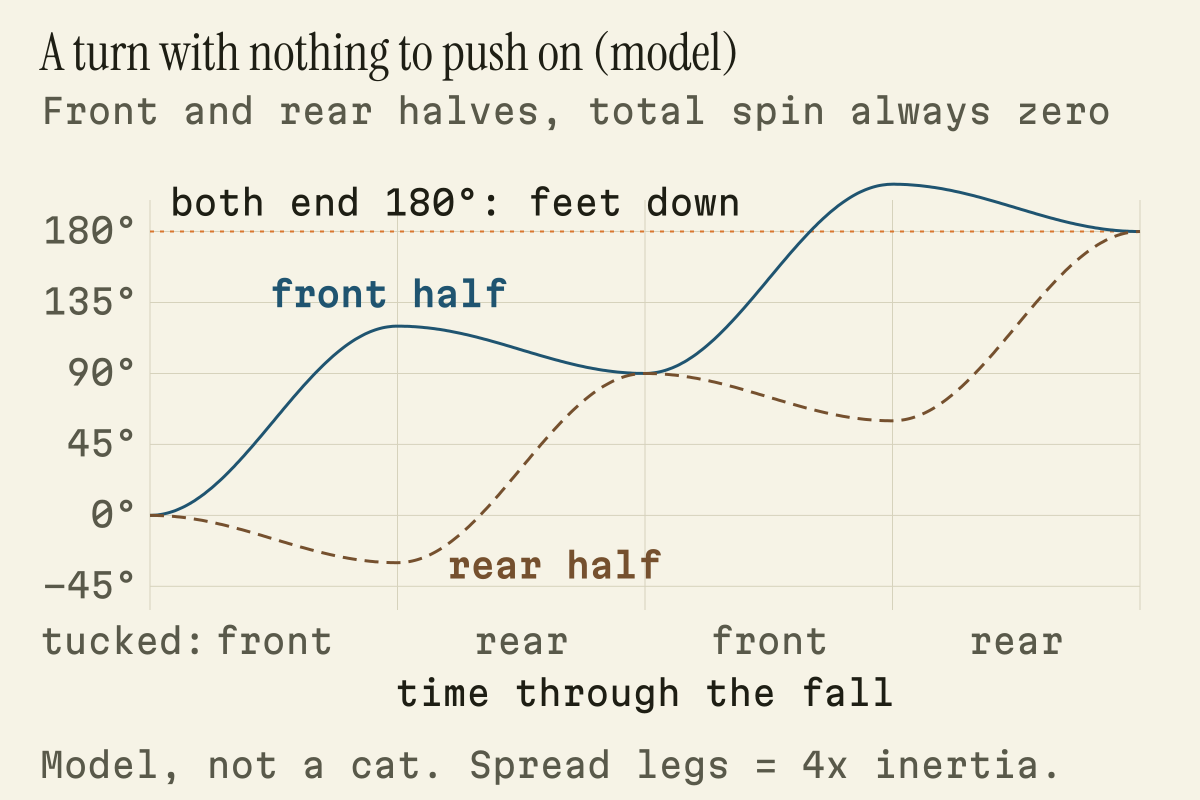
In this model, two rigid halves twist against each other while their total spin stays at zero; the half with spread legs has four times the inertia of the tucked half, and after two cycles both halves end turned over. The proportions are chosen for illustration, not measured on a cat.
Worked from A two-part model with total spin held at zero throughout; both halves end turned 180 degrees.
"Falling-cat model: front and rear halves turn in alternation" by Sniff, Purr, Preen & Shoal, https://sniffpurrpreenandshoal.com/how-they-sense/cat-righting-reflex/, licensed under CC BY 4.0 (https://creativecommons.org/licenses/by/4.0/)
Data: Model computed for this site; rule after Guyou (1894) and leg positions after Marey (1894), Comptes rendus de l'Académie des sciences 119, public domain
Marey credits the explanation to a fellow member of the Academy, Commandant Guyou, calls it very simple and entirely satisfactory, and asks Guyou to present it in mathematical form. Guyou's note follows directly after Marey's in the same issue. It begins by admitting that at first sight the turn seems impossible, because every point of the body has rotated half a turn around the long axis.
The resolution, Guyou explains, is that the total spin depends on the intermediate steps, not only on where the body starts and finishes. When the cat twists, the half with its legs extended has the larger inertia and rotates less, and the forward turn of the tucked half and the backward turn of the extended half stand in inverse ratio to their inertias. When the legs exchange positions and the twist reverses, the other half gains, and the two halves together finish turned forward by the difference.
Guyou's point is that two totals can behave differently. The total spin of the body, which he measures in what mathematicians then called areas, stays at zero from start to finish. The total angle turned does not have to. Because the forward turns are bigger than the backward ones, the angle keeps growing, and the body comes round a little more with each pair of twists.
Putting numbers on the rule
This site's model applies that rule with specific numbers. It is a simplified sketch that treats the cat as two rigid halves, front and rear, which can twist about one shared long axis, and because nothing external pushes on them, their total spin, the angular momentum in this model, remains at zero throughout.
In the model, the half with extended legs has four times the inertia of the tucked half, a ratio chosen for illustration. Each twist of 150 degrees, also a value chosen for this model, rotates the tucked half 120 degrees forward and the extended half 30 degrees back, which matches Guyou's rule with a ratio of 4 to 1.
Then the legs swap and the twist runs back. Now the rear half turns 120 degrees forward and the front half slips back 30. After one full cycle, both halves have gained 90 degrees in the same direction, though the body as a whole never had any spin.
| Model phase | Tucked half | Front half turns (degrees) | Rear half turns (degrees) |
|---|---|---|---|
| 1 | front | 120 | -30 |
| 2 | rear | -30 | 120 |
| 3 | front | 120 | -30 |
| 4 | rear | -30 | 120 |
| Total after two cycles | 180 | 180 |
Download the model's angles, step by step (CSV) (what the file holds) Data: Model computed for this site; rule after Guyou (1894) and leg positions after Marey (1894), Comptes rendus de l'Académie des sciences 119, public domain
Two cycles in this model bring both halves to 180 degrees, feet down. The Sniff test page explains how models are labeled on this site. The label matters here: the model demonstrates that a turn without a push is possible, not how a real cat actually moves.
The model is simpler than the mechanics in the research. It leaves out the bending of the spine that Marey describes, with the back arching one way and then the other, and it keeps both halves on one straight axis; since twisting is the only movement available to it, it needs large twists, 150 degrees at each step in this model.
A 1969 paper by T. R. Kane and M. P. Scher, “A dynamical explanation of the falling cat phenomenon,” is a later mechanical analysis of the problem. Only its bibliographic record was read for this page, so its contents are not described here, and whether it drew on any animals cannot be assigned.
Do cats always land on their feet?
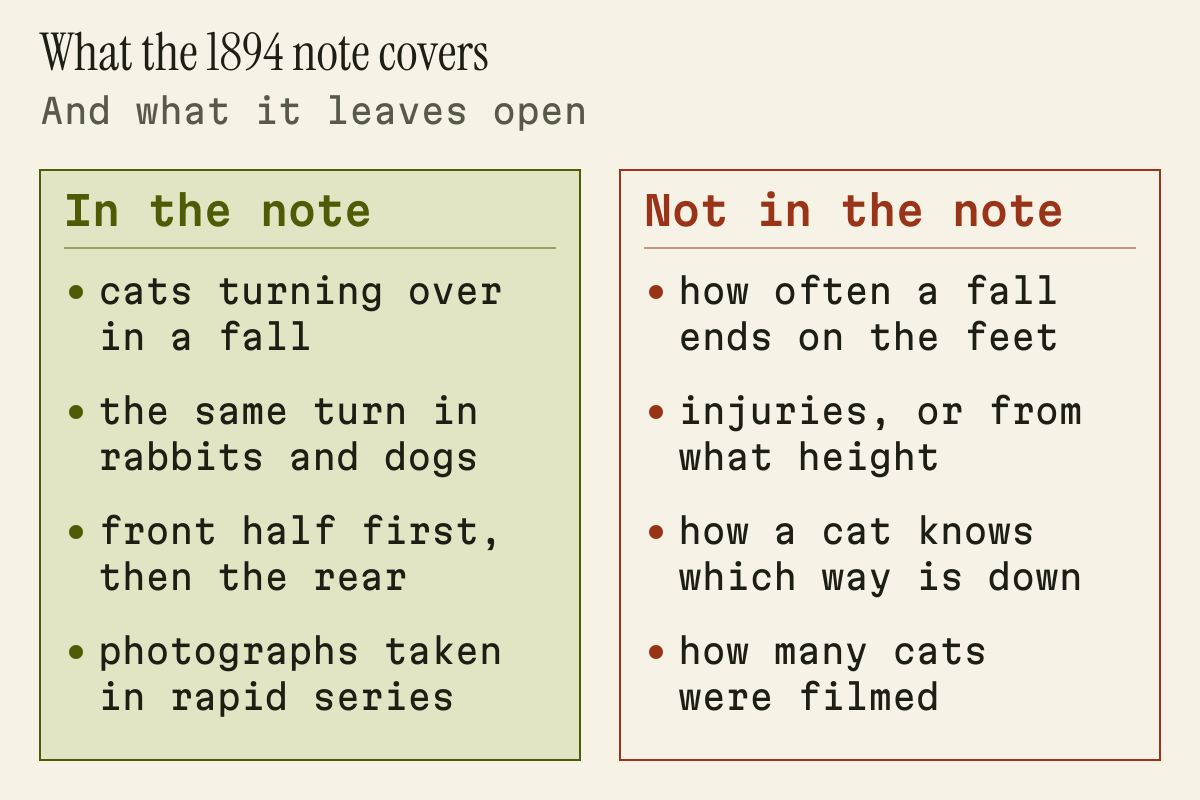
What Marey's 1894 note covers, and what it leaves open. The open questions are not answered by any source read for this page.
Worked from Marey 1894, Comptes rendus volume 119, pages 714 to 717; no values computed.
This figure in words
the two lists in the figure.
- In the note: cats turning over in a fall; the same turn in rabbits and dogs, with no numbers given; the front half turning first, then the rear; photographs taken in rapid series.
- Not in the note: how often a fall ends on the feet; injuries, or from what height; how a cat knows which way is down; how many cats were filmed.
"What Marey's 1894 note covers and what it leaves open" by Sniff, Purr, Preen & Shoal, https://sniffpurrpreenandshoal.com/how-they-sense/cat-righting-reflex/, licensed under CC BY 4.0 (https://creativecommons.org/licenses/by/4.0/)
Data: Marey (1894), Comptes rendus de l'Académie des sciences 119:714-717, public domain
Marey's note does not answer the question in this page's title, and it does not attempt to. It treats “always on its feet” as a popular saying and then explains how a cat accomplishes the turn, without saying anything about how often a fall ends feet-first, about injuries or about heights, which are questions for a veterinarian.
Landing on the feet is not the same as landing unhurt. Never drop a cat to watch it turn; falls can injure cats, and an injured cat needs a veterinarian.
How far can a cat fall without harm?
This page gives no height. How far a fall can go before a cat is hurt is a question about injuries, which belongs with a veterinarian. None of the sources read for this page measured it.
How does a falling cat know which way is down?
Marey's photographs record what the body does, not what the cat perceives while it falls, and no readable study of that sense was found for this page, so the question is left open here. Other senses in household animals have their own pages on this site, such as what a dog's eyes can tell apart and what happens inside a sniffing dog's nose.
Still unknown, among the sources read here, is how a falling cat senses which way is down, how many cats Marey photographed, and how often a fall in an ordinary home ends on the feet. The 1894 note establishes the order of the turn and rules out two explanations; the remaining questions wait for studies that can be read in full.
Sources
- Marey É-J (1894). "Des mouvements que certains animaux exécutent pour retomber sur leurs pieds, lorsqu'ils sont précipités d'un lieu élevé." Comptes rendus hebdomadaires des séances de l'Académie des sciences 119:714–717. archive.org/details/comptes-rendus-hebdomadai…Read: Public-domain original; pages 714 to 717 read, quotations checked against the page images
- Kane TR, Scher MP (1969). "A dynamical explanation of the falling cat phenomenon." International Journal of Solids and Structures 5(7):663–670. doi.org/10.1016/0020-7683(69)90086-9Read: Bibliographic record only
- Guyou (1894). "Note relative à la Communication de M. Marey." Comptes rendus hebdomadaires des séances de l'Académie des sciences 119:717–718. archive.org/details/comptes-rendus-hebdomadai…Read: Public-domain original; pages 717 to 718 read against the page images, paraphrased only
Cite this page
Sniff, Purr, Preen & Shoal. “How Do Cats Land on Their Feet? Marey Photographed the Twist.” Published November 20, 2026. https://sniffpurrpreenandshoal.com/how-they-sense/cat-righting-reflex/. Accessed on the day you read it.
How studies are read and numbers recheckedMending basket: every correctionReport an error on this page (contact@sniffpurrpreenandshoal.com)
More from How They Sense the House
Sense Mechanism explainer
Can Dogs See Color? Yes, With Two Cone Types, Not Three
Picture credit
"A Golden Retriever lying on grass" by Barras — https://commons.wikimedia.org/wiki/File:A_Golden_Retriever-9_(Barras).JPG — CC BY 3.0 (https://creativecommons.org/licenses/by/3.0/)
Sense Mechanism explainer
Dog Sense of Smell: A 2010 Model Traces a Sniff’s Side Path
Picture credit
"Dog Pointing a Partridge, by Jean-Baptiste Oudry" by Jean-Baptiste Oudry; Hermitage Museum, Saint Petersburg (inv. 2528) — https://commons.wikimedia.org/wiki/File:Jean-Baptiste_Oudry_-_Dog_Pointing_a_Partridge_-_WGA16781.jpg — Public domain (EU: Jean-Baptiste Oudry died 1755, more than 70 years ago (life plus 70 years); US: published before 1931; faithful photographic reproduction of a two-dimensional work)
Sense Mechanism explainer
Can Cats See in the Dark? Why Their Eyes Shine Back at You
Picture credit
"Tapetum lucidum en gato" by Dropus — https://commons.wikimedia.org/wiki/File:Tapetum_lucidum_gato.jpg — CC BY 3.0 (https://creativecommons.org/licenses/by/3.0/)