Sense Mechanism explainer
Can Dogs See Color? Yes, With Two Cone Types, Not Three
Sniff, Purr, Preen & Shoal Published
TL;DR
Dogs do see color, but with two kinds of cone cell, one fewer than the three measured in a human retina. A 1989 study of three dogs put the two peaks near 429 and 555 nanometers; it was read in abstract, and its sample source cannot be assigned. How much dogs rely on color in daily life is still unknown.
Doorplate
- Animal
- Dog (domestic dogs of several breeds and mixed breeds)
- Study
- Siniscalchi, d'Ingeo, Fornelli & Quaranta, 2017, Royal Society Open Science
- n (analysed / excluded)
- 16 analyzed / 6 excluded (the paper also lists 21 at the start, which does not add up)
- Couch sample
- pet homes pets living in households, tested in a university room
- Limits
- 16 dogs aged 1 to 8, 10 of them mixed breeds; one room, one screen task built from a human color-vision plate; gray-version check on 9 dogs
- Setup in one line
- Dogs sat with their owners facing a screen as running-cat animations in the red and green shades of Ishihara plate no. 22 crossed it
- Replicated?
- No repeat of this screen test among the sources read, as of 2026-11-20; its conclusion agrees with the 1989 cone study, read in abstract
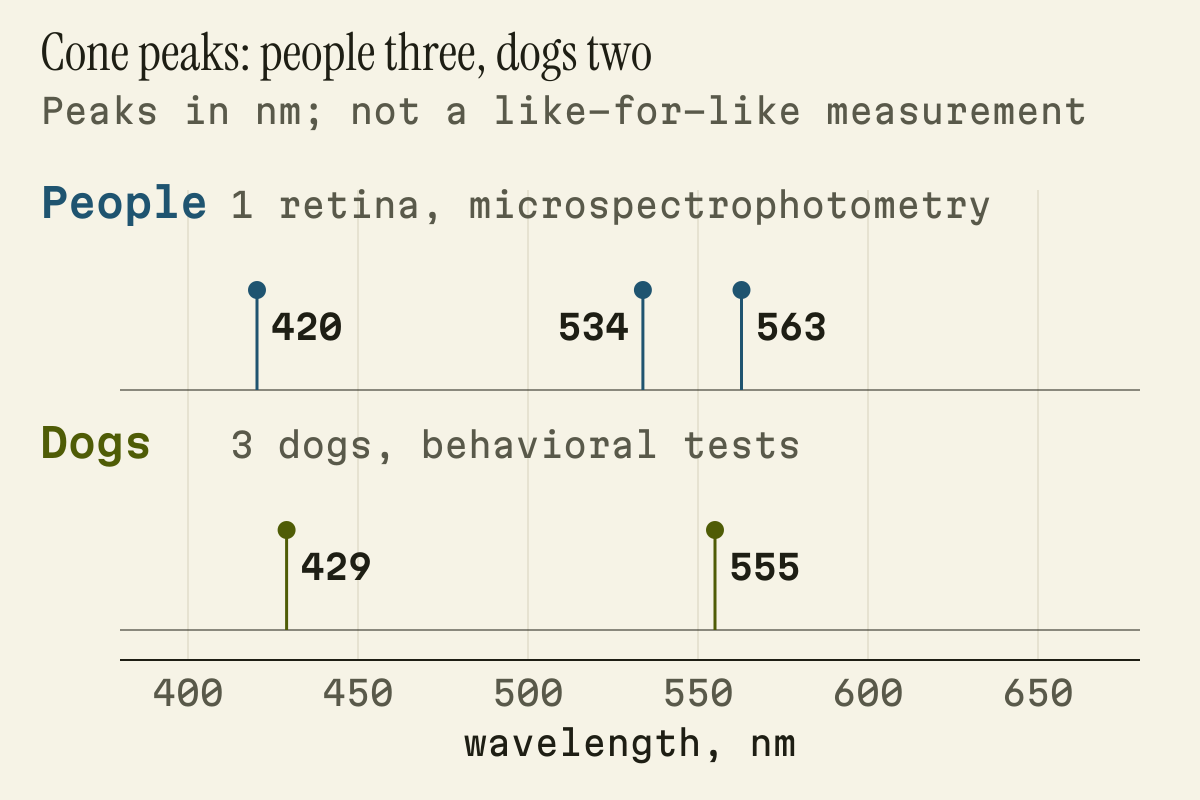
Cone peaks for people and for dogs, drawn as single lines. The human peaks were measured in cone cells and the dog peaks were computed from behavior, so this is not a like-for-like measurement.
Worked from Peak wavelengths from Neitz, Geist & Jacobs 1989 (abstract) and Bowmaker & Dartnall 1980 (abstract); the two were measured by different methods.
"Cone peak wavelengths in people and dogs" by Sniff, Purr, Preen & Shoal, https://sniffpurrpreenandshoal.com/how-they-sense/dog-vision/, licensed under CC BY 4.0 (https://creativecommons.org/licenses/by/4.0/)
Data: Bowmaker & Dartnall (1980), Journal of Physiology 298:501, doi:10.1113/jphysiol.1980.sp013097 (abstract); Neitz, Geist & Jacobs (1989), Visual Neuroscience 3:119, doi:10.1017/s0952523800004430 (abstract)
You throw a red ball into green grass, and your dog runs right past it. A dog's eye sorts daylight with two types of cone, the cells that respond to color, while the human retina in a 1980 study had three. In a 1989 study, Neitz, Geist and Jacobs put three dogs through behavioral tests and computed the two cone peaks at about 429 and 555 nanometers, by the abstract. The abstract does not say where the dogs came from, so their sample source cannot be assigned.
A nanometer, a billionth of a meter, is the unit used for the wavelength of light. In a 2017 paper, Siniscalchi and colleagues describe the 429 nm cone as sensitive to short-wavelength blue light and the 555 nm cone as covering the long and middle range that people see as red and green.
One missed ball proves nothing on its own. Researchers worked out how a dog's eye sorts color without asking a dog to name anything.
Are dogs color blind?
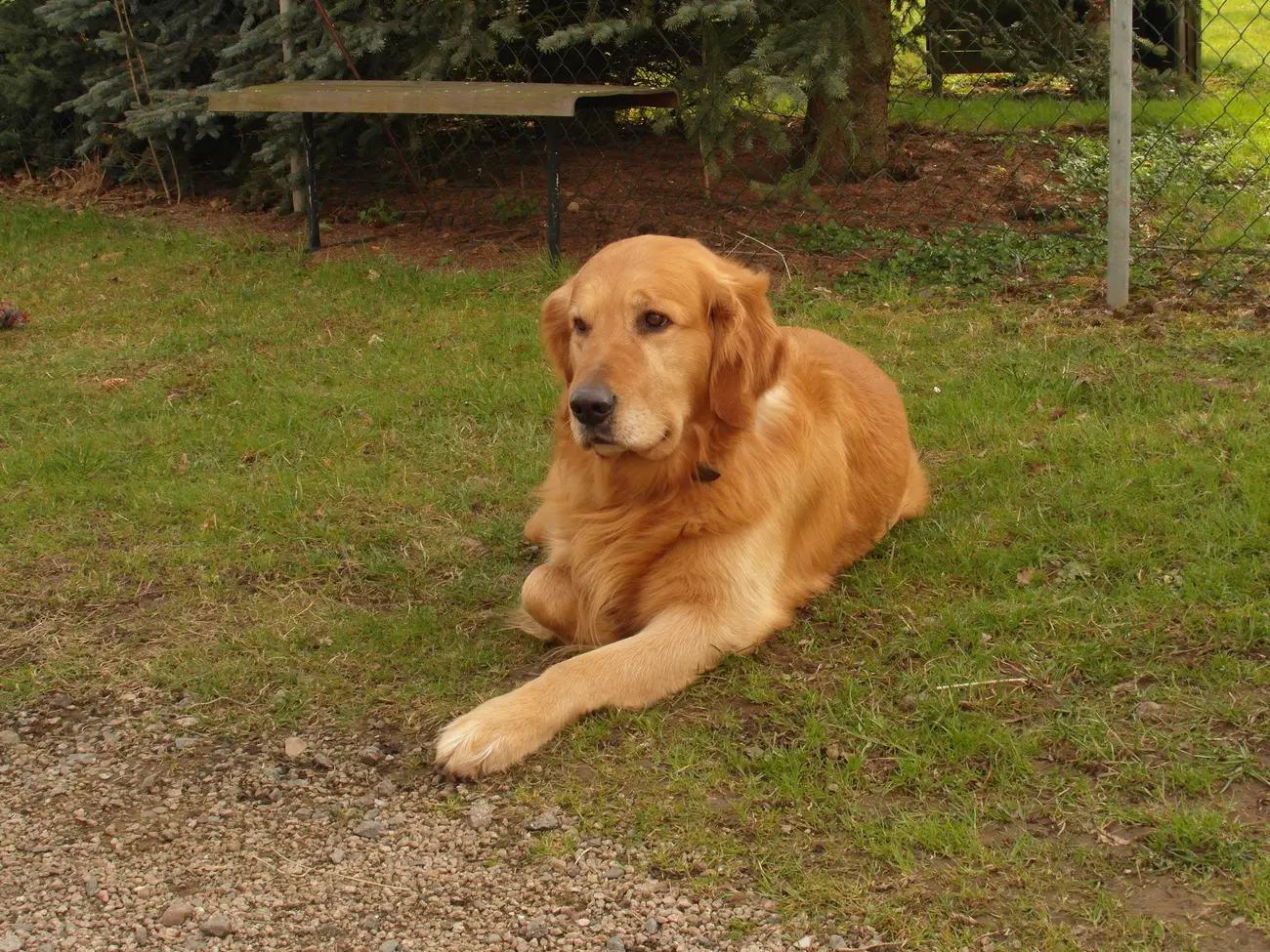
A golden retriever resting on a lawn, the same kind of green background as a backyard game of fetch.
"A Golden Retriever lying on grass" by Barras — https://commons.wikimedia.org/wiki/File:A_Golden_Retriever-9_(Barras).JPG — CC BY 3.0 (https://creativecommons.org/licenses/by/3.0/)
Not in the sense of seeing only shades of gray. Neitz, Geist and Jacobs inferred two classes of cone pigment in dogs, by the abstract, and concluded that dogs have dichromatic vision, meaning color vision built on two cone types.
In their 2013 paper, Kasparson and colleagues describe two cone types as giving a dog the potential for two-dimensional color vision. Summing up earlier work in their 2017 paper, Siniscalchi and colleagues say the dog's two-cone vision appears similar to human red-green color blindness. The closest human form, they write, is deuteranopia, one of the red-green types.
The human side of the comparison
The human peaks come from a different kind of study. In 1980, Bowmaker and Dartnall passed a measuring beam through single rods and cones taken from one man's retina, a method called microspectrophotometry. By the abstract, they found three classes of cone peaking at 420.3, 533.8 and 562.8 nm, from 3, 11 and 19 cones. Those numbers were read straight from cone cells, while the dog peaks were computed from what living dogs did, so the two sets are not a like-for-like measurement.
| Measure | People | Dogs |
|---|---|---|
| Cone types | 3 | 2 |
| Peaks, nm | 420.3, 533.8 and 562.8 | about 429 and 555 |
| How measured | light beam through single cones of one retina | computed from behavioral tests on 3 dogs |
| Study, as read | Bowmaker & Dartnall 1980, abstract | Neitz, Geist & Jacobs 1989, abstract |
Download the cone peak table (CSV) (what the file holds) Data: Bowmaker & Dartnall (1980), Journal of Physiology 298:501, doi:10.1113/jphysiol.1980.sp013097 (abstract); Neitz, Geist & Jacobs (1989), Visual Neuroscience 3:119, doi:10.1017/s0952523800004430 (abstract)
The Bowmaker and Dartnall abstract labels the three human cone classes “blue,” “green” and “red” by their wavelength bands. With the different methods kept in mind, the numbers alone put the dog's short-wave peak near the human “blue” cone and its long-wave peak between the human “green” and “red” ones.
Why color fades at dusk
Cones need good light. In their 2013 paper, Kasparson and colleagues note that cones make up only a small share of a dog's light-sensing cells, and that in dim light only the rods work, so a dog then has no color information at all. Other animals in the house raise other questions, such as a cat's eyes in the dark and how fish gather into shoals and schools.
These numbers describe the eyes in these studies, not any one dog. Questions about a particular dog's eyes or sight are for a veterinarian.
How did researchers test a dog's colors?
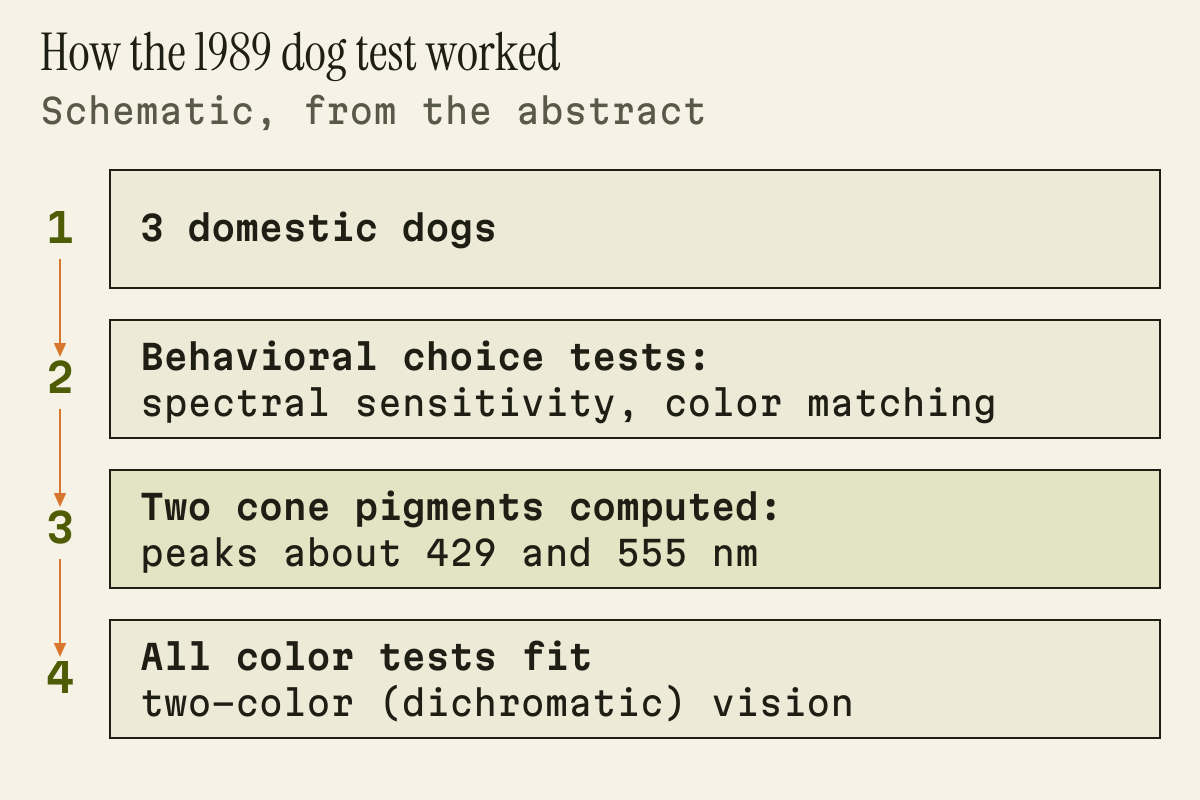
Schematic of the 1989 test, from the abstract: three dogs, behavioral choice tests, two cone pigments computed, and a result that fits two-color vision.
Worked from The Neitz, Geist & Jacobs 1989 abstract only; steps the abstract does not describe are left out.
This figure in words
the four steps in the schematic.
- Three domestic dogs took part.
- They went through behavioral choice tests that measured spectral sensitivity and tested color matching directly.
- Two cone pigments were computed from the results, with peaks of about 429 and 555 nm.
- All of the color tests fit two-color, or dichromatic, vision.
"How the 1989 dog color test worked, from the abstract" by Sniff, Purr, Preen & Shoal, https://sniffpurrpreenandshoal.com/how-they-sense/dog-vision/, licensed under CC BY 4.0 (https://creativecommons.org/licenses/by/4.0/)
Data: Neitz, Geist & Jacobs (1989), Visual Neuroscience 3:119, doi:10.1017/s0952523800004430 (abstract)
A dog cannot say what color it sees. A test has to ask through choices. Neitz, Geist and Jacobs ran a series of behavioral discrimination experiments with three dogs, by the abstract. From those choices they measured the dogs' spectral sensitivity, meaning how strongly an eye responds to light at each wavelength across the visible range, and they also ran direct tests of color matching.
The two peaks, about 429 and 555 nm, were computed from those results. They are estimates built on what the dogs did, not readings taken from the dogs' cone cells. The abstract states that every color test pointed the same way: dogs have dichromatic color vision.
What the abstract leaves out
The full paper is not open to read, so this page gives only what the abstract states. Left out here: how many test runs each dog did, how the lights were set, and how each dog scored. The Sniff test page explains how a reading level limits what a page can say.
The same two values turn up in later work. Siniscalchi and colleagues give 429 and 555 nm in their 2017 paper, citing studies that recorded electrical responses evoked by visual patterns and studies that stained cone cells in dog retinas.
Are dogs red-green color blind?
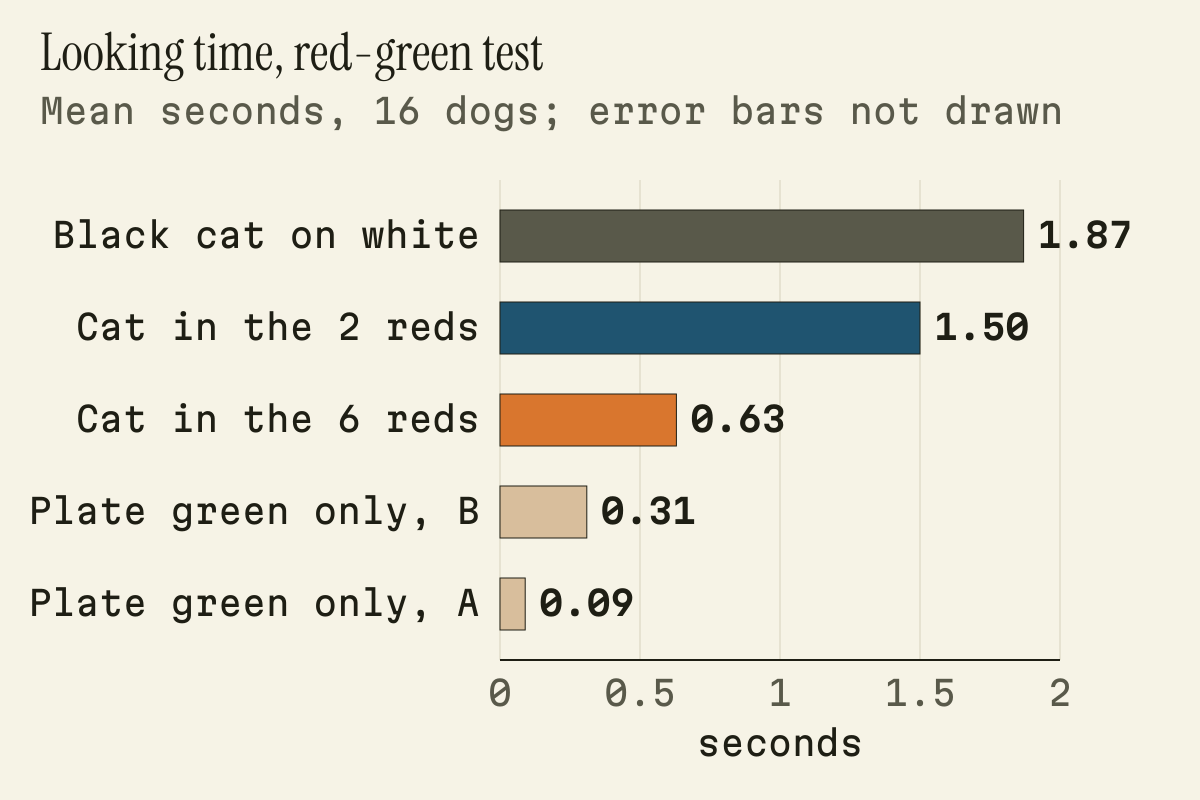
Mean looking time for 16 pet dogs in the 2017 screen test. Dogs looked longest at the black control cat and the cat drawn in the reds of the 2, and much less at the cat drawn in the reds of the 6.
Worked from Means as printed in the Results of Siniscalchi et al. 2017 (CC BY 4.0); error bars not drawn.
This figure in words
mean looking time in seconds, red-green test, 16 dogs. “2 reds” and “6 reds” are the red shades that form those numbers on the plate.
- Black cat on white (control): 1.87
- Cat in the 2 reds: 1.50
- Cat in the 6 reds: 0.63
- Plate green only, B: 0.31
- Plate green only, A: 0.09
"Mean looking time for each animation in the 2017 red-green test" by Sniff, Purr, Preen & Shoal, https://sniffpurrpreenandshoal.com/how-they-sense/dog-vision/, licensed under CC BY 4.0 (https://creativecommons.org/licenses/by/4.0/)
Data: Siniscalchi, d'Ingeo, Fornelli & Quaranta (2017), Royal Society Open Science 4:170869, doi:10.1098/rsos.170869, CC BY 4.0
Marcello Siniscalchi and colleagues at the University of Bari tested 16 pet dogs pet homes in 2017 with a version of the Ishihara test, a plate test commonly used to check people for red-green color blindness. The paper lists 21 dogs at the start and six exclusions: four did not look at any of the animations, and two had their heads turned by their owners. As printed, 21 minus 6 does not give 16, but the breed list and the count of males and females both add up to 16.
The setup
Each dog sat between its owner's legs about 2 meters from a large screen, and the owner was asked to stare at a fixed spot. A beep drew the dog's attention, then an animated cat ran across the screen. Two of the cats were built from Ishihara plate no. 22: one from the red shades that form the number 2 and one from the reds that form the 6, each set against the plate's green background shades.
The running cat was a deliberate choice. In a trial run, six dogs watched a running black cat and a black square cross the same screen. Their reaction times to the two showed no significant difference, but their score for alert behaviors was higher for the cat, 3.41 against 1.25, so the running cat became the target.
On that plate, people with typical color vision read 26, while people with red-green color blindness read only the 2. Before the dog tests, four men with deuteranopia watched the animations. All four saw the cat made from the reds of the 2, and none saw the cat made from the reds of the 6.
The result
The dogs responded in a similar way. Mean looking time was 1.50 seconds for the cat in the reds of the 2 and 0.63 seconds for the cat in the reds of the 6, against 1.87 seconds for a black cat on white used as a control. A score of alert behaviors, such as ears forward, freezing and a lifted paw, showed the same split: 2.31 against 0.43.
The authors put it this way in the abstract: dogs “exhibit a behavioural response similar to that of red–green blind human subjects.” The paper is published under a CC BY 4.0 license.
The design guarded against two easy mistakes. The authors write that each colored cat was shown to each dog only once, to keep a dog from tiring of one before the next, though their Methods also describe a separate trial with the two colored cats side by side. The black control cat always came last. The owners all had typical color vision and could see both colored cats, so, the authors argue, cued dogs might have reacted to both.
This was one study in one room at a university department, using a single task built for human eyes. The dogs were 1 to 8 years old, and 10 of the 16 were mixed breeds.
Do dogs pick by color or brightness?
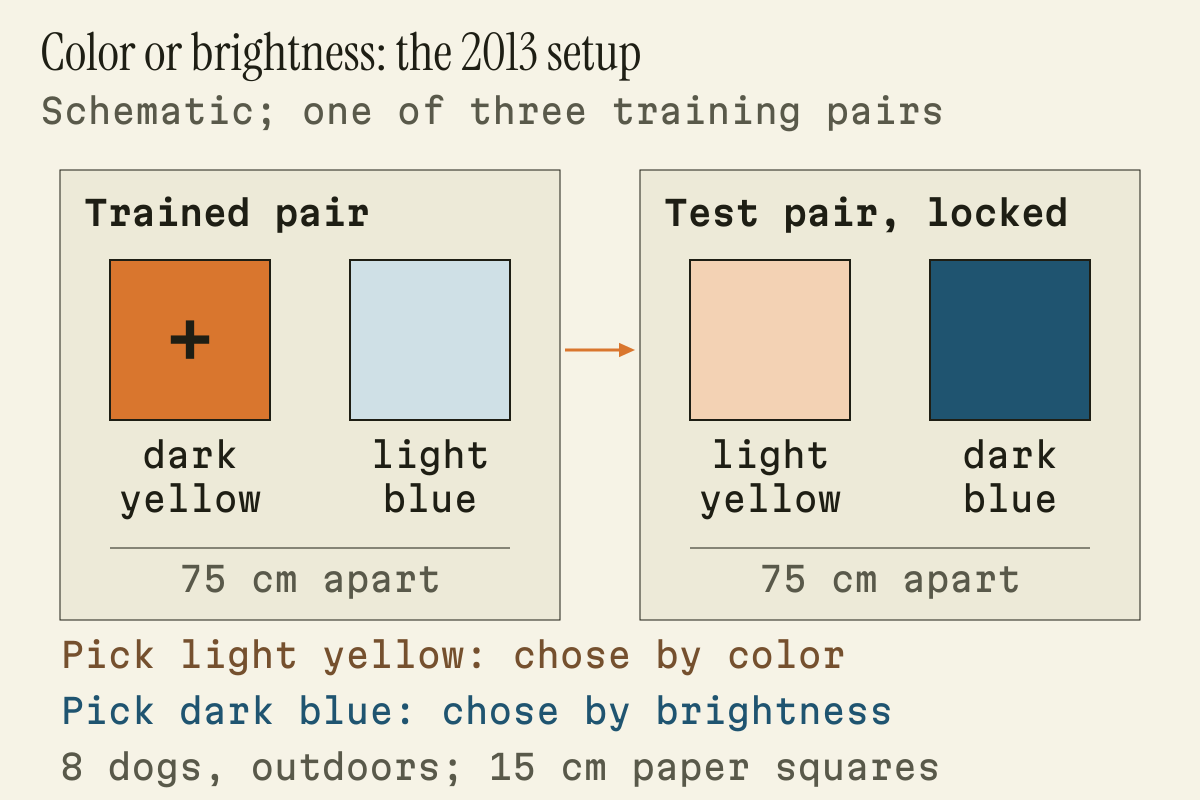
Schematic of the 2013 two-choice setup, showing one of the three training pairs. The colors here are stand-ins for the printed yellow and blue papers.
Worked from Design facts restated from Kasparson, Badridze & Maximov 2013 (Materials and methods); not traced from the paper's figures.
This figure in words
the setup in the schematic.
- Trained pair: a dark yellow card, marked with a plus, stood at the box that opened to food; a light blue card stood at a box that stayed shut.
- Test pair, with both boxes locked: light yellow against dark blue.
- Picking light yellow meant choosing by color; picking dark blue meant choosing by brightness.
- The two boxes stood 75 cm apart, the paper squares were 15 cm across, and the 8 dogs worked outdoors.
"The 2013 color-or-brightness test design" by Sniff, Purr, Preen & Shoal, https://sniffpurrpreenandshoal.com/how-they-sense/dog-vision/, licensed under CC BY 4.0 (https://creativecommons.org/licenses/by/4.0/)
Data: Kasparson, Badridze & Maximov (2013), Proceedings of the Royal Society B 280:20131356, doi:10.1098/rspb.2013.1356 (design facts restated)
A difference in color often comes with a difference in brightness, so a dog could pick the right card by lightness alone. In 2013, Kasparson, Badridze and Maximov set out to see which cue eight dogs would use when both were on offer. The paper describes them as outbred and previously untrained but does not say where they lived, so their sample source cannot be assigned.
Training, then a switch
The dogs worked outdoors in daylight. Two feedboxes stood 75 cm apart, each with a 15 cm square of yellow or blue paper in front and raw meat inside, but only the box at the trained card would open. In one group, for example, that card was dark yellow and the other was light blue.
Once a dog picked the trained card in more than 8 of 10 trials in two sessions in a row, test trials began. In a test, each color kept its hue but swapped its lightness: light yellow faced dark blue. Neither box opened. A dog trained on dark yellow that picked light yellow was going by color; one that picked dark blue was going by brightness.
Color won
Every dog chose by color more often than by brightness, and four of the eight picked the color match in all 10 of their test trials. One dog's 7 of 10 was not statistically clear on its own, and another was given 10 extra tests and ended at 16 of 20.
The authors had also checked that the brightness gap was large enough for a dog to notice, using published figures on how well dogs tell brightness apart. The dogs could have used brightness in this setup, yet they did not.
Siniscalchi's team ran a related check: nine of its dogs pet homes also saw gray versions of the two Ishihara cats, with the color taken out. Without color, looking time at either cat no longer differed significantly from looking time at the background animations, which suggests the red-green test was picking up color and not just lightness.
Sharpness and brightness
Color is only one part of what a dog's eye takes in, and Siniscalchi and colleagues, citing earlier studies, note that dogs see fine detail four to eight times less sharply than people. They add that a dog's ability to tell brightness apart is about two times worse than a person's.
| Study | Dogs | Sample source | What it tested | Read |
|---|---|---|---|---|
| Neitz, Geist & Jacobs 1989 | 3 | cannot be assigned | cone peaks from behavioral tests | abstract |
| Siniscalchi et al. 2017 | 16 (9 in the gray check) | pet homes | red-green screen test | full text, CC BY |
| Kasparson et al. 2013 | 8 | cannot be assigned | color against brightness | full text, read only |
Download the study table (CSV) (what the file holds) Data: Siniscalchi, d'Ingeo, Fornelli & Quaranta (2017), Royal Society Open Science 4:170869, doi:10.1098/rsos.170869, CC BY 4.0
These are small studies of three, eight and sixteen dogs. None of them shows how much color guides a dog through an ordinary day, how color combines with motion and scent, or how much dogs differ from one another.
Still unknown, too, is whether dogs weigh the two cues the same way when colors sit closer together, as Kasparson and colleagues point out. So is whether a faster target changes how much color helps, which Siniscalchi's team suggests testing. The 1989 peaks also rest here on the abstract alone, and no repeat of the 2017 screen test was among the sources read.
Sources
- Siniscalchi M, d'Ingeo S, Fornelli S, Quaranta A (2017). "Are dogs red–green colour blind?" Royal Society Open Science 4(11):170869. doi.org/10.1098/rsos.170869Read: Full text, open license; CC BY 4.0Text license: CC BY 4.0 (terms)
- Neitz J, Geist T, Jacobs GH (1989). "Color vision in the dog." Visual Neuroscience 3(2):119–125. doi.org/10.1017/s0952523800004430Read: Abstract only
- Kasparson AA, Badridze J, Maximov VV (2013). "Colour cues proved to be more informative for dogs than brightness." Proceedings of the Royal Society B 280(1766):20131356. doi.org/10.1098/rspb.2013.1356Read: Full text, read only; facts restated, no text, tables or figures reproduced
- Bowmaker JK, Dartnall HJA (1980). "Visual pigments of rods and cones in a human retina." Journal of Physiology 298:501–511. doi.org/10.1113/jphysiol.1980.sp013097Read: Abstract only
Cite this page
Sniff, Purr, Preen & Shoal. “Can Dogs See Color? Yes, With Two Cone Types, Not Three.” Published November 20, 2026. https://sniffpurrpreenandshoal.com/how-they-sense/dog-vision/. Accessed on the day you read it.
How studies are read and numbers recheckedMending basket: every correctionReport an error on this page (contact@sniffpurrpreenandshoal.com)
More from How They Sense the House
Sense Mechanism explainer
Dog Sense of Smell: A 2010 Model Traces a Sniff’s Side Path
Picture credit
"Dog Pointing a Partridge, by Jean-Baptiste Oudry" by Jean-Baptiste Oudry; Hermitage Museum, Saint Petersburg (inv. 2528) — https://commons.wikimedia.org/wiki/File:Jean-Baptiste_Oudry_-_Dog_Pointing_a_Partridge_-_WGA16781.jpg — Public domain (EU: Jean-Baptiste Oudry died 1755, more than 70 years ago (life plus 70 years); US: published before 1931; faithful photographic reproduction of a two-dimensional work)
Sense Mechanism explainer
Can Cats See in the Dark? Why Their Eyes Shine Back at You
Picture credit
"Tapetum lucidum en gato" by Dropus — https://commons.wikimedia.org/wiki/File:Tapetum_lucidum_gato.jpg — CC BY 3.0 (https://creativecommons.org/licenses/by/3.0/)
Sense Mechanism explainer
How Do Cats Land on Their Feet? Marey Photographed the Twist
Picture credit
"Falling cat, 1894" by Étienne-Jules Marey; Wikimedia Commons — https://commons.wikimedia.org/wiki/File:Falling_cat_1894.jpg — Public domain (EU: Étienne-Jules Marey died 1904, more than 70 years ago (life plus 70 years); US: published before 1931; the engraver who signed the print is not identified and the print's first publication is not traced)