Sniff Tool page
Dog Years: In One Labrador Study, Age 1 Matched About 31
Sniff, Purr, Preen & Shoal Published
TL;DR
By the formula from one 2020 DNA study of 104 dogs, mostly Labrador retrievers pet homes, a 1-year-old dog matches a human of about 31 and a 7-year-old about 62, far above times 7. The two rules meet near 9.6 years, a crossing computed for this page. This study cannot say whether other breeds and sizes follow the same curve.
Doorplate
- Animal
- Dog; Labrador retriever for the most part
- Study
- Wang et al. 2020, Cell Systems (DNA methylation in dogs and people)
- n (analysed / excluded)
- 95 dogs analyzed / 9 removed for too little DNA coverage (104 sampled)
- Couch sample
- pet homes privately owned dogs; blood drawn at dog shows, through mail-in kits or at a veterinary teaching hospital
- Limits
- Mostly one breed; ages 0.1 to 16 years at blood draw; blood DNA only; the authors note other breeds could give a different curve
- Setup in one line
- Each dog's blood methylation was matched to the most similar human profiles, and a curve was fitted to the pairs
- Replicated?
- As of 2026-11-20, no repeat in other breeds among the sources read for this page
This doorplate as data (CSV) what the file holds
Data: Wang et al. (2020), Cell Systems, doi:10.1016/j.cels.2020.06.006 (author manuscript, facts restated)
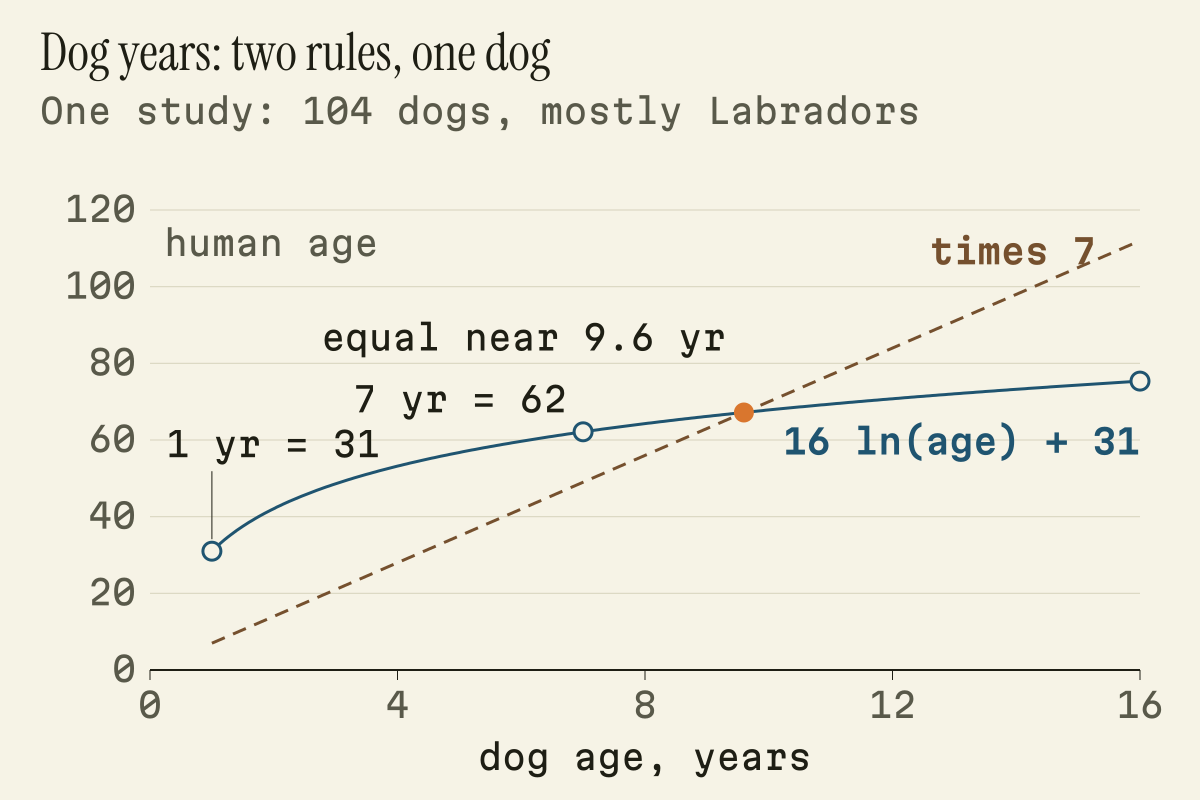
By the 2020 formula, human age climbs fast in a dog's early years and then levels off, while times 7 is a straight line; the two meet near 9.6 years.
Worked from The formula in Wang et al. 2020, human age = 16 ln(dog age) + 31; where it meets times 7 (about 0.15 and 9.6 years) is computed for this page.
"Dog years: the times-7 rule and the Wang et al. 2020 formula" by Sniff, Purr, Preen & Shoal, https://sniffpurrpreenandshoal.com/dogs/dog-years/, licensed under CC BY 4.0 (https://creativecommons.org/licenses/by/4.0/)
Data: Wang et al. (2020), Cell Systems, doi:10.1016/j.cels.2020.06.006 (author manuscript, formula only)
The fur around your dog's muzzle has started to turn gray. The old rule of thumb would turn that dog's age into human years by multiplying by 7. A 2020 study led by Tina Wang took a different route: it compared chemical marks on the DNA in blood from 104 dogs, primarily Labrador retrievers pet homes, with the same marks in people of known age.
How old is a dog in human years?
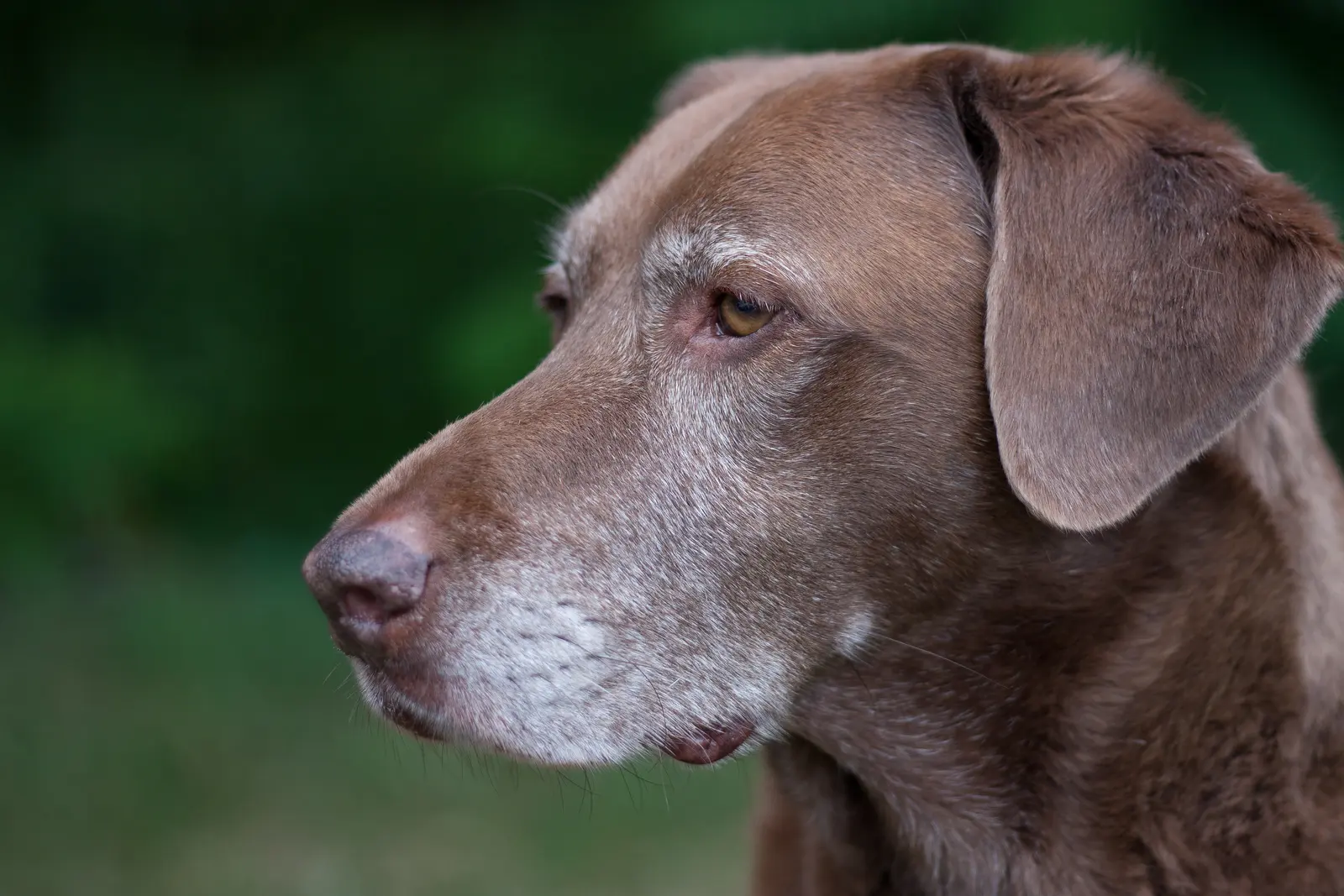
An older dog with white fur around the muzzle and eyes.
"noah (1 of 1)" by Trevor Hurlbut — https://commons.wikimedia.org/wiki/File:Old_dog_noah_(1_of_1).jpg — CC BY 2.0 (https://creativecommons.org/licenses/by/2.0/)
The study's answer is a formula: human age = 16 ln(dog age) + 31. Here ln is the natural logarithm, which rises quickly at first and then more and more slowly. By that formula a 1-year-old dog matches a human of 31, a 3-year-old about 48.6 and a 7-year-old about 62. A 16-year-old dog, the oldest age in the study, matches a human of about 75.
Set beside times 7, the formula runs furthest ahead in the early years. At 1 year the formula is 24 years ahead of the times-7 answer of 7, and at 3 years it is 27.6 years ahead (48.6 against 21). The gap then narrows until the two lines cross near 9.6 years, a point computed for this page; past it, the times-7 line runs ahead. For the dogs in this study, one dog year is not seven human years.
The marks behind the formula are methyl groups, small chemical tags that sit on some spots of DNA and not on others. The pattern shifts with age in a predictable way, which is why tools built on it are called epigenetic clocks. The authors matched each dog's blood profile to the most similar profiles from 320 people aged 1 to 103, taken from earlier published studies. They then fitted a curve to the pairs, repeated the match from the human side, and combined the two into one formula.
The paper also set the curve beside life stages. By its reckoning, a dog of about 8 weeks lines up with a baby of about 9 months, the stage when baby teeth come in for both. The paper puts that dog age at 0.15 years, where the curve is steep; by the formula as printed, 0.15 years comes out nearer 8 months.
Twelve years, the expected lifespan the authors give for Labrador retrievers, lines up with a human age of about 70. The match was looser for the teenage and middle years, where the DNA marks moved faster in dogs than standard life-stage tables suggest.
Dog years calculator
The calculator takes a dog's age in years or months and returns the human age by the 2020 formula, with times 7 beside it. It opens at 3 years, which the formula turns into about 48.6. It accepts ages from about 7.5 weeks (just over 1.7 months) to 16 years, and the table under it lists the same values as the data file.
Calculator · one study’s formula
16 ln(age) + 31 (Wang et al. 2020) times 7 the age being converted where the two agree. Across: dog age in years; up: human age.
Formula result: 3 years → about 48.6 by the 2020 formula; times 7 would say 21.0.
Formula from one study: 104 dogs, mostly Labrador retrievers, aged 0.1 to 16 years. Other breeds could give a different curve. It is a comparison of DNA changes, not a health measure.
| Dog age, years | Formula | Times 7 |
|---|---|---|
| 0.25 | 8.8 | 1.8 |
| 0.5 | 19.9 | 3.5 |
| 0.75 | 26.4 | 5.3 |
| 1 | 31.0 | 7.0 |
| 2 | 42.1 | 14.0 |
| 3 | 48.6 | 21.0 |
| 4 | 53.2 | 28.0 |
| 5 | 56.8 | 35.0 |
| 6 | 59.7 | 42.0 |
| 7 | 62.1 | 49.0 |
| 8 | 64.3 | 56.0 |
| 9 | 66.2 | 63.0 |
| 10 | 67.8 | 70.0 |
| 11 | 69.4 | 77.0 |
| 12 | 70.8 | 84.0 |
| 13 | 72.0 | 91.0 |
| 14 | 73.2 | 98.0 |
| 15 | 74.3 | 105.0 |
| 16 | 75.4 | 112.0 |
Formula: Wang et al. (2020), Cell Systems, doi:10.1016/j.cels.2020.06.006. The table as data (CSV)
"Dog years by the Wang et al. 2020 formula and by times 7" by Sniff, Purr, Preen & Shoal, https://sniffpurrpreenandshoal.com/dogs/dog-years/, licensed under CC BY 4.0 (https://creativecommons.org/licenses/by/4.0/) Data: Wang et al. (2020), Cell Systems, doi:10.1016/j.cels.2020.06.006 (author manuscript, formula only)
Ages can also be typed in months. Switching the unit converts the number already in the box. A 6-month-old puppy, for example, comes out at about 19.9 by the formula, against 3.5 by times 7.
The calculator stops at 16 years because the oldest dogs in the study were 16 when their blood was drawn, so an older age would stretch the curve past its data. At the young end, the formula reaches zero at about 0.144 years, roughly 7.5 weeks, and gives negative ages below that, so younger ages are refused. How these limits were set is described in Sniff test.
The formula compares DNA changes; it is not a health measure, and questions about an older dog's care belong with a veterinarian.
Who was in the study?
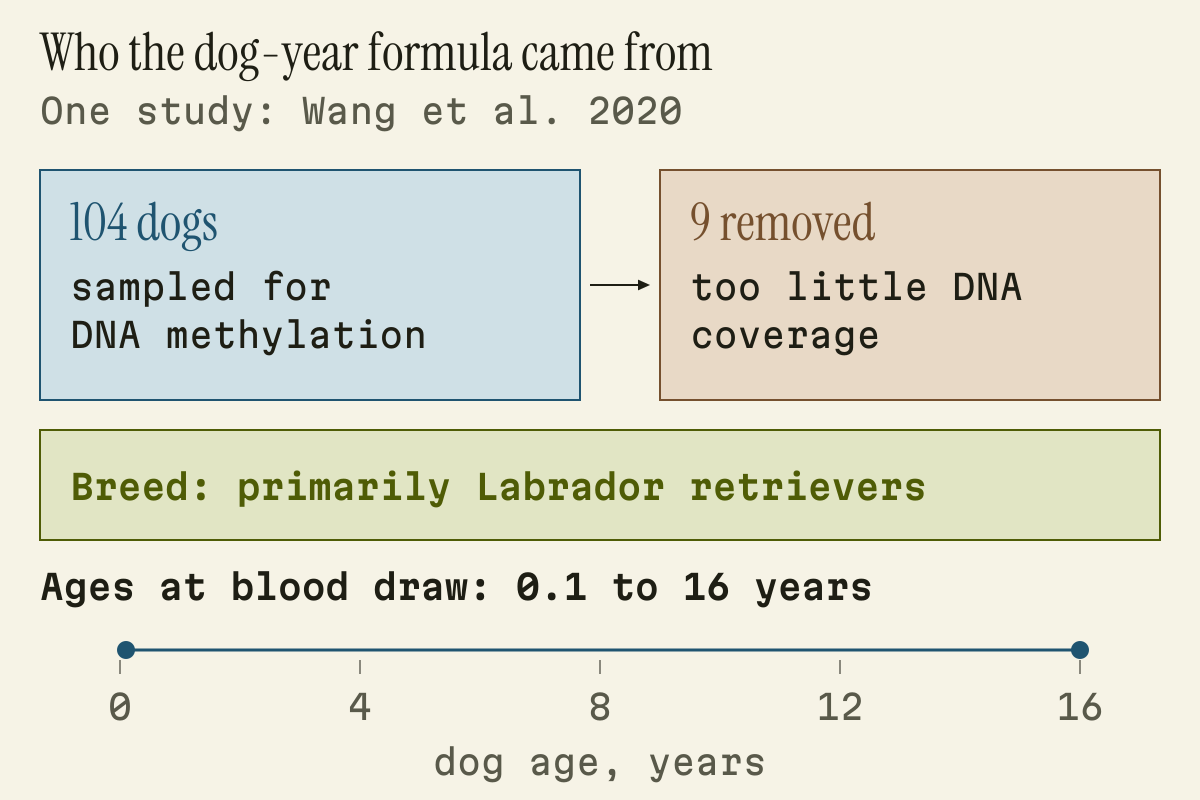
The sample behind the formula: 104 dogs sampled, 9 removed, mostly Labrador retrievers, aged 0.1 to 16 years at blood draw.
Worked from Sample facts in the Wang et al. 2020 author manuscript (Results and Methods); no numbers computed.
"Who the dog-year formula came from" by Sniff, Purr, Preen & Shoal, https://sniffpurrpreenandshoal.com/dogs/dog-years/, licensed under CC BY 4.0 (https://creativecommons.org/licenses/by/4.0/)
Data: Wang et al. (2020), Cell Systems, doi:10.1016/j.cels.2020.06.006 (author manuscript, sample facts restated)
The study sampled 104 dogs, primarily Labrador retrievers, aged 0.1 to 16 years at the time of the blood draw pet homes. Nine dogs were removed for too little DNA coverage, leaving 95 dogs to compare with people. The dogs were privately owned, and their blood was collected at dog shows, through mail-in kits drawn by veterinarians or veterinary technicians, or at a university veterinary teaching hospital. Only the dogs were sampled for this study; the human blood profiles came from earlier published work.
Size and breed are the open question. This study cannot say whether they change dog years. Its authors write that they focused on Labrador retrievers, a breed common enough to collect many unrelated dogs, and that breeds with very different lifespans could give different age-translation curves. They give no formula for any other breed, and this page gives none either.
The sample shapes the answer in other ways too. The DNA came from whole blood, and the authors note that the mix of white blood cells shifts with age in both dogs and people, which could affect the marks. Limits of this kind are not special to one paper; the page on dog word learning covers another dog study whose sample limits what it can say.
Where did times 7 come from?
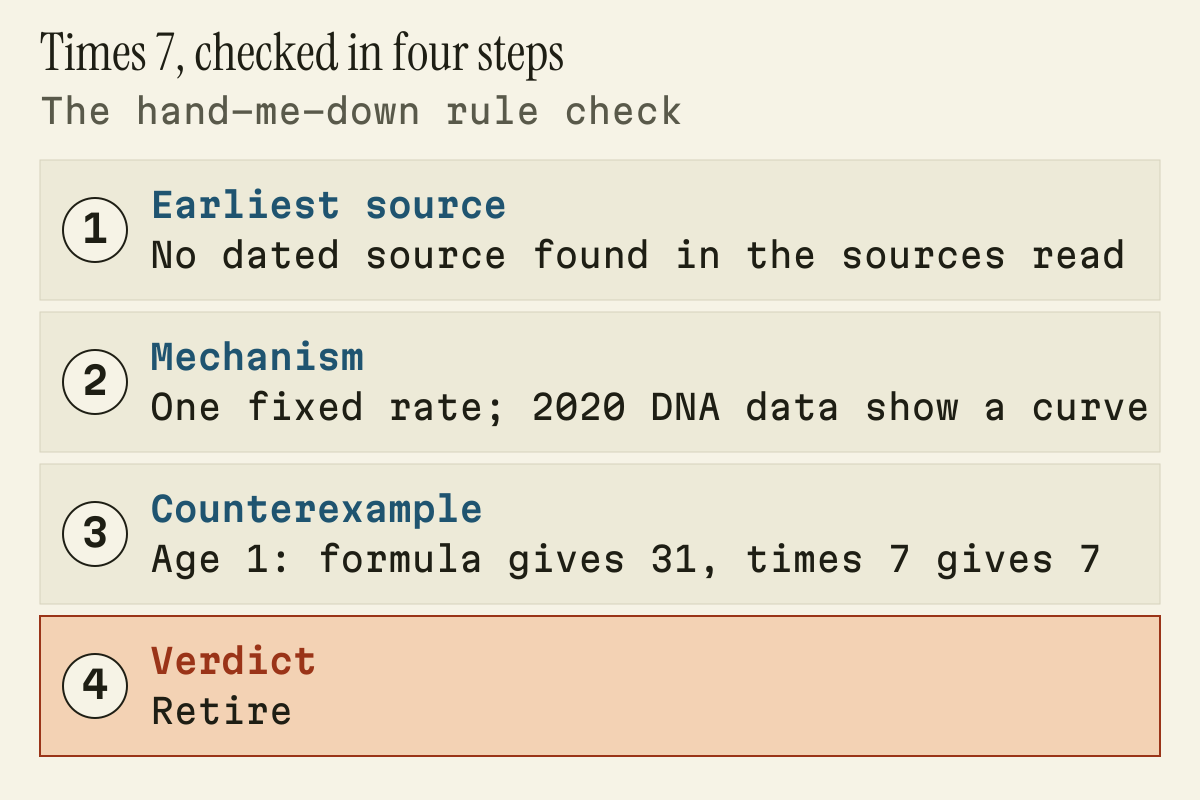
Times 7 put through the four-step check: no named source found, a mechanism the DNA data do not support, a counterexample at age 1, and a verdict to retire it.
Worked from The site's four-step check for rules of thumb, applied to times 7 with the Wang et al. 2020 formula.
This figure in words
the four-step check of times 7.
- Earliest source: no named, dated source turned up in the sources read for this page.
- Mechanism: the rule assumes one fixed rate for a dog's whole life; the 2020 DNA data show a curve instead.
- Counterexample: at age 1 the formula gives 31 and times 7 gives 7.
- Verdict: retire.
"Times 7, checked in four steps" by Sniff, Purr, Preen & Shoal, https://sniffpurrpreenandshoal.com/dogs/dog-years/, licensed under CC BY 4.0 (https://creativecommons.org/licenses/by/4.0/)
Data: Wang et al. (2020), Cell Systems, doi:10.1016/j.cels.2020.06.006 (author manuscript, formula only)
Times 7 fits what this site calls the hand-me-down rule, a rule of thumb that passes from owner to owner without a source anyone can point to. The check runs in four steps. No named, dated statement of the seven-to-one rule turned up in the sources read for this page, and the 2020 paper itself calls it an adage without giving a reference.
The mechanism is the weak point. A single multiplier assumes that a dog ages at one fixed speed from puppyhood to old age. The methylation data show a different shape: fast change early, then a long, slow climb. By the formula, the two rules agree only twice, at about 0.15 years (roughly 8 weeks) and at about 9.6 years, crossings worked out for this page.
The counterexamples sit on either side of those crossings. The table below lists a few ages from the data file, both rules side by side.
| Dog age, years | Formula, human years | Times 7 |
|---|---|---|
| 1 | 31.0 | 7.0 |
| 3 | 48.6 | 21.0 |
| 7 | 62.1 | 49.0 |
| 12 | 70.8 | 84.0 |
| 16 | 75.4 | 112.0 |
Download the dog years table (CSV) (what the file holds) Data: Wang et al. (2020), Cell Systems, doi:10.1016/j.cels.2020.06.006 (author manuscript, formula only)
At 1 year the formula gives 31 against the times-7 figure of 7; at 12 years it gives about 70.8, while times 7 says 84. The verdict is retire. That does not make the 2020 formula a universal answer, since it rests on one study of mostly one breed. For a dog study from a century earlier, read in the original, see Pavlov's dogs.
What is still not known is how other breeds, mixed-breed dogs and very small or very large dogs fit the curve. The study did not test them, and no repeat in other breeds was among the sources read for this page as of 2026-11-20. Nor does the formula say anything about one dog's health, only about how its blood DNA marks compare with people's; health questions belong with a veterinarian.
Sources
- Wang T, Ma J, Hogan AN, Fong S, Licon K, Tsui B, Kreisberg JF, Adams PD, Carvunis AR, Bannasch DL, Ostrander EA, Ideker T. (2020). "Quantitative Translation of Dog-to-Human Aging by Conserved Remodeling of the DNA Methylome." Cell Systems 11(2):176–185.e6. Author manuscript, PMC7484147. doi.org/10.1016/j.cels.2020.06.006Read: Full text, read only; author manuscript; facts restated, no text, tables or figures reproduced
Cite this page
Sniff, Purr, Preen & Shoal. “Dog Years: In One Labrador Study, Age 1 Matched About 31.” Published November 20, 2026. https://sniffpurrpreenandshoal.com/dogs/dog-years/. Accessed on the day you read it.
How studies are read and numbers recheckedMending basket: every correctionReport an error on this page (contact@sniffpurrpreenandshoal.com)
More from Dog Minds
Sniff Research story
What Do Dogs Dream About? Sleep Recordings Can’t Say
Picture credit
"Study of a Sleeping Dog" by Cornelis Visscher; Nationalmuseum, Stockholm (NMH 1878/1863) — https://commons.wikimedia.org/wiki/File:Cornelis_Visscher_-_Study_of_a_Sleeping_Dog_-_NMH_1878-1863_-_Nationalmuseum.jpg — Public domain (EU and US: Cornelis Visscher died 1658, more than 70 years ago (life plus 70 years))
Sniff Research story
How Many Words Do Dogs Know? A Gifted Few Learn Toy Names
Picture credit
"Puppy playing with a toy" by Justin Veenema (Unsplash) — https://commons.wikimedia.org/wiki/File:Puppy_playing_with_a_toy_(Unsplash).jpg — CC0 1.0 (https://creativecommons.org/publicdomain/zero/1.0/)
Sniff Research story
Pavlov’s Dogs: In the 1927 English Text, Metronomes Lead
Picture credit
"White Poodle in a Punt, by George Stubbs" by George Stubbs; National Gallery of Art, Washington (Paul Mellon Collection 1999.80.22) — https://commons.wikimedia.org/wiki/File:George_Stubbs,_White_Poodle_in_a_Punt,_c._1780,_NGA_110281FXD.jpg — CC0 1.0 (https://creativecommons.org/publicdomain/zero/1.0/); modified: color-adjusted version uploaded to Commons by another user from the National Gallery of Art file (other version listed on the gallery file page); not changed further