Shoal Tool page
Aquarium Volume Calculator: Glass and Gravel Take a Share
Sniff, Purr, Preen & Shoal Published
TL;DR
A tank's water volume is its inside floor area times the water depth, with the US gallon fixed at 231 cubic inches. In this example, a tank labeled 20 gallons, assumed 24 by 12 by 16 inches outside, holds about 15.0 gallons once glass, rim gap and gravel come out. Water hidden among gravel grains or behind decor remains unknown.
Tank doorplate
- Topic
- Water a tank holds, worked out from its outside size, minus the glass, the gap under the rim and the substrate
- System variables
- Shape; outside dimensions; glass thickness; waterline gap; substrate depth. Decor and water between gravel grains not counted
- Default units
- Inches and US gallons (1 gallon = 231 cubic inches); sizes also in cm or mm, results also in liters (1 inch = 2.54 cm)
- Hand-me-down rule checked?
- One inch of fish per gallon: oldest printing found for this page is a 1914 handbook that already calls it a rule often given; verdict rewrite
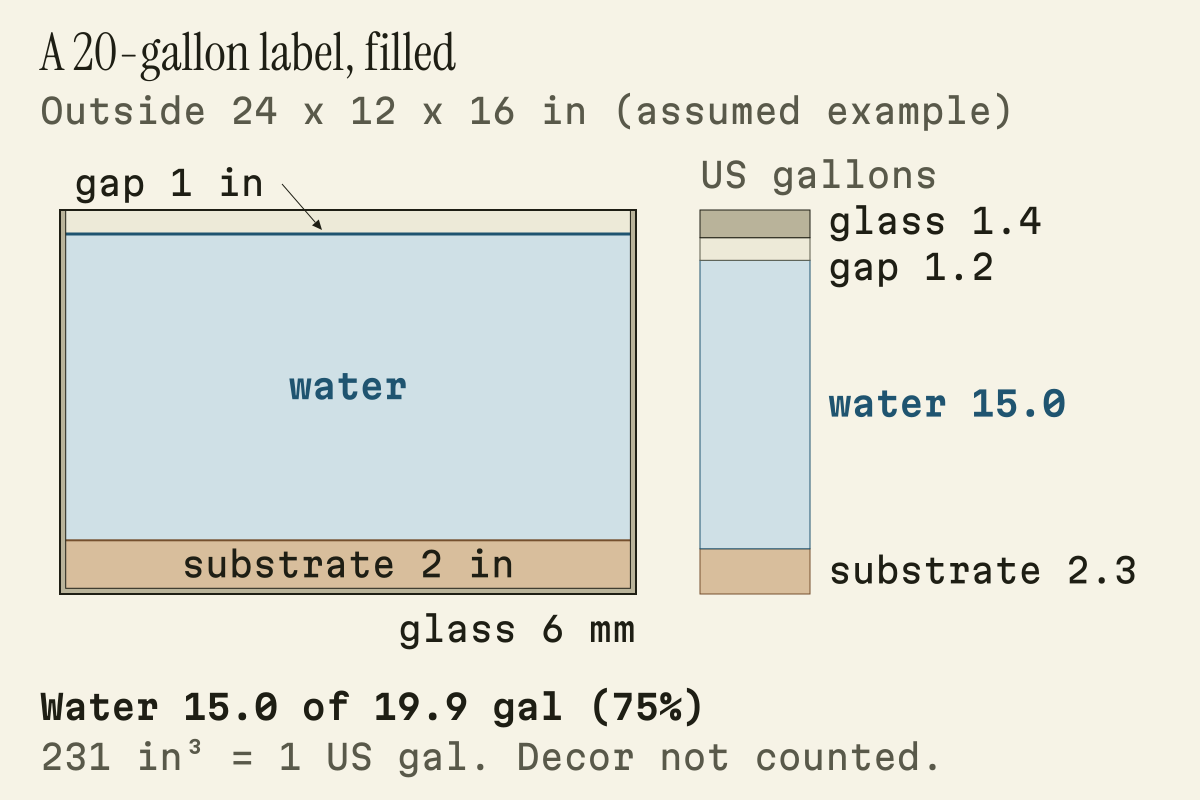
In this example, assumed outside dimensions of 24 by 12 by 16 inches enclose 19.95 gallons, and about 15.0 of them are water; the glass, the gap under the rim and the substrate take the rest.
Worked from Unit definitions in NIST Handbook 44 (2026), Appendix C; the glass, gap, substrate and water add up to the outside volume.
"Fish tank volume in this example: outside size versus the water inside (assumed dimensions)" by Sniff, Purr, Preen & Shoal, https://sniffpurrpreenandshoal.com/fish/tank-volume-calculator/, licensed under CC BY 4.0 (https://creativecommons.org/licenses/by/4.0/)
Data: NIST Handbook 44 (2026), Appendix C (unit definitions)
You fill a new tank one bucket at a time, and the count comes up short of the label. In this example, the outside of the tank encloses 4,608 cubic inches, or 19.95 gallons, and only three quarters of that space ends up as water.
Why does an outside measurement overstate the water?
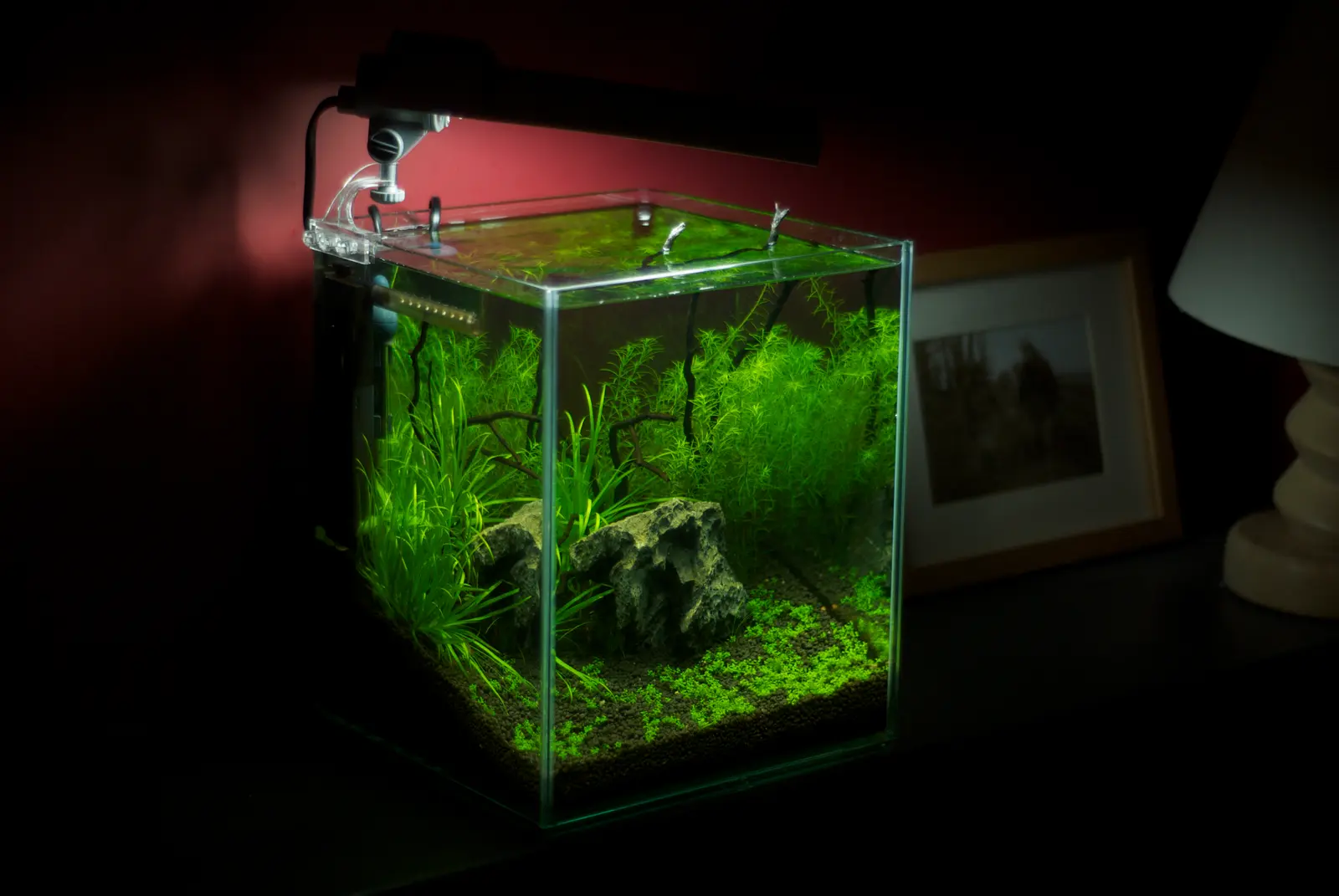
A small planted freshwater tank; the gravel, the rocks and the strip of air under the rim all sit inside its outside measurements.
"Freshwater nano aquarium" by Chris Penny — https://commons.wikimedia.org/wiki/File:Freshwater_nano_aquarium.jpg — CC BY 2.0 (https://creativecommons.org/licenses/by/2.0/)
A volume worked out from a tank's outside measurements counts everything within the outer faces of the glass, and the water gets only what is left over. For the assumed tank in this example, the deductions run in four steps:
- Outside volume: 24 × 12 × 16 inches is 4,608 cubic inches, or 19.95 gallons.
- Glass: 6 mm panes on four sides and the bottom take 1.44 gallons.
- Gap: a waterline 1 inch below the rim leaves 1.17 gallons of air.
- Substrate: 2 inches of gravel fill 2.35 gallons.
That leaves 14.99 gallons in this example, about 15.0 gallons or 56.7 liters. Across the worked examples in the data file, water fills from 0.627 to 0.861 of the outside volume.
At least one older guide gave a tank size without saying which side of the glass was measured. A 1923 US Bureau of Fisheries leaflet by E. C. Fearnow called a tank 24 inches long, 12 inches wide and 15 inches high one “with a capacity of 18 gallons.” Those measurements multiply to 4,320 cubic inches, about 18.7 gallons, a figure computed for this page.
Aquarium volume calculator
The calculator takes a tank shape, the outside measurements, the glass thickness, the gap from the waterline to the rim and the substrate depth. It returns the water left in US gallons and liters, beside the outside volume and each part's share. It opens on the assumed 20-gallon example, and switching units converts the numbers already typed.
Calculator · geometry and units only
water 15.0 gal substrate 2.3 gal gap below the rim 1.2 gal glass 1.4 gal. Front section, drawn to scale.
Model: outside size 19.9 US gal (76 L); water about 15.0 US gal (57 L), 75% of the outside size. Glass 1.4, gap 1.2, substrate 2.3 gal.
Water volume only. Decor, plants and the water between gravel grains are not counted, and a bow front is drawn as one arc, so a real tank differs. The calculator does not say how many fish a tank can hold.
| Tank, outside | Glass / gap / substrate | Outside, gal | Water, gal | Water, L | Share |
|---|---|---|---|---|---|
| Box 24 x 12 x 16 in | 6 mm / 1 / 2 in | 19.95 | 14.99 | 56.7 | 75% |
| Box 24 x 12 x 16 in | 4 mm / 0.5 / 1 in | 19.95 | 17.18 | 65.0 | 86% |
| Box 24 x 12 x 16 in | 10 mm / 1.5 / 3 in | 19.95 | 12.51 | 47.4 | 63% |
| Cube 40 cm | 6 mm / 2 / 4 cm | 16.91 | 13.28 | 50.3 | 79% |
| Cylinder 30 x 40 cm | 5 mm / 2 / 3 cm | 7.47 | 6.02 | 22.8 | 81% |
| Hexagon 16 x 20 in | 6 mm / 1 / 2 in | 19.20 | 15.15 | 57.4 | 79% |
| Bow front 36 x 12 x 3 x 20 in | 8 mm / 1 / 2 in | 43.67 | 34.26 | 129.7 | 79% |
Units: NIST Handbook 44 (2026), Appendix C. The examples as data (CSV)
"Tank volume worked examples" by Sniff, Purr, Preen & Shoal, https://sniffpurrpreenandshoal.com/fish/tank-volume-calculator/, licensed under CC BY 4.0 (https://creativecommons.org/licenses/by/4.0/) Data: NIST Handbook 44 (2026), Appendix C (unit definitions)
The calculator gives water volume only; it does not say how many fish a tank can hold, and fish health questions belong with a veterinarian.
It gives no weight either: the units here define volume, not mass, and whether a stand or floor can carry a filled tank is a matter for their own load specifications. The method is set out in Sniff test.
What shapes can the calculator handle?
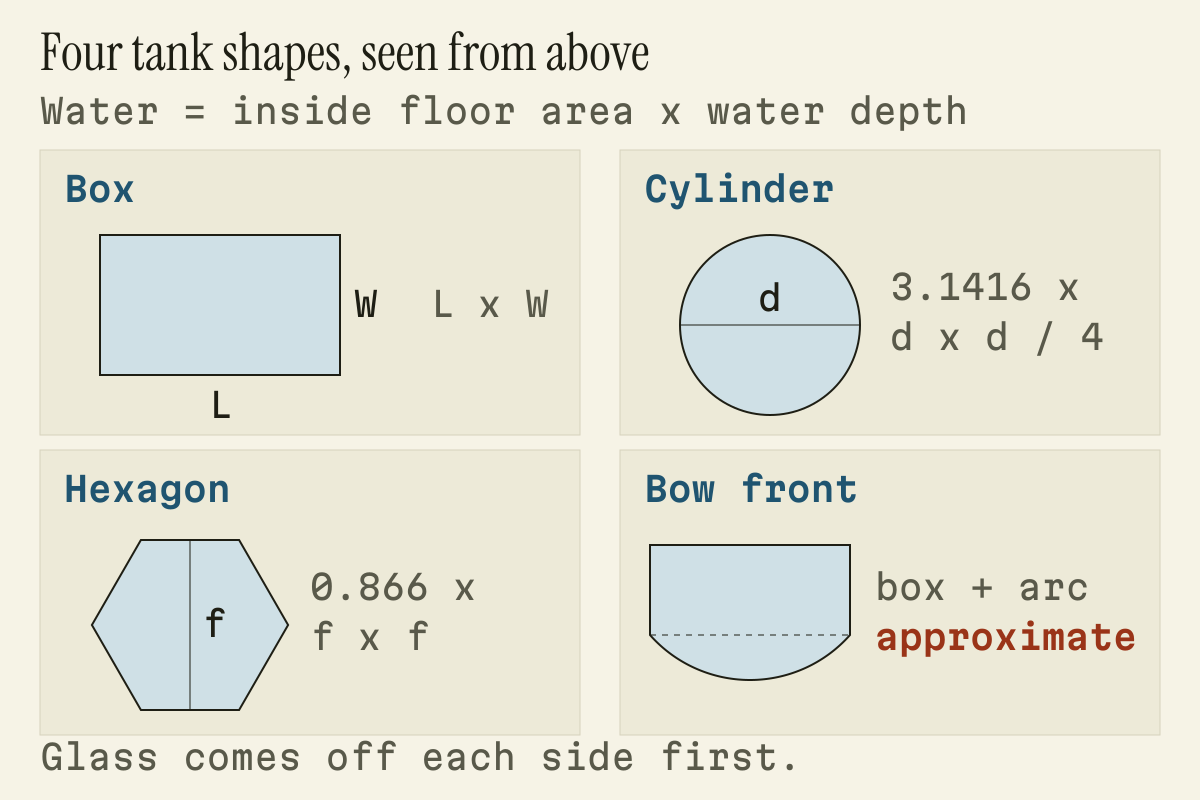
Four floor plans seen from above, each with its area rule; the bow front is approximate.
Worked from Plane geometry for each floor plan; the glass thickness is taken off every side before the area is worked out.
"Four tank shapes the calculator handles" by Sniff, Purr, Preen & Shoal, https://sniffpurrpreenandshoal.com/fish/tank-volume-calculator/, licensed under CC BY 4.0 (https://creativecommons.org/licenses/by/4.0/)
Five shapes are built in: box, cube, cylinder, regular hexagon and bow front. For each, the calculator takes the glass off every side, works out the inside floor area and multiplies it by the water depth.
A bow front is the one estimate among the five shapes: the calculator treats the curved front as a single circular arc on a box, and real curved glass may not follow that arc, so its answers are approximate.
How fish spread through that water is another matter, taken up in shoal and school.
What is a US gallon?
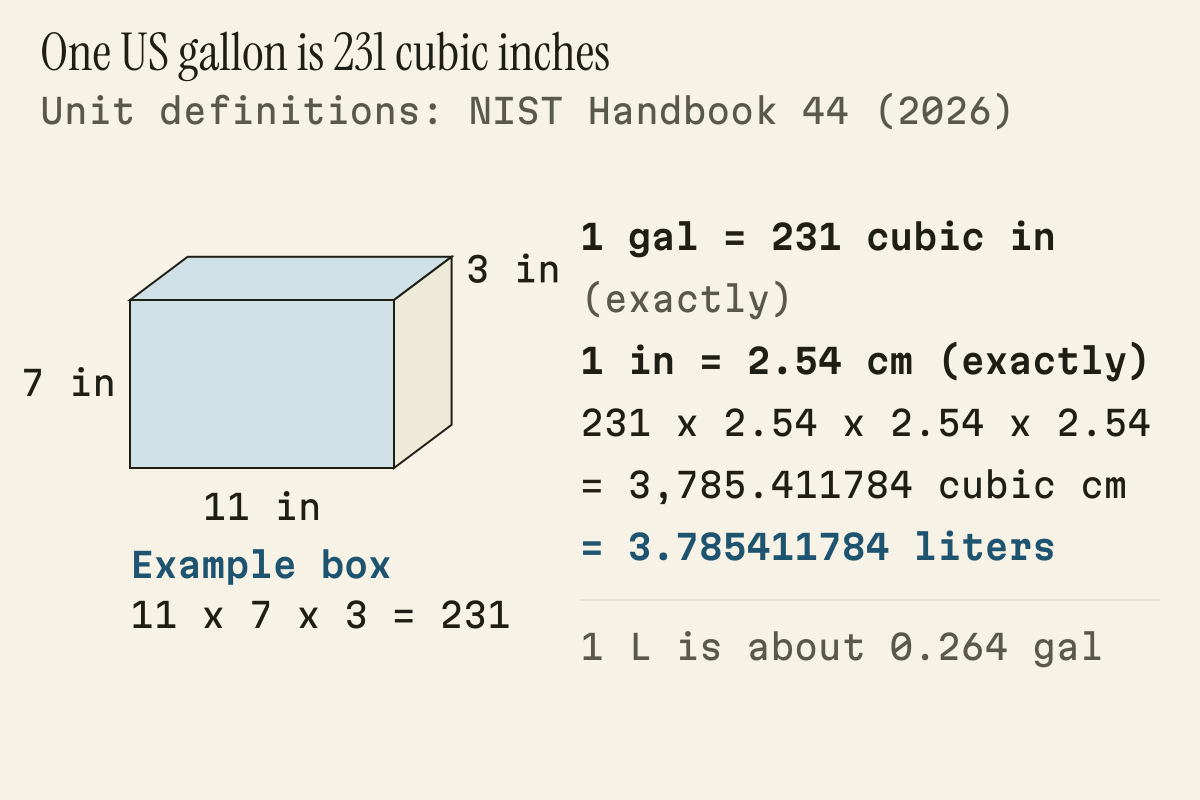
An example box of 11 by 7 by 3 inches holds 231 cubic inches, one US gallon.
Worked from Unit definitions in NIST Handbook 44 (2026), Appendix C; 231 × 2.54 × 2.54 × 2.54 cubic centimeters is computed for this page and matches the handbook's table.
"One US gallon is 231 cubic inches, or 3.785411784 liters" by Sniff, Purr, Preen & Shoal, https://sniffpurrpreenandshoal.com/fish/tank-volume-calculator/, licensed under CC BY 4.0 (https://creativecommons.org/licenses/by/4.0/)
Data: NIST Handbook 44 (2026), Appendix C (unit definitions)
NIST Handbook 44 (2026), Appendix C, lists “1 gallon (gal) = 231 cubic inches” and gives the gallon as “231 cubic inches (exactly).” The same appendix defines the inch as “2.54 centimeters (exactly).” Multiplying 231 by 2.54 three times gives 3,785.411784 cubic centimeters, so one US gallon is 3.785411784 liters, the figure in the handbook's own table.
The British Imperial gallon in that appendix is larger: 277.42 cubic inches, or about 4.546 liters. The calculator works in US gallons. The site's other calculator, for dog years, shows its formula and limits the same way.
Is one inch of fish per gallon a real rule?
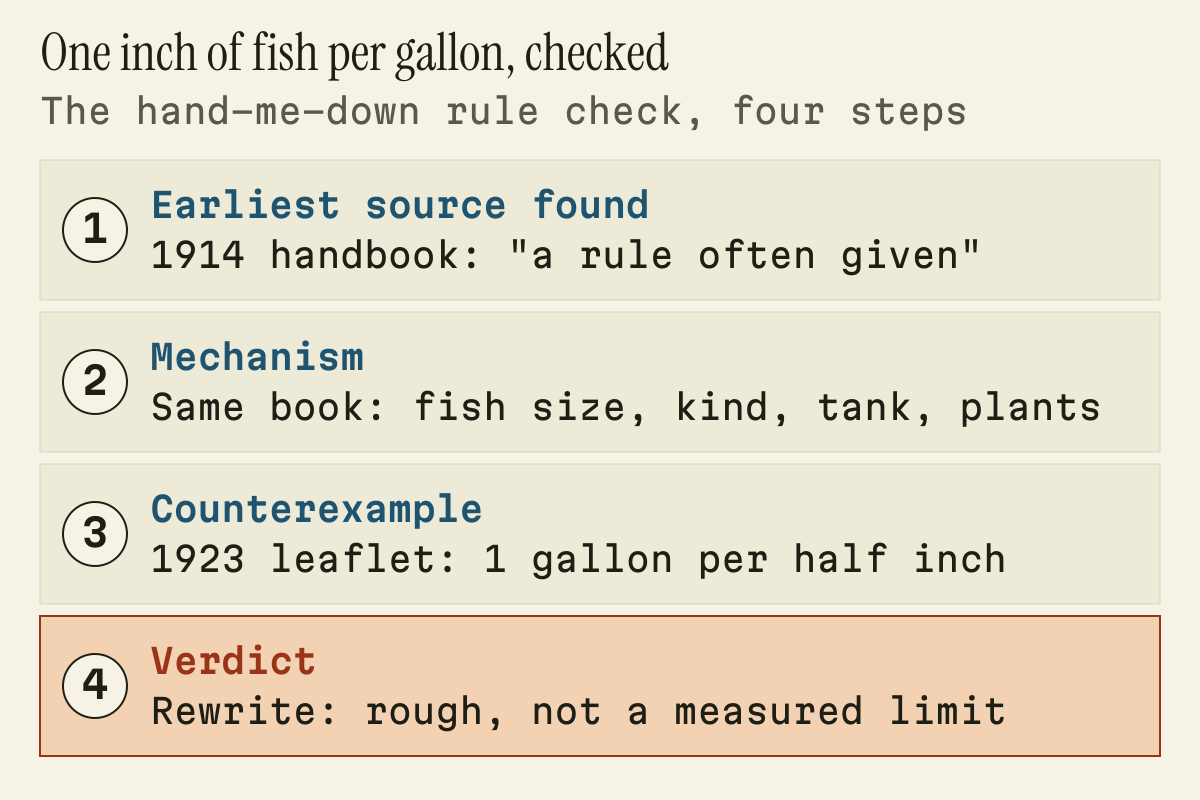
One inch of fish per gallon put through the four-step check: a 1914 printing, its own caveat, a stricter 1923 rule, and a verdict to rewrite it.
Worked from The four steps of the hand-me-down rule check, applied with quotations from Osburn 1914 (page 31) and Fearnow 1923 (page 4).
This figure in words
the four-step check of one inch of fish per gallon.
| Step | Finding | Source |
|---|---|---|
| Earliest source found | A 1914 handbook already calls it “a rule often given” | Osburn 1914, p. 31 |
| Mechanism | The same page says the number depends on the fishes' size and kind, the tank's proportions and the plants | Osburn 1914, p. 31 |
| Counterexample | A 1923 federal leaflet printed a rule twice as strict, 1 gallon to each half inch | Fearnow 1923, p. 4 |
| Verdict | Rewrite: a rough old figure, not a measured limit | This page |
"One inch of fish per gallon, checked in four steps" by Sniff, Purr, Preen & Shoal, https://sniffpurrpreenandshoal.com/fish/tank-volume-calculator/, licensed under CC BY 4.0 (https://creativecommons.org/licenses/by/4.0/)
Data: Osburn (1914), The Care of Home Aquaria, p. 31 (public domain in the US); Fearnow (1923), Bureau of Fisheries Document No. 935, p. 4 (US federal work)
Download the four-step check (CSV) (what the file holds) Data: Osburn (1914), The Care of Home Aquaria, p. 31; Fearnow (1923), Bureau of Fisheries Document No. 935, p. 4
One inch of fish per gallon fits what this site calls the hand-me-down rule, a rule of thumb passed between hobbyists without a source anyone can point to. Only its history and reasoning are checked here; this page gives no number of fish.
The oldest printing of the one-inch wording found for this page is in Raymond C. Osburn's The Care of Home Aquaria, published by the New York Zoological Society in 1914. Page 31 reads: “A rule often given is—one inch of fish (not counting the tail) to each gallon of water.” Searches of the scanned text of three older aquarium books, from 1883, 1890 and 1909, turned up no one-inch wording.
The same page undercuts it as a fixed rate: “It is difficult to lay down any hard and fast rule for this, because the number of fishes that can be kept depends upon their size and kind as well as upon the proportions of the tank and the amount of plant life in good thrifty condition.” No study tying fish length to water volume was among the sources read.
Nine years later, Fearnow's leaflet printed a stricter figure: “A good rule in stocking an aquarium is to allow 1 gallon of water to each one-half inch of fish.” Two early sources set the figure a factor of two apart.
The verdict is rewrite: as printed in 1914, one inch per gallon was a rough starting figure its own page hedged, not a measured limit, and being a hand-me-down rule does not by itself make it wrong. Still unknown, from the sources read, is who printed the rule before 1914, how much water sits between gravel grains, and how much decor displaces.
Sources
- National Institute of Standards and Technology (2026). "Appendix C. General Tables of Units of Measurement." Handbook 44 – 2026. NIST HB 44-2026. doi.org/10.6028/NIST.HB.44-2026Read: Public-domain original; U.S. Government work (17 U.S.C. §105), Appendix C read in full
- Fearnow EC (1923). Goldfish, Their Care in Small Aquaria. Bureau of Fisheries Document No. 935. Washington: US Department of Commerce, Bureau of Fisheries. archive.org/details/department-commerce-goldf…Read: Public-domain original; U.S. Government work (17 U.S.C. §105), pages 2 and 4 checked against the scan
- Osburn RC (1914). The Care of Home Aquaria. New York Aquarium Nature Series. New York: New York Zoological Society. archive.org/details/careofhomeaquari00osbuRead: Public-domain original; published in the US in 1914, author d. 1955 (public domain in the EU since 2026, life plus 70 years), page 31 checked against the scan
- Mulertt H (1883). The Goldfish and Its Systematic Culture with a View to Profit. Cincinnati. archive.org/details/goldfishitssyste00muleRead: Public-domain original; published in the US in 1883, scanned text searched for a one-inch rule, nothing quoted
- Bateman GC (1890). Fresh-Water Aquaria: Their Construction, Arrangement, and Management. London: L.U. Gill. archive.org/details/cu31924031275856Read: Public-domain original; public domain in the US (published 1890), scanned text searched for a one-inch rule, nothing quoted
- Smith HM (1909). Japanese Goldfish: Their Varieties and Cultivation. Washington: W. F. Roberts Company. archive.org/details/japanesegoldfish00smitRead: Public-domain original; author d. 1941, scanned text searched for a one-inch rule, nothing quoted
Cite this page
Sniff, Purr, Preen & Shoal. “Aquarium Volume Calculator: Glass and Gravel Take a Share.” Published November 20, 2026. https://sniffpurrpreenandshoal.com/fish/tank-volume-calculator/. Accessed on the day you read it.
How studies are read and numbers recheckedMending basket: every correctionReport an error on this page (contact@sniffpurrpreenandshoal.com)
More from Fish Minds & Tanks
Shoal Research story
Goldfish Memory: The 3-Second Claim Meets Two Lab Studies
Picture credit
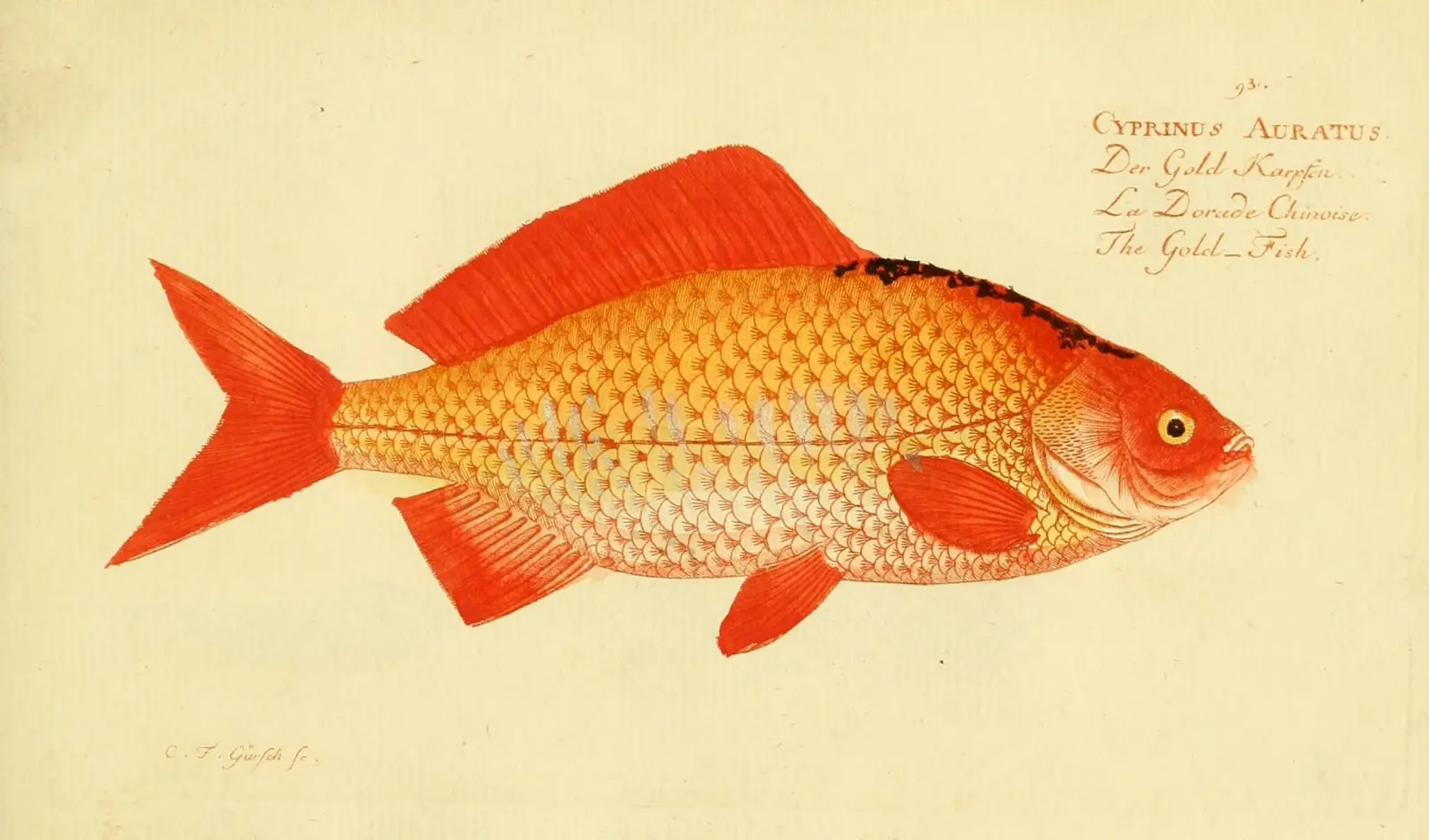
"Cyprinus auratus, The Gold-Fish: Ichthyologie, ou Histoire naturelle des poissons, Plate 93" by Marcus Elieser Bloch (engraved by C. F. Gürsch); Biodiversity Heritage Library — https://commons.wikimedia.org/wiki/File:Ichthyologie;_ou,_Histoire_naturelle_des_poissons_(Plate_93)_(6918365142).jpg — Public domain (EU: Marcus Elieser Bloch died 1799, more than 70 years ago (life plus 70 years); the engraver C. F. Gürsch's death year not traced; the plate was engraved by 1796; US: published before 1931; faithful scan)
Shoal Mechanism explainer
Shoal vs School: A School Is a Shoal That Moves in Step
Picture credit
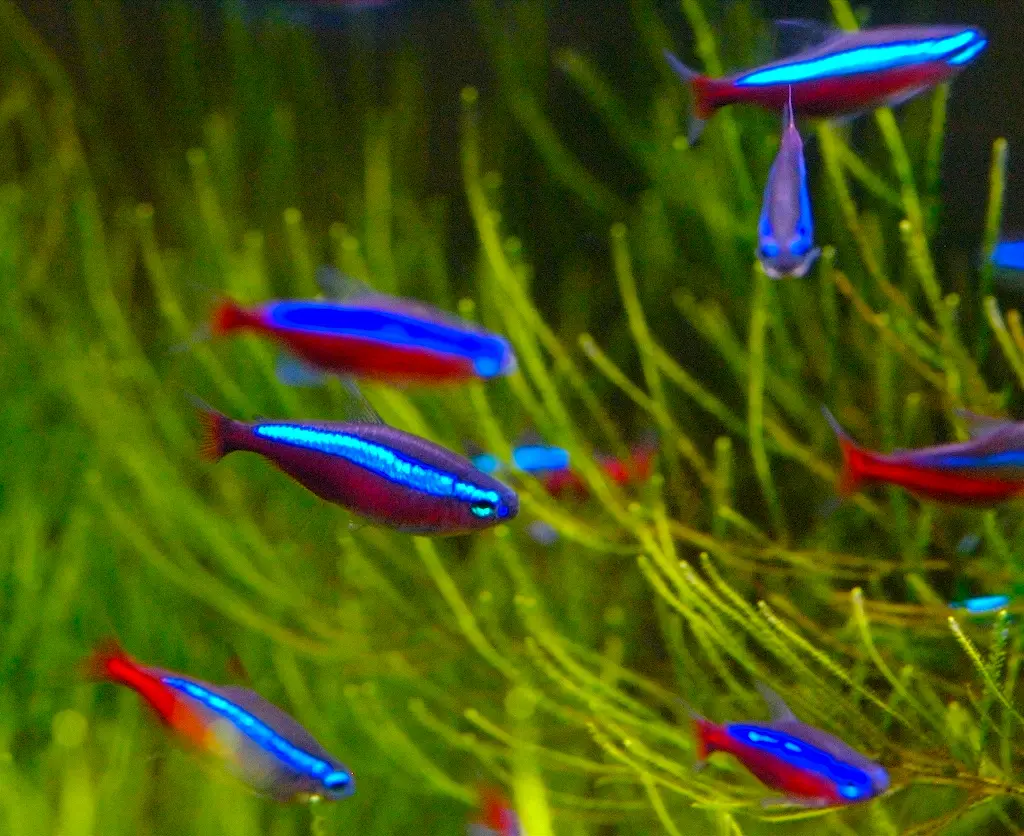
"Peace with my buddies" by Leino Olé from Saint Lambert, Canada — https://commons.wikimedia.org/wiki/File:Peace_with_my_buddies_-_Flickr_-_Leino88.jpg — CC BY 2.0 (https://creativecommons.org/licenses/by/2.0/)
Shoal Tank card entry
Axolotl Metamorphosis: In Paris, Some Offspring Changed
Picture credit
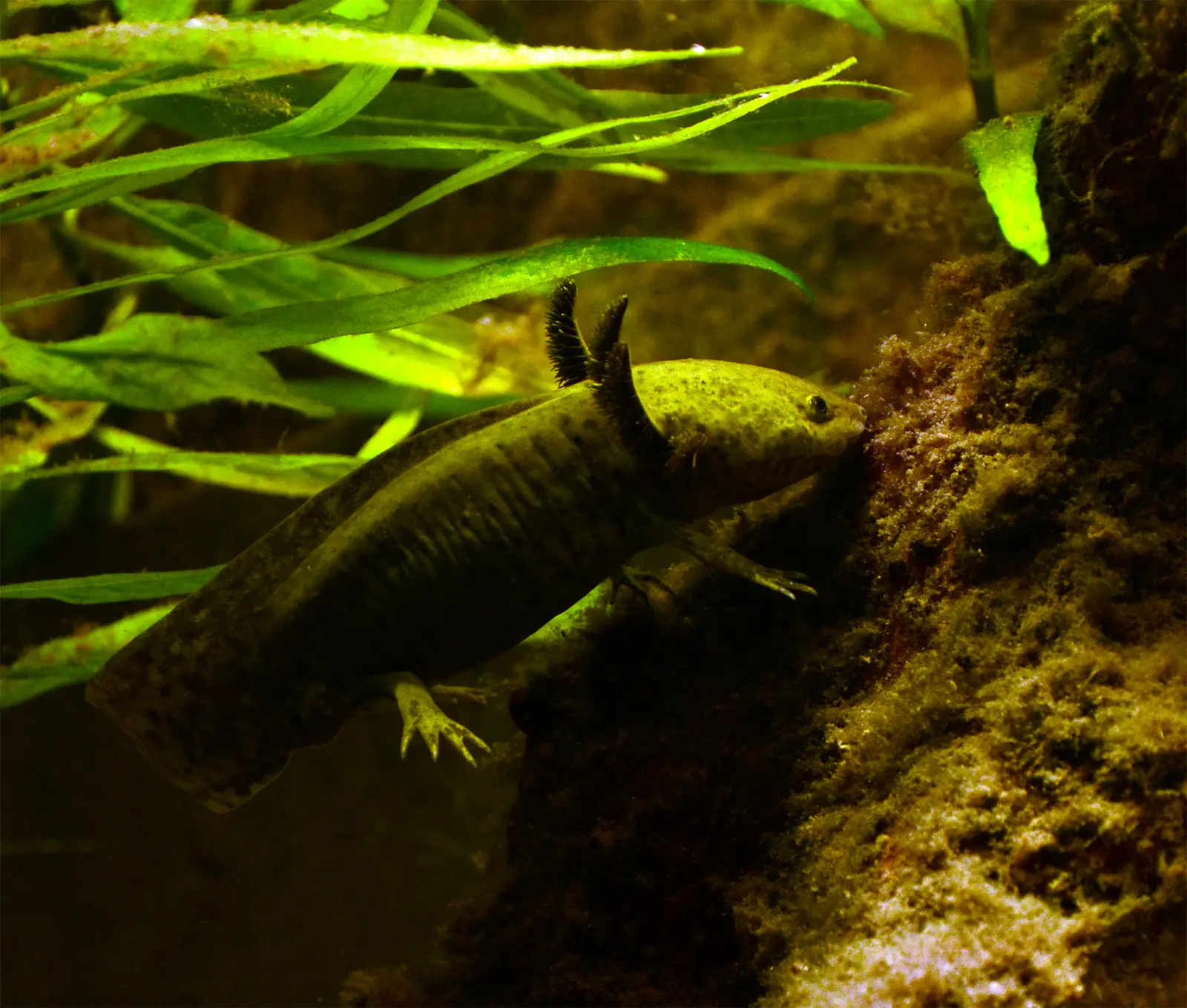
"Axolotl (Ambystoma mexicanum), Aquarium Dubuisson, Liège" by Vassil — https://commons.wikimedia.org/wiki/File:Axolotl_Ambystoma_mexicanum_Aquarium_Li%C3%A8ge_30012016_1.jpg — CC0 1.0 (https://creativecommons.org/publicdomain/zero/1.0/)