Shoal Research story
Goldfish Memory: The 3-Second Claim Meets Two Lab Studies
Sniff, Purr, Preen & Shoal Published
TL;DR
In two lab studies, goldfish showed signs of learning across days, not three seconds. By the abstract, eight goldfish lab colony in a 1994 lever study seemed to anticipate a once-a-day feeding hour, and maze-tested goldfish lab colony in 2019 improved over three days. How long a lesson lasts is unknown; neither text read for this page reports it.
Doorplate
- Animal
- Goldfish (Carassius auratus)
- Study
- Gee, Stephenson & Wright 1994, Journal of the Experimental Analysis of Behavior
- n (analysed / excluded)
- not in the abstract read
- Couch sample
- lab colony fish trained in an experimental lever setup; origin, age and sex not in the abstract read
- Limits
- Abstract only; one species; lab tanks with a lever; a daily light change in the first experiment
- Setup in one line
- 8 fish trained on a food lever; then only presses in 1 hour of 24 paid, same time daily, for 4 weeks; then 6 days with feeders off
- Replicated?
- As of 2026-11-20: a second experiment in the same paper, under constant light; independent repeats not traced for this page
This doorplate as data (CSV) what the file holds
Data: Gee, Stephenson & Wright (1994), Journal of the Experimental Analysis of Behavior, abstract only
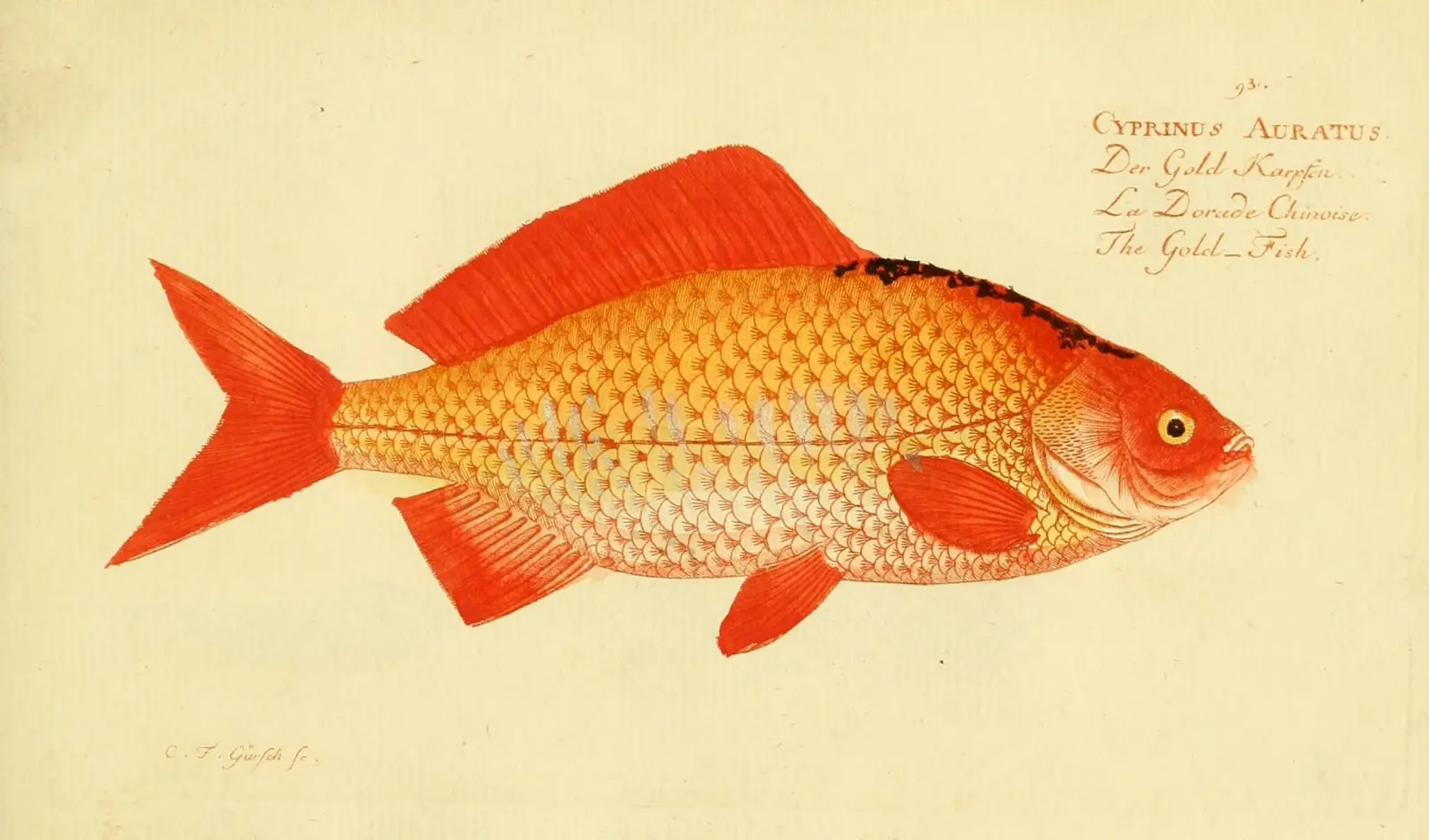
Plate 93 of Marcus Elieser Bloch's fish atlas, printed in 1796, labels this fish Cyprinus auratus and, in English, The Gold-Fish.
“Cyprinus auratus, The Gold-Fish: Ichthyologie, ou Histoire naturelle des poissons, Plate 93”, Marcus Elieser Bloch (engraved by C. F. Gürsch); Biodiversity Heritage Library; public domain.
Full credit
"Cyprinus auratus, The Gold-Fish: Ichthyologie, ou Histoire naturelle des poissons, Plate 93" by Marcus Elieser Bloch (engraved by C. F. Gürsch); Biodiversity Heritage Library — https://commons.wikimedia.org/wiki/File:Ichthyologie;_ou,_Histoire_naturelle_des_poissons_(Plate_93)_(6918365142).jpg — Public domain (EU: Marcus Elieser Bloch died 1799, more than 70 years ago (life plus 70 years); the engraver C. F. Gürsch's death year not traced; the plate was engraved by 1796; US: published before 1931; faithful scan)
You lift the lid of the food tin, and the goldfish is already at the front glass. A 1994 study by Philip Gee, David Stephenson and Donald Wright built a laboratory test around that kind of moment, training eight goldfish lab colony to press a lever for food. By the abstract, the only part of the paper read for this page, the fish came to press in a pattern that suggested they anticipated their daily feeding time.
A feeding time that comes once a day is a long way from three seconds.
This page checks the three-second figure first, using the hand-me-down rule: find where the rule first appeared in print, ask what mechanism would make it true, look for counterexamples, then keep, rewrite or retire it. The two studies follow in detail, with a plain account of what neither one measured.
Where does the three-second claim come from?
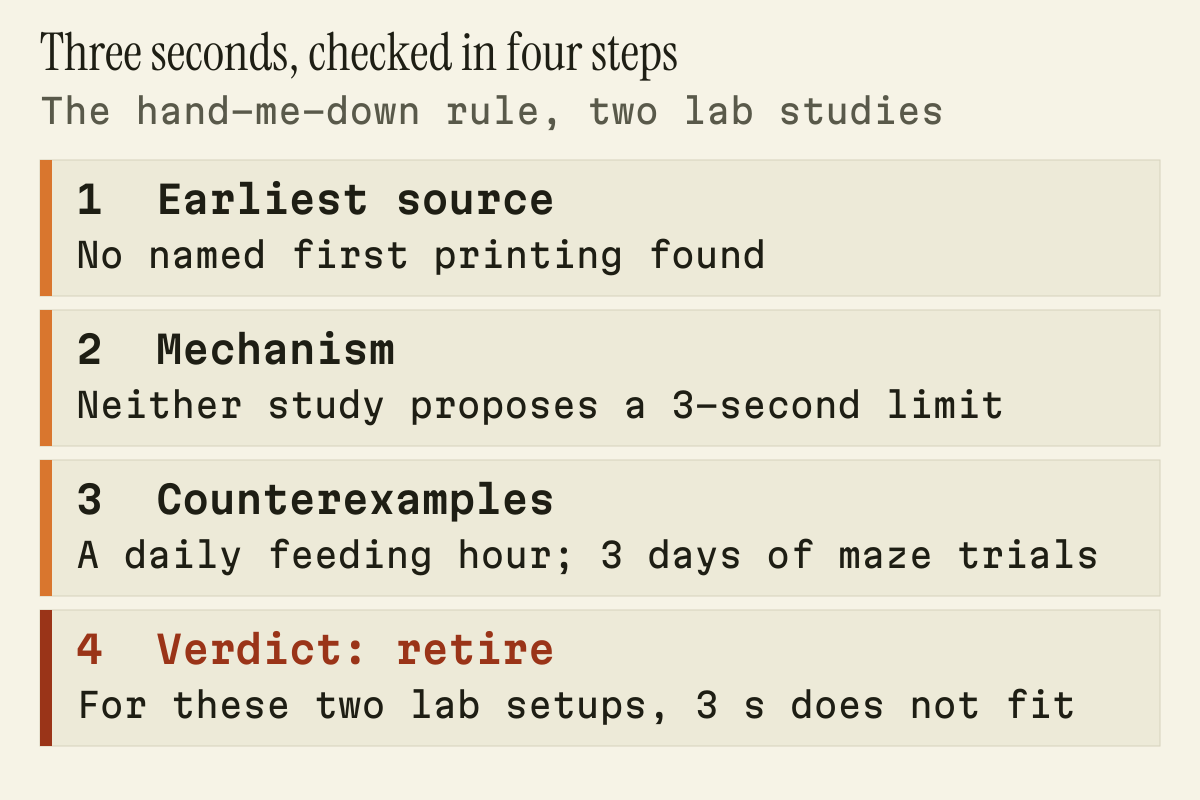
The three-second claim run through the four steps of the hand-me-down rule, using only the two lab studies read for this page.
Worked from The abstract of Gee, Stephenson & Wright 1994 and the full text of Abreu et al. 2019.
This figure in words
The four steps and what each one found.
| Step | Question | What this page found |
|---|---|---|
| 1. Earliest source | Who first printed the three-second figure? | No named source turned up in the sources read for this page |
| 2. Mechanism | What would make a three-second limit true? | Neither study read proposes one |
| 3. Counterexamples | Do any tests show learning that lasts longer? | A response pattern tied to a daily feeding hour; maze trials across three days |
| 4. Verdict | Keep, rewrite or retire? | Retire, for goldfish in these two lab setups |
"The three-second goldfish memory claim, checked in four steps" by Sniff, Purr, Preen & Shoal, https://sniffpurrpreenandshoal.com/fish/goldfish-memory/, licensed under CC BY 4.0 (https://creativecommons.org/licenses/by/4.0/)
Data: Gee, Stephenson & Wright (1994), Journal of the Experimental Analysis of Behavior, abstract only; Abreu et al. (2019), Brazilian Journal of Medical and Biological Research, Creative Commons Attribution License, version not stated on the article page
Step one looks for where the rule first appeared in print. None of the sources read for this page states the three-second figure or says where it began, so the claim's origin cannot be traced here. That gap is typical of a hand-me-down rule, which travels without a source anyone can name.
Step two asks what would have to be true for the rule to work. A limit of three seconds would mean that a goldfish loses whatever it learned almost at once. Neither of the two studies read here proposes any mechanism like that, and both were designed to test learning that builds over hours or days.
Step three looks for cases the rule gets wrong. The lever study kept fish on a feeding hour that came round once every 24 hours, and the maze study ran its trials across three consecutive days. Learning that shows up across a whole day, or across three days of trials, does not fit a limit of three seconds.
Step four is the verdict: retire. For goldfish in these two laboratory setups, three seconds does not describe what they learned. The verdict covers lab fish in two studies; it says nothing about how any single fish in a living room is doing.
What did the lever study measure?
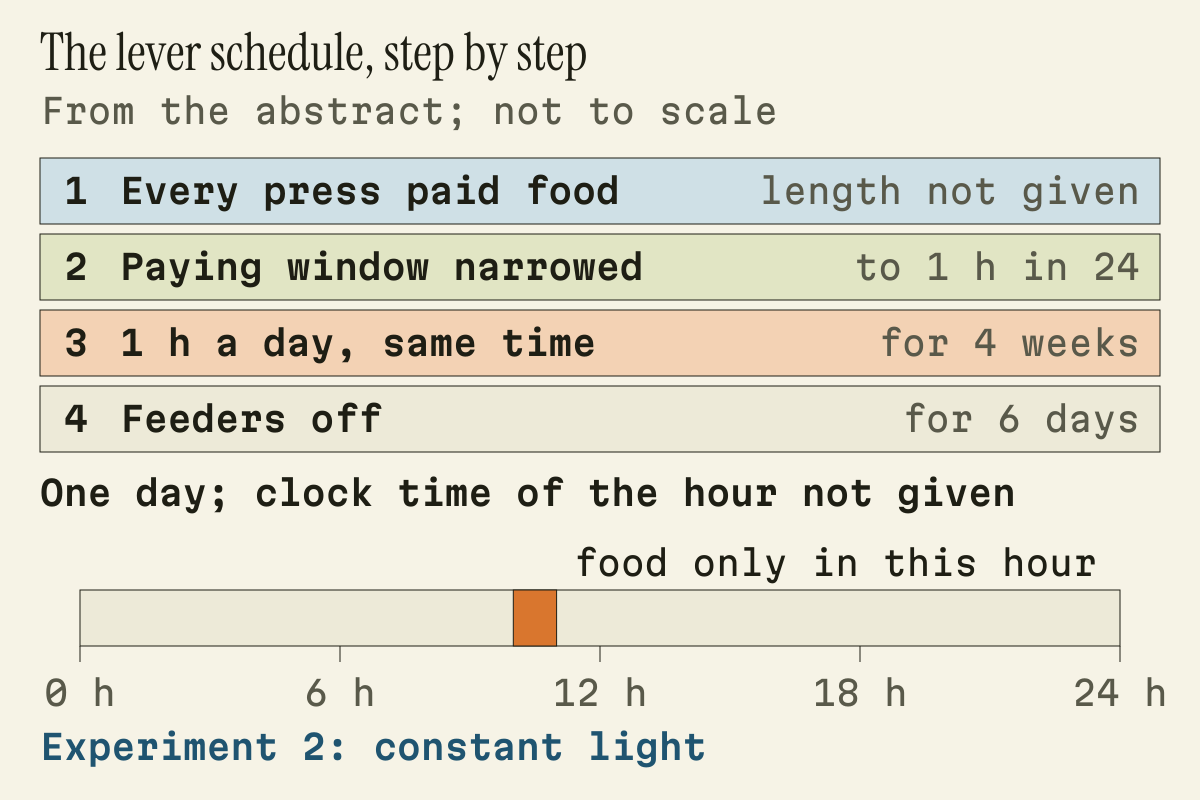
The lever schedule as the abstract describes it, in four stages; from the abstract and not to scale, and the clock time of the feeding hour is not given.
Worked from The abstract of Gee, Stephenson & Wright 1994 only; the order of stages follows the abstract, which does not give the length of the first two.
This figure in words
The schedule in the first experiment, in order.
- Each press on the lever delivered food; the abstract does not say for how long.
- The window in which presses paid off was narrowed in stages to 1 hour in every 24.
- That 1-hour window opened at the same time each day and stayed in place for 4 weeks.
- The food dispensers were switched off for 6 days.
"The lever study's feeding schedule, from the abstract" by Sniff, Purr, Preen & Shoal, https://sniffpurrpreenandshoal.com/fish/goldfish-memory/, licensed under CC BY 4.0 (https://creativecommons.org/licenses/by/4.0/)
Data: Gee, Stephenson & Wright (1994), Journal of the Experimental Analysis of Behavior, abstract only
Gee, Stephenson and Wright published the study in the Journal of the Experimental Analysis of Behavior in 1994. The experiment used operant conditioning, the kind of learning in which an animal's own action, here a press on a lever, brings a result such as food. Only the abstract was read for this page, so every detail below comes from that single summary paragraph.
In the first experiment, the lighting changed at a fixed time each day. Eight fish lab colony learned to work a lever that delivered food with every press. The window in which presses paid off was then narrowed in stages, until food came only during 1 hour in every 24.
Feeding time and its fade
That one-hour window opened at the same time each day and stayed in place for 4 weeks. Then the food dispensers were switched off for 6 days of extinction, the part of a learning study in which the action no longer earns anything.
By the abstract, the pattern of presses suggested that the fish could tell the time of day well enough to anticipate their feeding hour, an ability the abstract calls temporal discrimination. The abstract adds that this pattern persisted for a limited number of days once the food stopped, without giving the count.
A daily light change could have served as a clock. The second experiment removed that cue by keeping the light on around the clock, and by the abstract it produced evidence that the same kind of timing could still develop. The abstract does not give the number of fish in that experiment, where any of the fish came from, or how many were left out of the analysis.
Can goldfish learn a place?
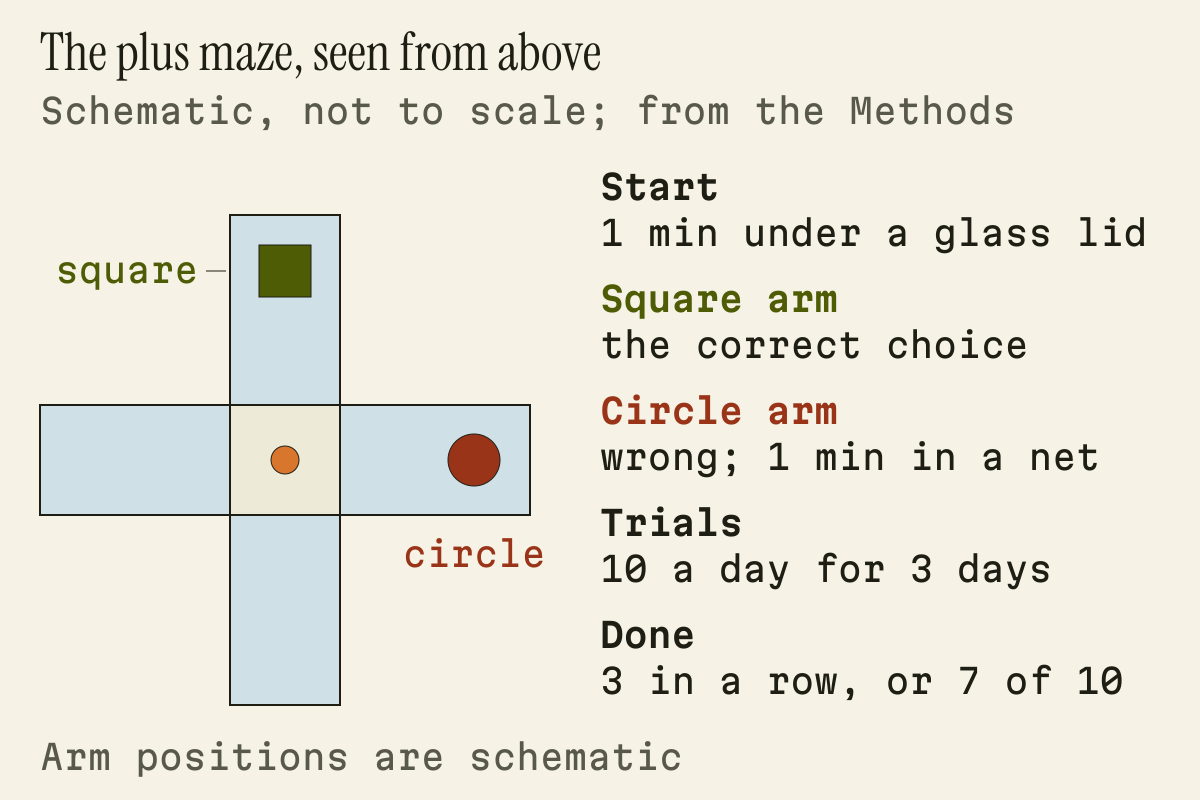
A schematic of the plus maze in the 2019 study, not to scale; which arms carried the square and the circle is drawn for illustration only.
Worked from The Methods of Abreu et al. 2019 (open access, Creative Commons Attribution License, version not stated on the article page); arm positions and sizes are schematic.
This figure in words
The maze task, as the Methods describe it.
- The test tank was a plus-shaped maze with four arms.
- A square marked the correct arm and a circle marked a wrong arm.
- Each trial began with the fish held for 1 minute under a glass lid at the center.
- A wrong choice was followed by 1 minute confined by a net in that arm.
- Each fish ran 10 trials a day for three consecutive days, up to 30 in all.
- A fish was done after three correct choices in a row, or seven correct in a set of 10.
"The plus-maze task in the 2019 goldfish study, schematic" by Sniff, Purr, Preen & Shoal, https://sniffpurrpreenandshoal.com/fish/goldfish-memory/, licensed under CC BY 4.0 (https://creativecommons.org/licenses/by/4.0/)
Data: Abreu et al. (2019), Brazilian Journal of Medical and Biological Research, Methods, Creative Commons Attribution License, version not stated on the article page
A 2019 study led by C. C. Abreu at the Federal University of Pará in Brazil asked whether a richer tank changes how fast goldfish learn their way around. The paper is open access under a Creative Commons Attribution License, version not stated on the article page. Six-month-old goldfish lab colony lived for 183 days in one of two 332-liter tanks. One tank held live plants, a resin boat and a pump-driven current that ran 12 hours a day; the other held none of these.
The test tank was a plus-shaped maze with four arms, two of them marked. A square showed the correct arm and a circle a wrong one. Each trial began with the fish held for 1 minute under a glass lid at the center. A fish that chose the wrong arm was confined there by a net for 1 minute before going back to its home tank.
What the richer tank changed
Each fish ran 10 trials a day for three consecutive days, up to 30 trials in all. It finished once it made three correct choices in a row, or seven correct choices in a set of 10. Abreu and colleagues tracked the number of sessions each fish needed. Fish from the richer tank reached that mark faster than fish from the bare tank, and the difference passed the study's statistical test (log-rank test, P = 0.0354).
The paper calls this spatial learning and memory. Because the correct arm also carried a square, the task may test a visual cue as much as a place. The setup does not separate the two. The text read for this page does not state the number of fish that ran the maze.
The study also counted brain cells in 7 fish lab colony from each group and found more in the fish from the richer tank. The count covered the telencephalon, the front part of the fish brain, which earlier goldfish studies cited in the paper describe as essential for spatial learning. The authors present the cell difference and the faster learning as two findings that coincided, and they did not test the mechanism linking them.
A single fish in a maze is a different question from what fish do together. How a group of fish moves as one is covered in Shoal vs School, and another tank animal with an unusual history has its own page in Axolotl Metamorphosis.
How long do the lessons last?
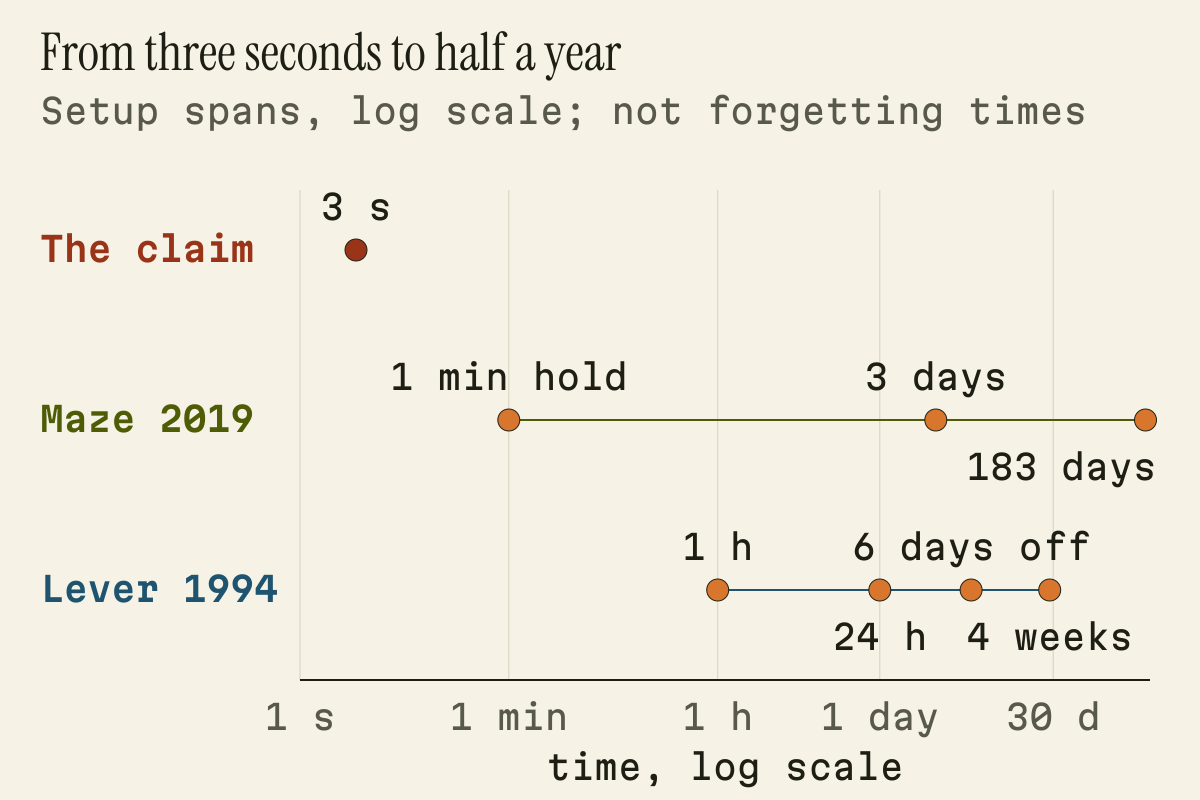
The time spans built into each setup on one log scale, from 3 seconds to 183 days; these are not forgetting times.
Worked from Time spans from the abstract of Gee, Stephenson & Wright 1994 and the Methods of Abreu et al. 2019; seconds for each span computed for this page.
This figure in words
Each span on the scale, shortest first.
- The claim: 3 seconds, the figure being checked, not a measurement.
- Maze study, 2019: a 1-minute hold under the glass lid before each trial.
- Lever study, 1994: a 1-hour daily window when presses paid off.
- Lever study, 1994: a 24-hour cycle for the daily schedule.
- Maze study, 2019: 3 days over which the trials ran.
- Lever study, 1994: 6 days with the feeders switched off.
- Lever study, 1994: 4 weeks on the final 1-hour schedule.
- Maze study, 2019: 183 days of housing in the two tanks before the maze.
"Time spans in two goldfish studies, from three seconds to half a year" by Sniff, Purr, Preen & Shoal, https://sniffpurrpreenandshoal.com/fish/goldfish-memory/, licensed under CC BY 4.0 (https://creativecommons.org/licenses/by/4.0/)
Data: Gee, Stephenson & Wright (1994), Journal of the Experimental Analysis of Behavior, abstract only; Abreu et al. (2019), Brazilian Journal of Medical and Biological Research, Creative Commons Attribution License, version not stated on the article page
On a single time line, three seconds sits far to the left of anything either study ran. The shortest span in either setup is the 1-minute hold under the glass lid. The longest are the 4 weeks on the 1-hour schedule and the 183 days of housing before the maze.
None of those spans is a forgetting time. To answer “how long is a goldfish memory?” directly, a study would train fish, wait a set interval, and then test what was left. Neither the 1994 abstract nor the 2019 Methods describes that design. The closest is the lever study's extinction stage, where the feeding-hour pattern faded within a limited number of days, a count the abstract does not give.
Do goldfish recognize their owners? No study read for this page tested it. The fish in both studies responded to a lever, a light schedule, a feeding hour and a shape on a maze arm, not to a particular person.
Neither study offers care advice, and none is given here; a question about a goldfish's health or its water belongs with a veterinarian who treats fish. Sources and reading levels on this page are explained in Sniff test.
The two studies side by side
Each row below carries the couch sample marker for its study, which records where the fish came from rather than grading the work:
| Study | Couch sample | Task and cue | Time spans | Result | Read for this page |
|---|---|---|---|---|---|
| Lever study, 1994 | lab colony, 8 fish trained | Lever for food; daily light change in experiment 1 | 1-hour window daily for 4 weeks, then 6 days off | Pattern suggested anticipation of feeding time | Abstract only |
| Maze study, 2019 | lab colony, maze count not stated | Plus maze; square on the correct arm | 10 trials a day over 3 days, after 183 days of housing | Fish from the richer tank met the mark faster | Full text, open license |
Download the goldfish studies (CSV) (what the file holds) Data: Gee, Stephenson & Wright (1994), Journal of the Experimental Analysis of Behavior, abstract only; Abreu et al. (2019), Brazilian Journal of Medical and Biological Research, Creative Commons Attribution License, version not stated on the article page
What is still unknown, from these two studies, is how long a goldfish keeps a lesson once it stops paying off. It is also unknown whether a planted home tank changes learning the way the 2019 tanks did, and whether results from eight lever fish and two maze groups hold for goldfish outside a laboratory.
Sources
- Gee P, Stephenson D, Wright DE (1994). "Temporal discrimination learning of operant feeding in goldfish (Carassius auratus)." Journal of the Experimental Analysis of Behavior 62(1):1-13. doi.org/10.1901/jeab.1994.62-1Read: Abstract only; the full text is available only as page scans, which were not read
- Abreu CC, Fernandes TN, Henrique EP, Pereira PDC, Marques SB, Herdeiro SLS, Oliveira FRR, Magalhães NGM, Anthony DC, Melo MAD, Guerreiro-Diniz C, Diniz DG, Picanço-Diniz CW (2019). "Small-scale environmental enrichment and exercise enhance learning and spatial memory of Carassius auratus, and increase cell proliferation in the telencephalon: an exploratory study." Brazilian Journal of Medical and Biological Research 52(5):e8026. doi.org/10.1590/1414-431X20198026Read: Full text, open license; Creative Commons Attribution License, version not stated on the article page
Cite this page
Sniff, Purr, Preen & Shoal. “Goldfish Memory: The 3-Second Claim Meets Two Lab Studies.” Published November 20, 2026. https://sniffpurrpreenandshoal.com/fish/goldfish-memory/. Accessed on the day you read it.
How studies are read and numbers recheckedMending basket: every correctionReport an error on this page (contact@sniffpurrpreenandshoal.com)
More from Fish Minds & Tanks
Shoal Tool page
Aquarium Volume Calculator: Glass and Gravel Take a Share
Picture credit
"Freshwater nano aquarium" by Chris Penny — https://commons.wikimedia.org/wiki/File:Freshwater_nano_aquarium.jpg — CC BY 2.0 (https://creativecommons.org/licenses/by/2.0/)
Shoal Mechanism explainer
Shoal vs School: A School Is a Shoal That Moves in Step
Picture credit
"Peace with my buddies" by Leino Olé from Saint Lambert, Canada — https://commons.wikimedia.org/wiki/File:Peace_with_my_buddies_-_Flickr_-_Leino88.jpg — CC BY 2.0 (https://creativecommons.org/licenses/by/2.0/)
Shoal Tank card entry
Axolotl Metamorphosis: In Paris, Some Offspring Changed
Picture credit
"Axolotl (Ambystoma mexicanum), Aquarium Dubuisson, Liège" by Vassil — https://commons.wikimedia.org/wiki/File:Axolotl_Ambystoma_mexicanum_Aquarium_Li%C3%A8ge_30012016_1.jpg — CC0 1.0 (https://creativecommons.org/publicdomain/zero/1.0/)