Sniff Research story
Pavlov’s Dogs: In the 1927 English Text, Metronomes Lead
Sniff, Purr, Preen & Shoal Published
TL;DR
In G. V. Anrep’s 1927 English translation of Ivan Pavlov’s lectures, the metronome is named 313 times and the bell only 3 times. Bells did appear in some of Pavlov’s work, as a 1997 history paper documents from a 1906 lecture onward. How closely the English wording matches the sounds actually used in the laboratory is still unknown.
Doorplate
- Animal
- Laboratory dogs in Pavlov's experiments, as described in the lectures
- Study
- Pavlov 1927, Conditioned Reflexes, translated by G. V. Anrep
- n (analysed / excluded)
- No single sample: the lectures pool many experiments; the order-of-stimuli series used 5 dogs / no exclusions stated
- Couch sample
- lab colony dogs kept for laboratory experiments
- Limits
- Lectures summarizing many experimenters' work; word counts describe the 1927 English translation only, taken from the scan's text layer with a five-page comparison
- Setup in one line
- A sound or other signal started before food; saliva measured in drops
- Replicated?
- As of 2026-11-20, not assessed: no later conditioning study was read for this page
George Stubbs painted this white poodle in a punt around 1780, more than a century before Pavlov’s laboratory. It shows an alert dog, not one of the laboratory dogs.
"White Poodle in a Punt, by George Stubbs" by George Stubbs; National Gallery of Art, Washington (Paul Mellon Collection 1999.80.22) — https://commons.wikimedia.org/wiki/File:George_Stubbs,_White_Poodle_in_a_Punt,_c._1780,_NGA_110281FXD.jpg — CC0 1.0 (https://creativecommons.org/publicdomain/zero/1.0/); modified: color-adjusted version uploaded to Commons by another user from the National Gallery of Art file (other version listed on the gallery file page); not changed further
The can opener turns once, and your dog is already at the kitchen door. Ivan Pavlov’s laboratory turned moments like that into measurements. In one demonstration described in the 1927 lectures, saliva began to flow 9 seconds after a metronome started, and eleven drops came within 45 seconds lab colony.
The sound was the point of the experiment. Which sound the laboratory reached for is a question the published lectures themselves can answer.
What did Pavlov’s lectures actually name?
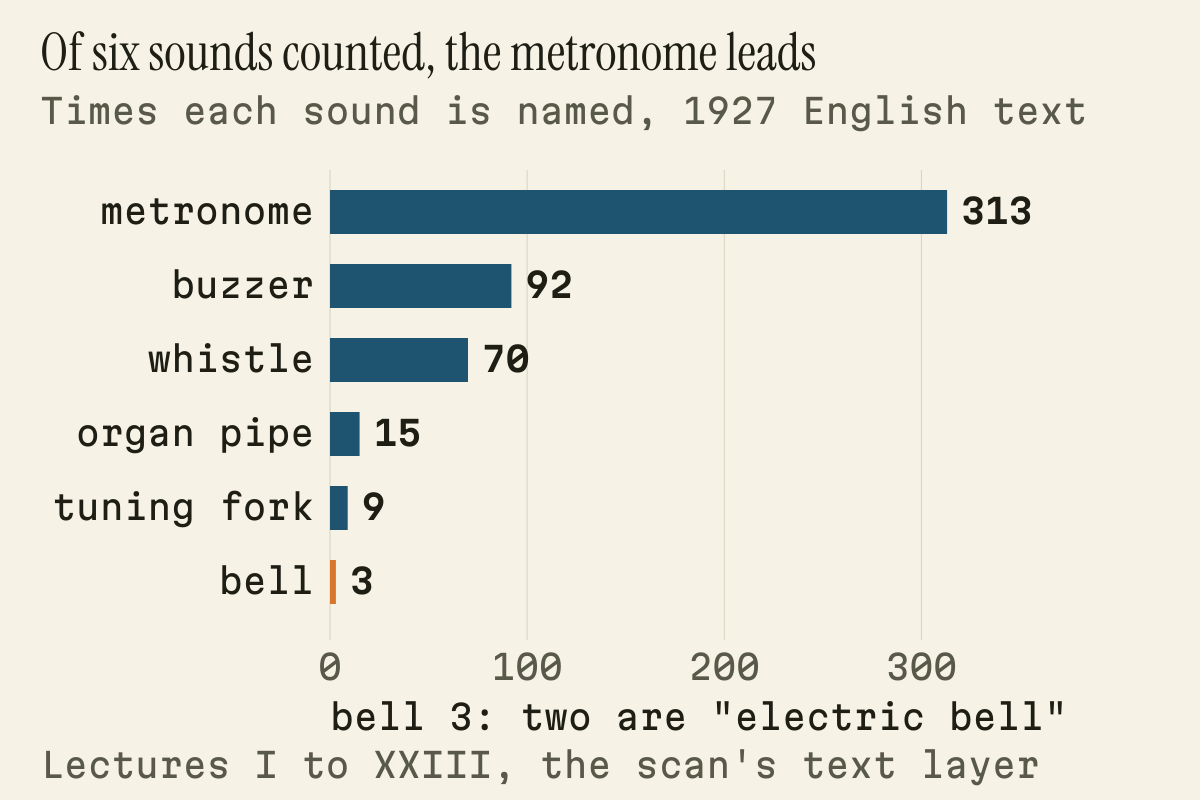
Times each sound source is named in Lectures I to XXIII of the 1927 English translation. Two of the three bells are an electric bell.
Worked from Whole-word counts in the 1927 Anrep translation, Lectures I to XXIII; a five-page hand check matched 13 of 13.
"How often the 1927 English translation of Pavlov's lectures names each sound source" by Sniff, Purr, Preen & Shoal, https://sniffpurrpreenandshoal.com/dogs/pavlovs-dogs/, licensed under CC BY 4.0 (https://creativecommons.org/licenses/by/4.0/)
Data: Pavlov 1927, Conditioned Reflexes, tr. G. V. Anrep (public domain)
Conditioned Reflexes collects 23 lectures by Pavlov. Anrep’s translation was published by Oxford University Press in 1927, and the copy counted here is a photographic reprint made from sheets of that first edition. Counted across Lectures I to XXIII, the metronome is named 313 times. The buzzer comes next with 92 mentions, and the whistle has 70.
The bell has 3. Two of them name the buzzing of an electric bell: “the loud buzzing of an electric bell” on p. 27 and “the buzzing of an electric bell” on p. 34. The third, on p. 145 in Lecture VIII, is “the sound of a bell” as one of four sounds played in a fixed order.
The six sound words counted here are named 502 times in all, and the bell accounts for 3 of them, about 0.6 percent. The metronome alone is named more than 100 times as often as the bell.
The p. 34 case shows how blurry the words can be. In Lecture III, a dog has two food signals firmly established, “one to the sound of a metronome and the other to the buzzing of an electric bell.” The table printed just below that sentence names the two sounds only as “Sound of metronome” and “Buzzer.” Whether the laboratory thought of these as two names for one device cannot be settled from the page.
| Sound source | Times named, Lectures I to XXIII |
|---|---|
| metronome | 313 |
| buzzer | 92 |
| whistle | 70 |
| organ pipe | 15 |
| tuning fork | 9 |
| bell | 3 |
Download the word counts (CSV) (what the file holds) Data: Pavlov 1927, Conditioned Reflexes, tr. G. V. Anrep (public domain)
How was the counting done?
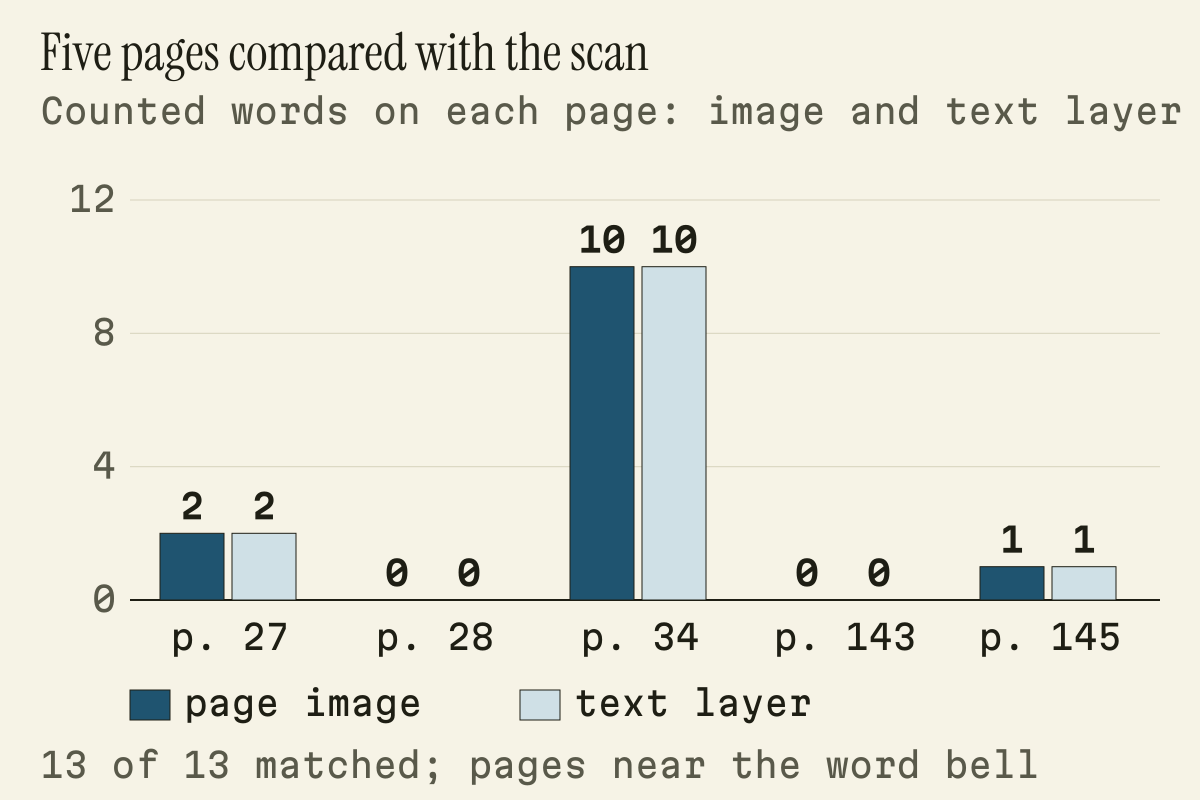
Mentions of the six counted sound words on five pages, counted on the page images and in the scan’s text layer. The pages were picked near the word bell.
Worked from Page images of pp. 27, 28, 34, 143 and 145 of the 1927 Anrep translation, compared page by page with the text-layer counts.
"Mentions counted on five pages: page images against the scan's text layer" by Sniff, Purr, Preen & Shoal, https://sniffpurrpreenandshoal.com/dogs/pavlovs-dogs/, licensed under CC BY 4.0 (https://creativecommons.org/licenses/by/4.0/)
Data: Pavlov 1927, Conditioned Reflexes, tr. G. V. Anrep (public domain)
A count is only as good as its rules, so the rules were set before counting began. They follow the method set out on Sniff test:
- Only the text of Lectures I to XXIII counts. The bibliography and the index are counted separately and not added; in this copy, none of the six words appears in either.
- Tables and figure captions could not be separated from the text, so they are included.
- Singular, plural and possessive forms count. Verb forms are listed apart: buzzing appears 18 times and whistling 2 times.
- A word split at the end of a line counts only when the two halves make a counted word.
The scan’s text layer is the machine-read text that comes with the page images, and it makes mistakes. Words within two letters of a counted term were compared with the page, and three turned out to be misreadings: two of metronome and one of buzzer. They were added. Two counting methods were then compared, and they differed once, where a table split organ pipe across two cells.
Five pages were checked against the page images: pp. 27, 28, 34, 143 and 145. All 13 mentions on those pages matched the text-layer count, 13 of 13. Those pages were chosen because they sit near the rare word bell, so the check leans toward rare terms, and only p. 34 is a page crowded with metronomes. The counts describe this one translation.
How does a conditioned reflex form?
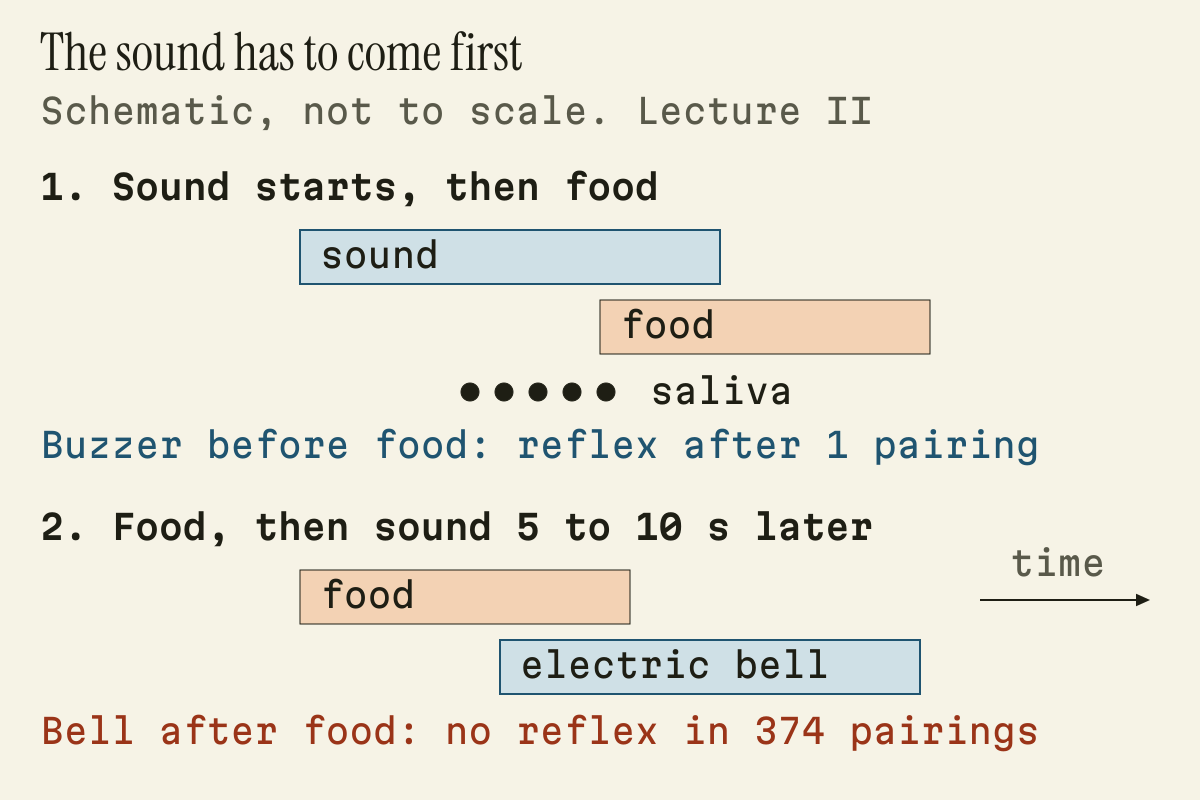
Schematic, not to scale: in Lecture II, a buzzer that started before food became a signal after one pairing; an electric bell started 5 to 10 seconds after food did not, in 374 pairings.
Worked from The order of stimuli and the pairing counts on p. 27 of the 1927 Anrep translation; drawn as plain bars, not to scale.
This figure in words
- Sound starts, then food arrives while the sound is still on: the sound gains the salivary response. A buzzer did so after one pairing.
- Food comes first and a sound starts 5 to 10 seconds later: no conditioned reflex forms. An electric bell used this way failed after 374 pairings.
"Order of sound and food in two conditioning experiments, Lecture II of the 1927 lectures" by Sniff, Purr, Preen & Shoal, https://sniffpurrpreenandshoal.com/dogs/pavlovs-dogs/, licensed under CC BY 4.0 (https://creativecommons.org/licenses/by/4.0/)
Data: Pavlov 1927, Conditioned Reflexes, tr. G. V. Anrep (public domain)
Food in the mouth makes a dog salivate without any learning. Pavlov called that an inborn, or unconditioned, reflex. In these food experiments, a conditioned reflex is the same response triggered by a signal that the animal has learned comes before food. The dogs in these demonstrations had undergone surgery in the laboratory beforehand so that their saliva could be collected and counted in drops.
Lecture II opens its demonstrations with the metronome. The text on p. 22 reads: “But when the sounds from a beating metronome are allowed to fall upon the ear, a salivary secretion begins after 9 seconds, and in the course of 45 seconds eleven drops have been secreted. The activity of the salivary gland has thus been called into play by impulses of sound—a stimulus quite alien to food.”
A few lines later on the same page, the lecture puts the idea plainly: “The sound of the metronome is the signal for food, and the animal reacts to the signal in the same way as if it were food.”
The next demonstration on p. 22 simply shows the dog food. Secretion begins after 5 seconds, and six drops are collected in 15 seconds. The lecture treats this as a signal too: the effect of the sight and smell of food, it goes on, is acquired during the animal’s own life rather than inborn.
What did Pavlov’s experiment show?
Above all, the experiments in these lectures showed that timing decides whether a sound becomes a signal. On p. 27, the lecture reports that the signal “should begin to operate before the unconditioned stimulus comes into action.” It then gives results from experiments by Dr. Krestovnikov, run on five dogs lab colony.
The page reads: “With another dog the loud buzzing of an electric bell set going 5 to 10 seconds after administration of food failed to establish a conditioned alimentary reflex even after 374 combinations, whereas the regular rotation of an object in front of the eyes of the animal, the rotation beginning before the administration of food, acquired the properties of a conditioned stimulus after only 5 combinations. The electric buzzer set going before the administration of food established a conditioned alimentary reflex after only a single combination.”
The electric bell that appears in Lecture II is the one that did not work, because it came after the food.
These lectures report results dog by dog and experiment by experiment, without the sample descriptions a modern paper gives. For contrast, dog years rests on a modern dog study with a narrow sample, and dog dreams covers what sleep recordings show in dogs after a learning task.
What else could become a signal?
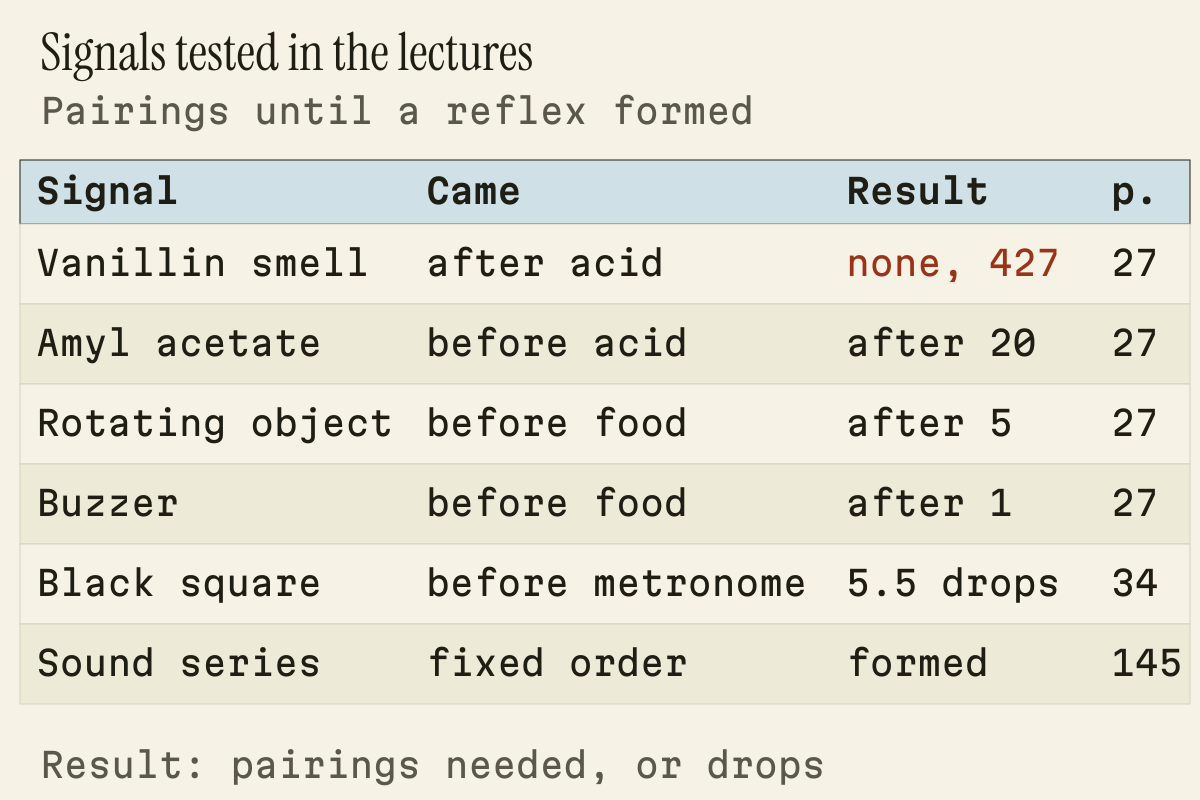
Signals tested in the 1927 lectures and how many pairings each needed. The vanillin smell, given after acid, did not become a signal in 427 tries.
Worked from Results on pp. 27, 34 and 145 of the 1927 Anrep translation, one row per experiment.
This figure in words
- Vanillin smell, given 5 to 10 seconds after acid: no reflex in 427 pairings (p. 27).
- Amyl acetate smell, given before acid: a signal after 20 pairings (p. 27).
- Rotating object, started before food: a signal after 5 pairings (p. 27).
- Buzzer, started before food: a signal after 1 pairing (p. 27).
- Black square, shown before the metronome: 5.5 drops by its tenth showing (p. 34).
- Series of four sounds, reinforced in a fixed order: a reflex formed (p. 145).
"Signals tested in Lectures II to VIII of the 1927 lectures, with the pairings each needed, evidence table" by Sniff, Purr, Preen & Shoal, https://sniffpurrpreenandshoal.com/dogs/pavlovs-dogs/, licensed under CC BY 4.0 (https://creativecommons.org/licenses/by/4.0/)
Data: Pavlov 1927, Conditioned Reflexes, tr. G. V. Anrep (public domain)
Sound was only one kind of signal, and food was not the only trigger. On p. 27, Lecture II describes a little acid put into a dog’s mouth, which brings head shaking, tongue movements and a heavy flow of saliva. The lecture states that any stimulus given often enough while the acid goes in will bring the same reaction.
Smell followed the same timing rule. In one case, the odor of vanillin was given 427 times, each time 5 to 10 seconds after the acid, and it did not become a signal lab colony. When the order was reversed, the odor of amyl acetate became an effective signal after 20 pairings.
A visual stimulus could work too: the regular rotation of an object in front of the dog’s eyes, started before food, became an effective signal after 5 pairings.
Later lectures stack signals on top of each other. On p. 34, in Lecture III, a dog that already salivated to a metronome was shown a black square for ten seconds, and fifteen seconds later the metronome sounded. By the square’s tenth showing it brought 5.5 drops of saliva (2.5 plus 3), though before the experiments it had brought none. The lecture calls this a conditioned reflex of the second order.
A third step could not be built on food reflexes, the same page adds. In protective reactions to an unpleasant stimulus on the skin, a third order was reached, but no further.
Did the order inside a signal matter?
Order mattered inside a signal as well. In Lecture VIII, on p. 145, a fixed series of four stimuli, made up of a noise, two different tones and the sound of a bell, was reinforced in that order, and a conditioned reflex formed. When the order was changed and the changed series was repeatedly given without reinforcement, it lost its effect and became inhibitory, while the original order, still reinforced, kept working.
Two signals from different senses given together did not simply add up. On p. 143, the effect of such a combination nearly always equaled that of the stronger component used alone, so the weaker one appeared overshadowed, although further experiments showed it still played a part.
The dog’s state counted too. Lecture II says on p. 28 that an alert nervous system is essential. With a mostly drowsy dog, building a new reflex becomes a long and tedious process, and the first reflex in an animal is usually harder to establish than the ones after it.
Where did the bell come from?
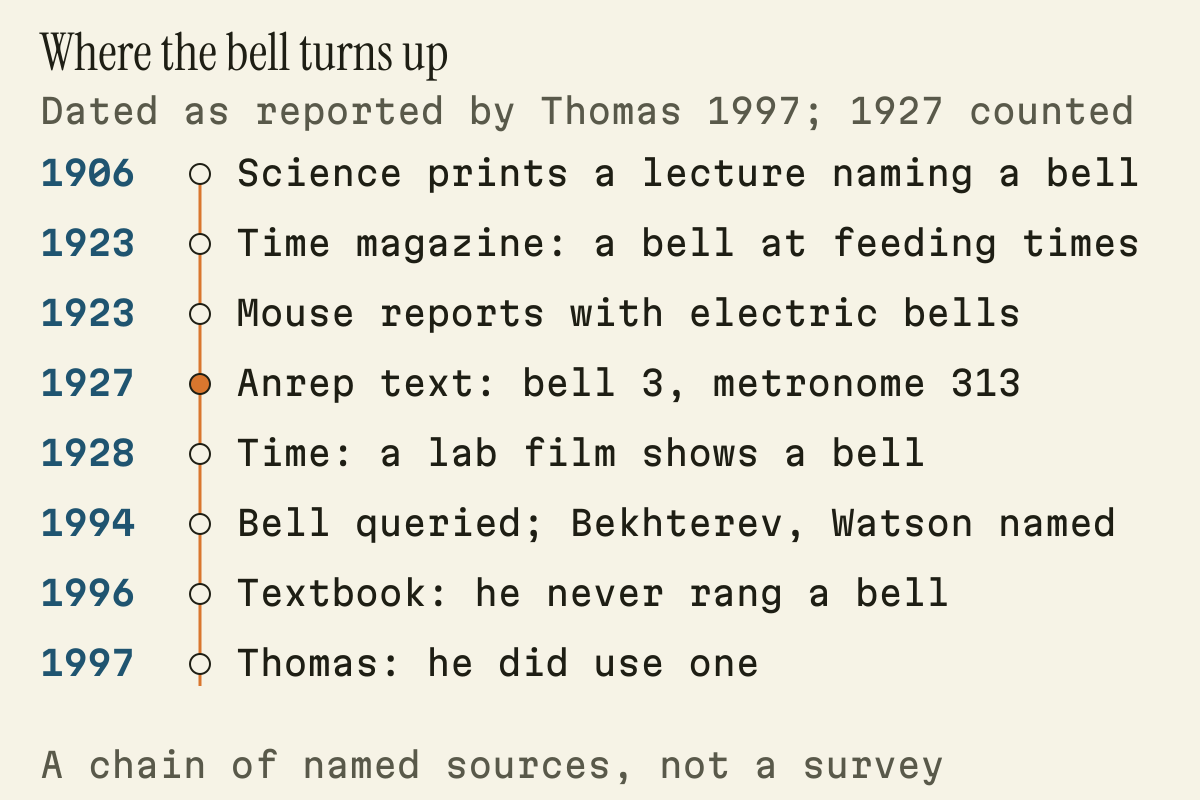
Where a bell turns up in named sources about Pavlov, dated as reported in Roger Thomas’s 1997 paper, with the 1927 counts added from the translation.
Worked from Dates and publications as reported by Thomas 1997 (read only, facts taken); the 1927 counts from the Anrep translation.
This figure in words
- 1906: Science prints Pavlov’s Huxley lecture, which mentions the violent ringing of a bell.
- 1923: Time magazine describes a bell rung at regular feeding times.
- 1923: Pavlov reports mice trained to electric bells over several generations.
- 1927: the Anrep translation names the bell 3 times and the metronome 313 times.
- 1928: Time says a film made in Pavlov’s laboratory shows dogs salivating at a bell.
- 1994: A. C. Catania asks whether Pavlov ever used a bell; R. A. Littman names Bekhterev and Watson as the bell’s popularizers.
- 1996: a textbook by M. Domjan states that Pavlov never rang a bell.
- 1997: Roger Thomas answers that he did.
"Where a bell appears in named sources about Pavlov, 1906 to 1997" by Sniff, Purr, Preen & Shoal, https://sniffpurrpreenandshoal.com/dogs/pavlovs-dogs/, licensed under CC BY 4.0 (https://creativecommons.org/licenses/by/4.0/)
Data: Thomas (1997), American Journal of Psychology 110:115-125 (facts only); Pavlov 1927, Conditioned Reflexes, tr. G. V. Anrep (public domain)
The bell story is a case for the hand-me-down rule, so it gets the same four steps as any other rule passed along without a source.
Earliest source. Roger Thomas, writing in the American Journal of Psychology in 1997, gives Pavlov’s 1906 Huxley lecture in London, printed in Science, as perhaps the first English-language journal report. In it, Pavlov says that very strong sounds, such as the violent ringing of a bell, were slow to produce a conditioned response.
Mechanism. Nothing in the method needs a bell. On pp. 22 and 27, a metronome, a buzzer and a rotating object all became signals once they reliably came before food. A bell would simply be one more sound among many possible signals.
Did Pavlov use a bell?
Counterexamples. Thomas reports that Time magazine described a bell at feeding times in July 1923. In 1928 the magazine said a film showed dogs salivating at a bell; Thomas dates that film, Mechanics of the Brain, to 1925 and 1926, made in Pavlov’s laboratory by the film director Vsevolod Pudovkin.
The same year as the first Time report, Pavlov described white mice trained to electric bells, claiming that each generation learned faster. Thomas notes that he told this in talks during a 1923 visit to the United States, at Battle Creek, Michigan, and the University of Chicago, and again that year in an address to a physiology congress in Edinburgh, which his son Vladimir delivered.
The 1927 translation steps back from that work in a footnote on p. 285, in Lecture XVII: the question of inheriting such reflexes “must be left entirely open.” Within the lectures themselves, the bell is rare beside the metronome and the buzzer.
Verdict: rewrite. Pavlov’s laboratory did use bells, so the 1996 textbook line that he never rang one goes too far. In the 1927 lectures, though, of the six sound sources counted, the metronome and the buzzer are named most, and both electric-bell mentions describe a buzzing.
The counts leave much open. They show how often a word appears in one English translation, not how often each sound was used in the laboratory, and the Russian originals were not counted. No other English translation was counted either, so whether another translator would also write electric bell where the table on p. 34 says Buzzer is unknown.
Other questions are still unknown here. The 1925 to 1926 film was not viewed, so what it actually shows remains unconfirmed. How classical conditioning is used with dogs today is not covered either: no modern study of conditioning in pet dogs was read, and the page gives no training steps.
Sources
- Pavlov IP (1927). Conditioned Reflexes: An Investigation of the Physiological Activity of the Cerebral Cortex. Translated and edited by G. V. Anrep. London: Oxford University Press. archive.org/details/conditionedrefle0000ippaRead: Public-domain original; Lectures I to XXIII counted, bibliography and index counted apart, quoted passages compared with the page images
- Thomas RK (1997). “Correcting some Pavloviana regarding ‘Pavlov’s bell’ and Pavlov’s ‘mugging’.” American Journal of Psychology 110(1):115–125. doi.org/10.2307/1423704Read: Full text, read only; facts restated, no text, tables or figures reproduced
Cite this page
Sniff, Purr, Preen & Shoal. “Pavlov’s Dogs: In the 1927 English Text, Metronomes Lead.” Published November 20, 2026. https://sniffpurrpreenandshoal.com/dogs/pavlovs-dogs/. Accessed on the day you read it.
How studies are read and numbers recheckedMending basket: every correctionReport an error on this page (contact@sniffpurrpreenandshoal.com)
More from Dog Minds
Sniff Tool page
Dog Years: In One Labrador Study, Age 1 Matched About 31
Picture credit
"noah (1 of 1)" by Trevor Hurlbut — https://commons.wikimedia.org/wiki/File:Old_dog_noah_(1_of_1).jpg — CC BY 2.0 (https://creativecommons.org/licenses/by/2.0/)
Sniff Research story
What Do Dogs Dream About? Sleep Recordings Can’t Say
Picture credit
"Study of a Sleeping Dog" by Cornelis Visscher; Nationalmuseum, Stockholm (NMH 1878/1863) — https://commons.wikimedia.org/wiki/File:Cornelis_Visscher_-_Study_of_a_Sleeping_Dog_-_NMH_1878-1863_-_Nationalmuseum.jpg — Public domain (EU and US: Cornelis Visscher died 1658, more than 70 years ago (life plus 70 years))
Sniff Research story
How Many Words Do Dogs Know? A Gifted Few Learn Toy Names
Picture credit
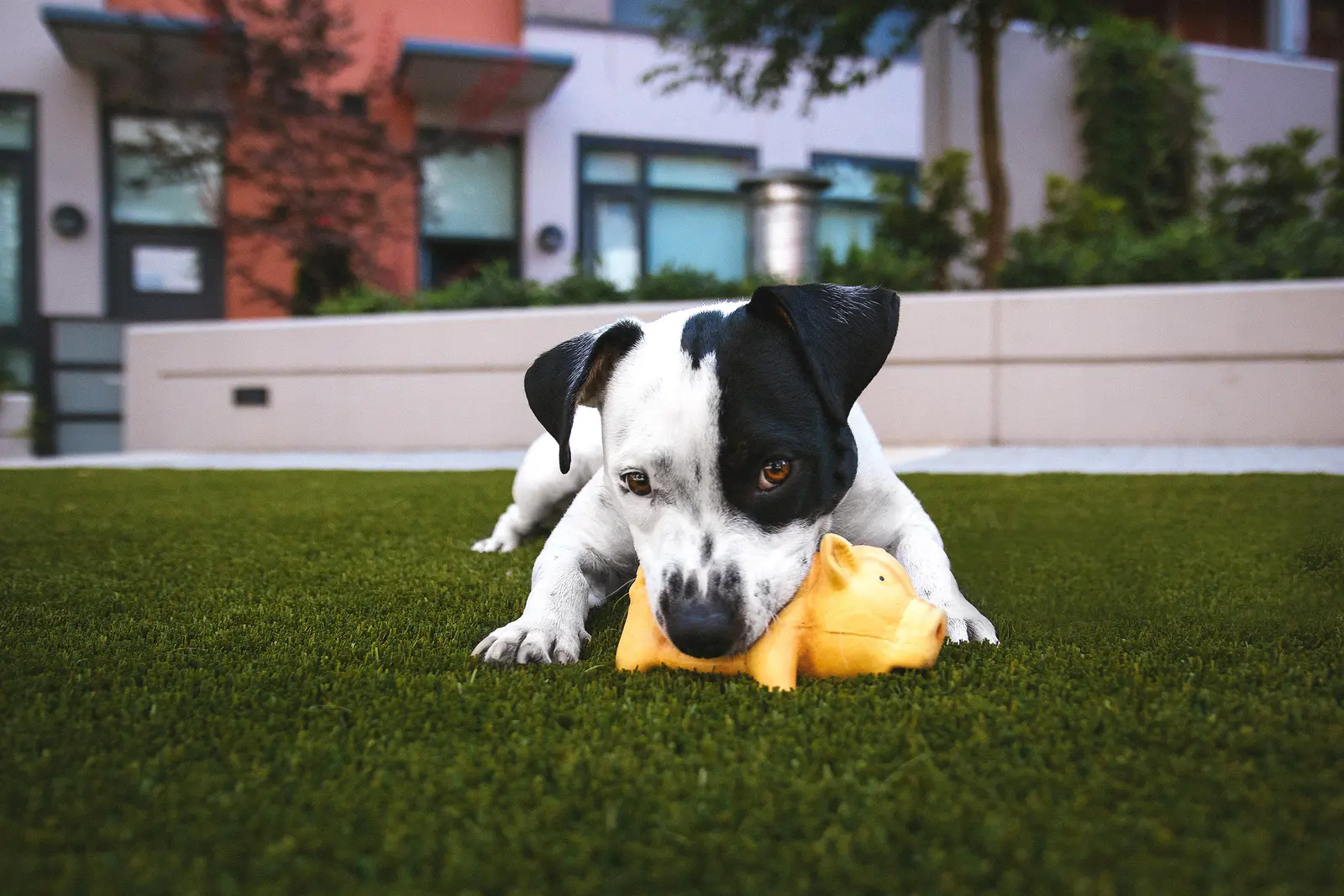
"Puppy playing with a toy" by Justin Veenema (Unsplash) — https://commons.wikimedia.org/wiki/File:Puppy_playing_with_a_toy_(Unsplash).jpg — CC0 1.0 (https://creativecommons.org/publicdomain/zero/1.0/)