Shoal Tank card entry
Axolotl Metamorphosis: In Paris, Some Offspring Changed
Sniff, Purr, Preen & Shoal Published
TL;DR
Axolotls can change into a land-living form, and in Paris the ones that changed were offspring born there: by August 1867, Auguste Duméril counted sixteen lab colony that had lost their gills. Their parents lab colony bred in the water in 1865 with gills on. Why only a few changed is still unknown from the sources read here.
Tank doorplate
- Topic
- When axolotls kept in Paris changed form, which ones changed, and the species' name and status
- System variables
- None measured; dates and head counts as printed in two Comptes rendus notes and a 2022 history
- Default units
- Calendar dates as printed; counts of animals
- Hand-me-down rule checked?
- None checked on this page
Tank card
- Common name
- Axolotl
- Scientific name
- Ambystoma mexicanum (Shaw and Nodder, 1798)
- Family
- Ambystomatidae (mole salamanders); order Caudata, class Amphibia
- Max standard length (cm)
- No reusable source
- Temperature range (°C / °F)
- No reusable source
- pH range
- No reusable source
- Hardness range (dGH)
- No reusable source
- Grouping & compatibility notes in sources
- In 1865, plants carrying eggs were moved to separate basins, away from the parents
- Conservation status (IUCN)
- Critically Endangered, as given in a 2022 history; the ITIS record keeps an older comment, Vulnerable
- Data sources
- ITIS record TSN 586244 (CC0); Duméril's notes of 1865 and 1867 in Comptes rendus; Reiß 2022 (CC BY, version not stated on the article page)
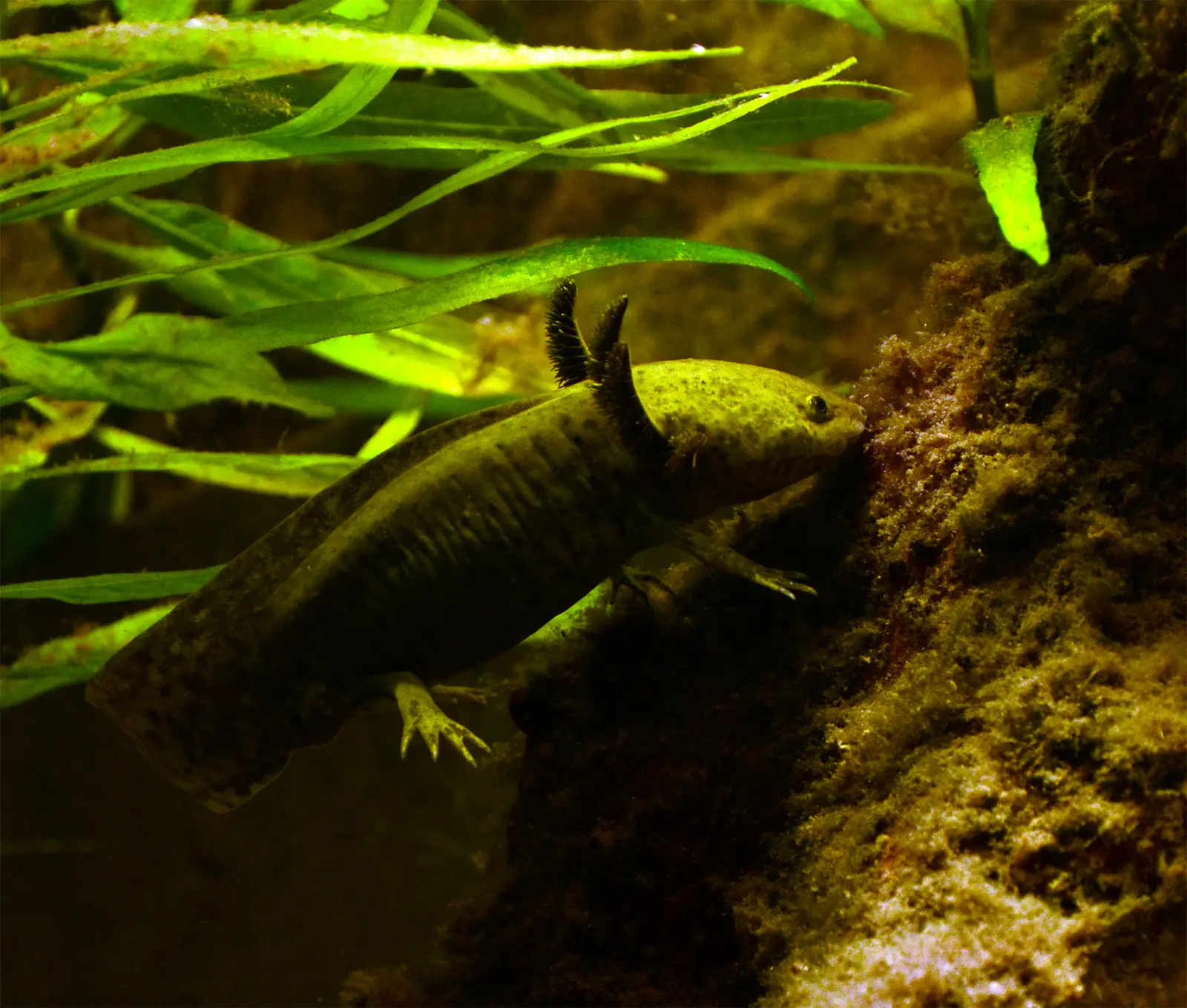
An axolotl at the Aquarium Dubuisson in Liège in 2016, the frilled external gills standing out behind its head.
"Axolotl (Ambystoma mexicanum), Aquarium Dubuisson, Liège" by Vassil — https://commons.wikimedia.org/wiki/File:Axolotl_Ambystoma_mexicanum_Aquarium_Li%C3%A8ge_30012016_1.jpg — CC0 1.0 (https://creativecommons.org/publicdomain/zero/1.0/)
On the floor of the tank, the axolotl hangs still while the frilly gills at its neck sway. In 1864, 34 live axolotls were shipped from Mexico City to Paris, according to a 2022 history of the species by Christian Reiß. The same history says that until at least 1914, every axolotl in Europe descended from the Paris animals.
What happened in Paris?
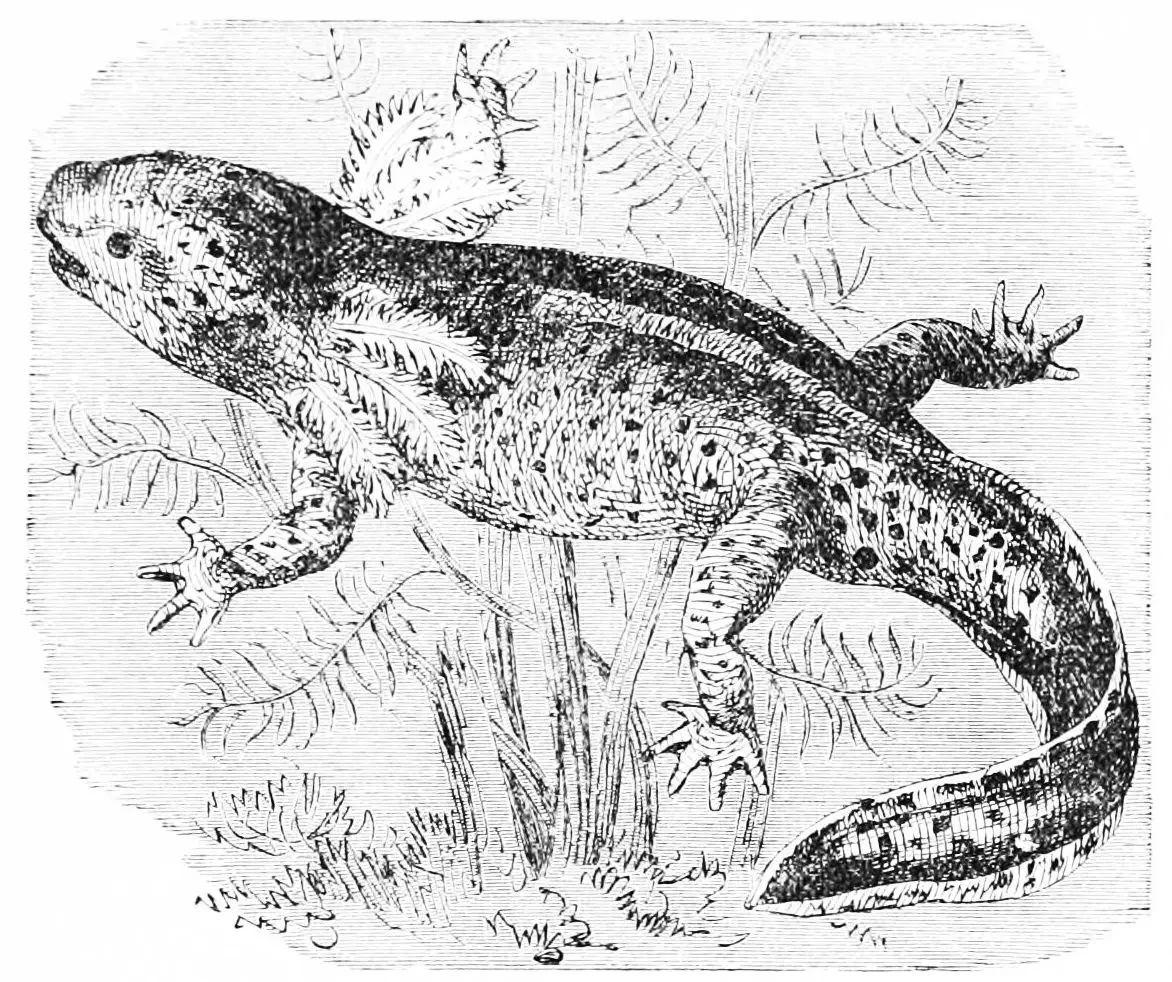
An engraving of the axolotl, printed as Siredon pisciforme in Popular Science Monthly in 1882.
"Siredon pisciforme or Mexican axolotl, Popular Science Monthly, volume 20" by Unknown author; Popular Science Monthly, volume 20 (April 1882) — https://commons.wikimedia.org/wiki/File:PSM_V20_D767_Siredon_pisciforme_or_mexican_axolotl.jpg — Public domain (EU: anonymous work (engraver unknown) published 1882, more than 70 years ago (70 years from publication); US: published before 1931)
Most of the 1864 shipment went to the Jardin d'Acclimatation, a Paris zoo, the 2022 history says. A small group went to the reptile menagerie of the Muséum d'Histoire naturelle, kept by the zoologist Auguste Duméril.
His report to the Academy of Sciences, printed in Comptes rendus for 17 April 1865, describes them: “Les six individus (cinq mâles et une femelle) […] ont été donnés au Muséum par le Jardin zoologique d’Acclimatation du bois de Boulogne” (p. 765). In this page's translation: the six animals lab colony, five males and one female, were given to the museum by the Jardin d'Acclimatation.
The same report dates the breeding (p. 766). On 18 January 1865, after about a year in captivity, the aquarium holding the axolotls broke into “une grande agitation”; the female began laying the next morning and finished on the 20th. The scene came again on 6 March.
So the founders bred while still in their gilled, water-living form. Larvae do not breed, the 2022 history points out, and this overturned the view of the anatomist Georges Cuvier that axolotls were only the larvae of another salamander.
By 1866, the museum collection held 800 axolotls, the history reports.
Can axolotls turn into salamanders?
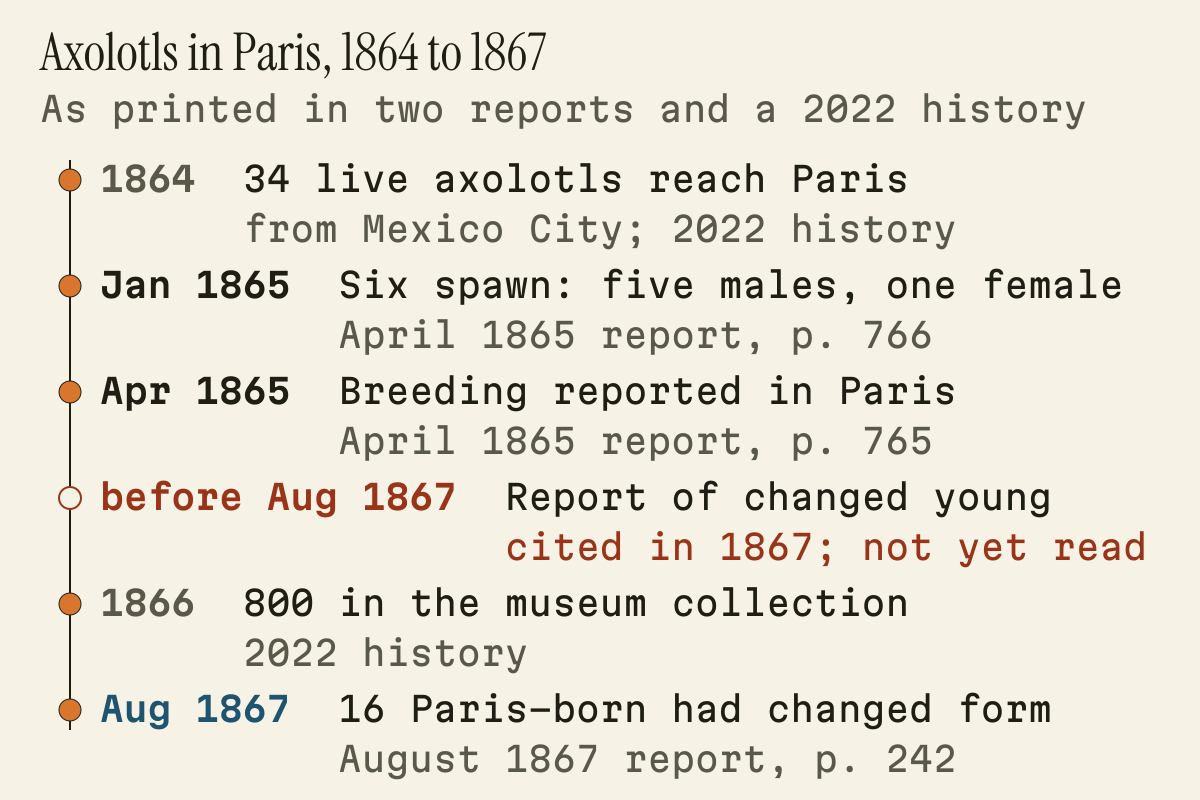
Dates and counts as printed in Duméril's two reports and the 2022 history; the earlier report of changed young is cited in 1867 but has not been read.
Worked from Duméril's notes in Comptes rendus of 17 April 1865 (pages 765 and 766) and 5 August 1867 (page 242), checked against the page images, and the 2022 history by Reiß.
This figure in words
the Paris record from 1864 to 1867.
- 1864: 34 live axolotls reach Paris from Mexico City (2022 history).
- January 1865: the museum's six lab colony, five males and one female, spawn (1865 report, page 766).
- April 1865: the breeding is reported to the Academy of Sciences (1865 report, page 765).
- Before August 1867: an earlier report of changed young, cited in the 1867 note and not yet read.
- 1866: 800 axolotls in the museum collection (2022 history).
- August 1867: 16 Paris-born axolotls lab colony had changed form (1867 report, page 242).
"Axolotls in Paris, 1864 to 1867, as printed" by Sniff, Purr, Preen & Shoal, https://sniffpurrpreenandshoal.com/fish/axolotl/, licensed under CC BY 4.0 (https://creativecommons.org/licenses/by/4.0/)
Data: Duméril (1865), Comptes rendus 60:765-767 (public domain); Duméril (1867), Comptes rendus 65:242-246 (public domain); Reiß (2022), Frontiers in Cell and Developmental Biology, CC BY, version not stated on the article page
Download the Paris timeline (CSV) (what the file holds) Data: Duméril (1865, 1867), Comptes rendus (public domain); Reiß (2022), Frontiers in Cell and Developmental Biology, CC BY, version not stated on the article page
An axolotl is already a salamander, but some did take a land-living form, and the ones that changed were born in Paris. Duméril's note of 5 August 1867 opens by recalling that the axolotls had bred at the menagerie “et que plusieurs de ceux qui y sont nés avaient subi des métamorphoses” (p. 242). In this page's translation: several of those born there had undergone metamorphosis.
By August 1867, Duméril wrote, sixteen of these animals lab colony had become covered in yellowish-white spots and then lost their gills completely, along with the thin crest of the back and tail. Inside, three of the four arches that carry the gills had gone, and the teeth on the roof of the mouth had moved. The note compares these changes with those of salamanders passing from larva to adult. To Duméril, this bore out Cuvier's guess that the axolotl was a larva (p. 243).
The founders are not among those the note describes as changed. The 2022 history also credits the change to offspring of the first animals in Duméril's care.
Why do most axolotls stay aquatic?
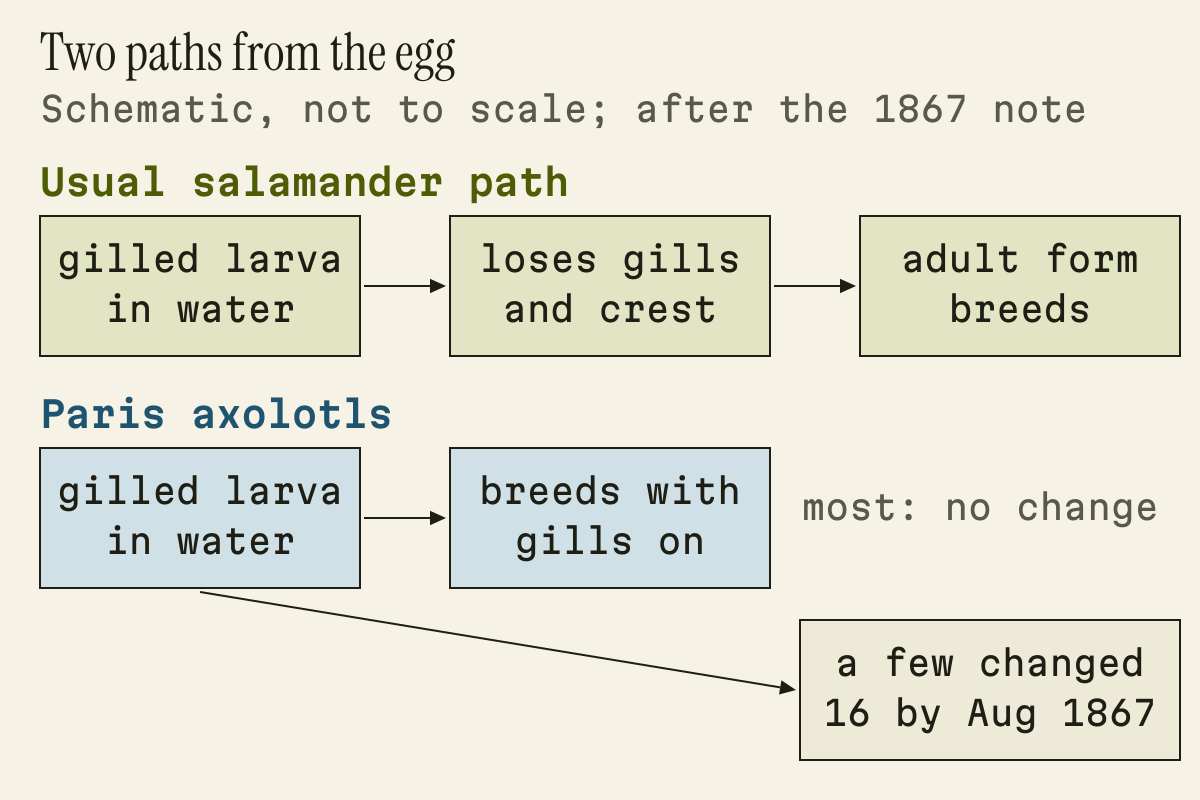
Schematic, not to scale: a usual salamander larva loses its gills and crest before breeding as an adult; the Paris axolotls bred with gills on, and a few of their Paris-born young changed.
Worked from The changes listed in Duméril's 1867 note (page 242) and the breeding dated in his 1865 report (page 766); a schematic, not a measurement.
"Two paths from the egg: a usual salamander and the Paris axolotls (schematic)" by Sniff, Purr, Preen & Shoal, https://sniffpurrpreenandshoal.com/fish/axolotl/, licensed under CC BY 4.0 (https://creativecommons.org/licenses/by/4.0/)
Data: Duméril (1865), Comptes rendus 60:766; Duméril (1867), Comptes rendus 65:242 (public domain)
The sources read for this page do not explain why most axolotls keep their gills. Duméril's 1867 note calls his first attempts to bring on the change unsuccessful: lowering the water, or giving the animals a refuge where they could leave it (p. 243). Of nine animals whose gills he kept cutting, two changed and a third seemed about to, a share he judged higher than in unoperated animals; he would not call gill loss the cause (p. 245). The 2022 history sums up both attempts as bringing no transformation.
Why only some animals changed was one of the questions Duméril set out to answer, the history notes. Health questions about an axolotl belong with a veterinarian who treats amphibians; this page gives no water settings and no care advice.
What is the axolotl's scientific name?
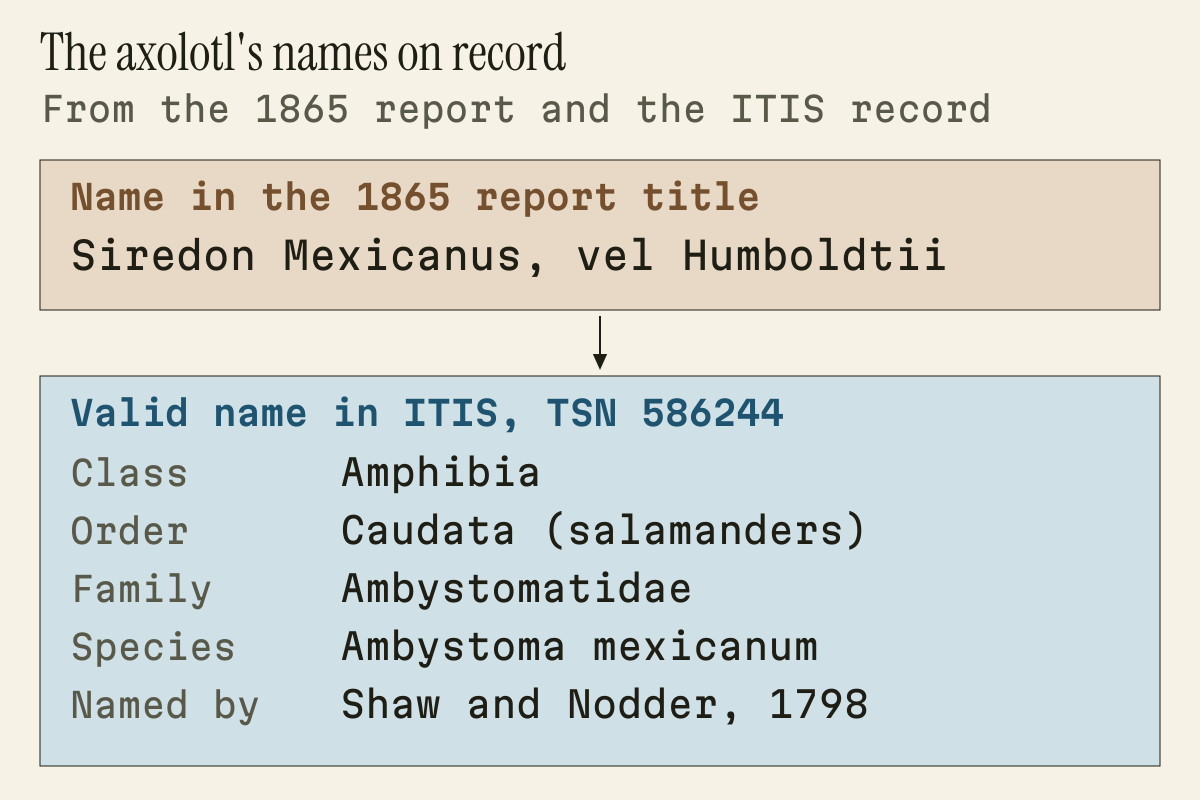
The name in the 1865 report title, Siredon Mexicanus, above the valid name in the ITIS record, Ambystoma mexicanum, with its family, order and class.
Worked from The title of the 1865 report (page 765) and the ITIS record for TSN 586244, read 2026-11-20.
This figure in words
the axolotl's names on record.
- 1865 report title: Siredon Mexicanus, vel Humboldtii.
- ITIS valid name: Ambystoma mexicanum (Shaw and Nodder, 1798), TSN 586244.
- Family Ambystomatidae, order Caudata, class Amphibia.
"The axolotl's names on record, from the 1865 report and ITIS" by Sniff, Purr, Preen & Shoal, https://sniffpurrpreenandshoal.com/fish/axolotl/, licensed under CC BY 4.0 (https://creativecommons.org/licenses/by/4.0/)
Data: ITIS, TSN 586244 (CC0); Duméril (1865), Comptes rendus 60:765 (public domain)
Download the Tank card fields and their sources (CSV) (what the file holds) Data: ITIS, TSN 586244 (CC0); Duméril (1865), Comptes rendus (public domain); Reiß (2022), Frontiers in Cell and Developmental Biology, CC BY, version not stated on the article page
The Integrated Taxonomic Information System (ITIS), whose data are released under CC0, lists the axolotl as Ambystoma mexicanum (Shaw and Nodder, 1798), a valid name. Its synonyms there include Siredon axolotl and Siredon humboldtii. How the site picks a name source is set out in Sniff test.
ITIS places the species in the family Ambystomatidae, the mole salamanders, in the order Caudata and the class Amphibia. An axolotl is an amphibian, not a fish, even in a tank. Fish have their own research record, from how goldfish memory has been tested in lab tanks to when a group of fish counts as a school.
The 2022 history says the IUCN Red List classes the axolotl as Critically Endangered, with only a few hundred left in the canals of Xochimilco in Mexico City. The ITIS record keeps an older comment, “Listed as Vulnerable on IUCN Red List,” and names the IUCN Red List of 2000 among its sources. Still unknown from the sources read: what the report of changed young cited in 1867 said, and why only some of the Paris-born axolotls changed.
Sources
- Duméril A (1867). "Expériences faites à la ménagerie des Reptiles du Muséum d'Histoire naturelle, sur des Batraciens urodèles à branchies extérieures, du Mexique, dits Axolotls, et démontrant que la vie aquatique se continue sans trouble apparent après l'ablation des houppes branchiales." Comptes rendus hebdomadaires des séances de l'Académie des sciences 65:242–246. archive.org/details/comptes-rendus-hebdomadai…Read: Public-domain original; author d. 1870, pages 242, 243 and 245 checked against the scan
- Duméril A (1865). "Reproduction, dans la Ménagerie des Reptiles au Muséum d'Histoire naturelle, des Axolotls, Batraciens urodèles à branchies persistantes, de Mexico (Siredon Mexicanus, vel Humboldtii), qui n'avaient encore jamais été vus vivants en Europe." Comptes rendus hebdomadaires des séances de l'Académie des sciences 60:765–767. archive.org/details/comptes-rendus-hebdomadai…Read: Public-domain original; author d. 1870, pages 765 and 766 checked against the scan
- Reiß C (2022). "Cut and Paste: The Mexican Axolotl, Experimental Practices and the Long History of Regeneration Research in Amphibians, 1864-Present." Frontiers in Cell and Developmental Biology 10:786533. doi.org/10.3389/fcell.2022.786533Read: Full text, open license; Creative Commons Attribution License, version not stated on the article page
- Integrated Taxonomic Information System (ITIS). "Ambystoma mexicanum (Shaw and Nodder, 1798)." Taxonomic Serial No. 586244. www.itis.gov/servlet/SingleRpt/SingleRptRead: Full text, open license; CC0 public domain, as stated on the ITIS About page, version not stated; species report read in full
Cite this page
Sniff, Purr, Preen & Shoal. “Axolotl Metamorphosis: In Paris, Some Offspring Changed.” Published November 20, 2026. https://sniffpurrpreenandshoal.com/fish/axolotl/. Accessed on the day you read it.
How studies are read and numbers recheckedMending basket: every correctionReport an error on this page (contact@sniffpurrpreenandshoal.com)
More from Fish Minds & Tanks
Shoal Research story
Goldfish Memory: The 3-Second Claim Meets Two Lab Studies
Picture credit
"Cyprinus auratus, The Gold-Fish: Ichthyologie, ou Histoire naturelle des poissons, Plate 93" by Marcus Elieser Bloch (engraved by C. F. Gürsch); Biodiversity Heritage Library — https://commons.wikimedia.org/wiki/File:Ichthyologie;_ou,_Histoire_naturelle_des_poissons_(Plate_93)_(6918365142).jpg — Public domain (EU: Marcus Elieser Bloch died 1799, more than 70 years ago (life plus 70 years); the engraver C. F. Gürsch's death year not traced; the plate was engraved by 1796; US: published before 1931; faithful scan)
Shoal Tool page
Aquarium Volume Calculator: Glass and Gravel Take a Share
Picture credit
"Freshwater nano aquarium" by Chris Penny — https://commons.wikimedia.org/wiki/File:Freshwater_nano_aquarium.jpg — CC BY 2.0 (https://creativecommons.org/licenses/by/2.0/)
Shoal Mechanism explainer
Shoal vs School: A School Is a Shoal That Moves in Step
Picture credit
"Peace with my buddies" by Leino Olé from Saint Lambert, Canada — https://commons.wikimedia.org/wiki/File:Peace_with_my_buddies_-_Flickr_-_Leino88.jpg — CC BY 2.0 (https://creativecommons.org/licenses/by/2.0/)