Shoal Mechanism explainer
Shoal vs School: A School Is a Shoal That Moves in Step
Sniff, Purr, Preen & Shoal Published
TL;DR
A shoal is any group of fish that stays together by choice; a school is a shoal whose fish line up and match their speed. A 2013 review places shoals on one scale, from the loose swarm to the aligned school. Where home-tank fish sit on that scale is unknown from the sources read here.
Doorplate
- Animal
- Fish in groups, many species; the review names the zebrafish as a common lab model
- Study
- Delcourt, Denoël, Ylieff & Poncin 2013, Fish and Fisheries (review)
- n (analysed / excluded)
- Not applicable: a review of published work; no fish were tested for it
- Couch sample
- cannot be assigned: a review of other studies, not a sample of fish
- Limits
- Read only, facts restated; a review of video-tracking methods whose opening section sums up the terms and credits them to earlier authors
- Setup in one line
- Places shoals on one scale, from swarm to school, set by how closely fish align and match their speed
- Replicated?
- As of 2026-11-20: a 2012 review by Delcourt & Poncin, read in abstract, also treats the field's accepted definitions as the standard and notes they give no way to measure the behaviors
This doorplate as data (CSV) what the file holds
Data: Delcourt, Denoël, Ylieff & Poncin (2013), Fish and Fisheries, facts restated
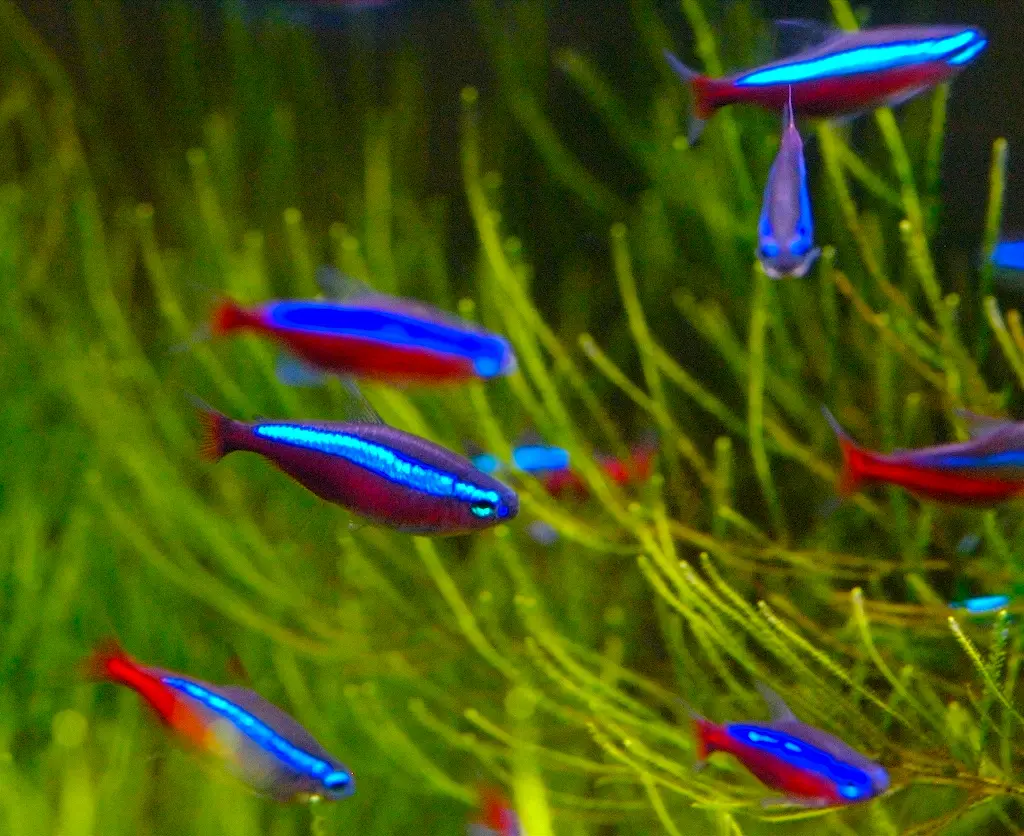
Tetras over fine green plants in a freshwater aquarium; in this frame most face the same way and one turns toward the camera.
"Peace with my buddies" by Leino Olé from Saint Lambert, Canada — https://commons.wikimedia.org/wiki/File:Peace_with_my_buddies_-_Flickr_-_Leino88.jpg — CC BY 2.0 (https://creativecommons.org/licenses/by/2.0/)
You walk past the tank, and the small fish bunch together near the plants. A 2013 review from the University of Liège, citing an estimate published in 1978, says that more than 25% of the roughly 27,000 species of teleosts, a large group of bony fishes, form shoals throughout their lives. By the same estimate, more than 50% do so as juveniles.
Fish researchers have two words for that kind of group. They do not mean the same thing.
Johann Delcourt, Mathieu Denoël, Marc Ylieff and Pascal Poncin wrote the review, and its main subject is video tracking: following many fish at once on camera. Its opening pages sum up the vocabulary of fish groups. That summary is the main source for the definitions below. The paper sits in the university's open repository as an author's manuscript that may be read but not reproduced, so its points are restated here rather than quoted.
What is the difference between a shoal and a school?
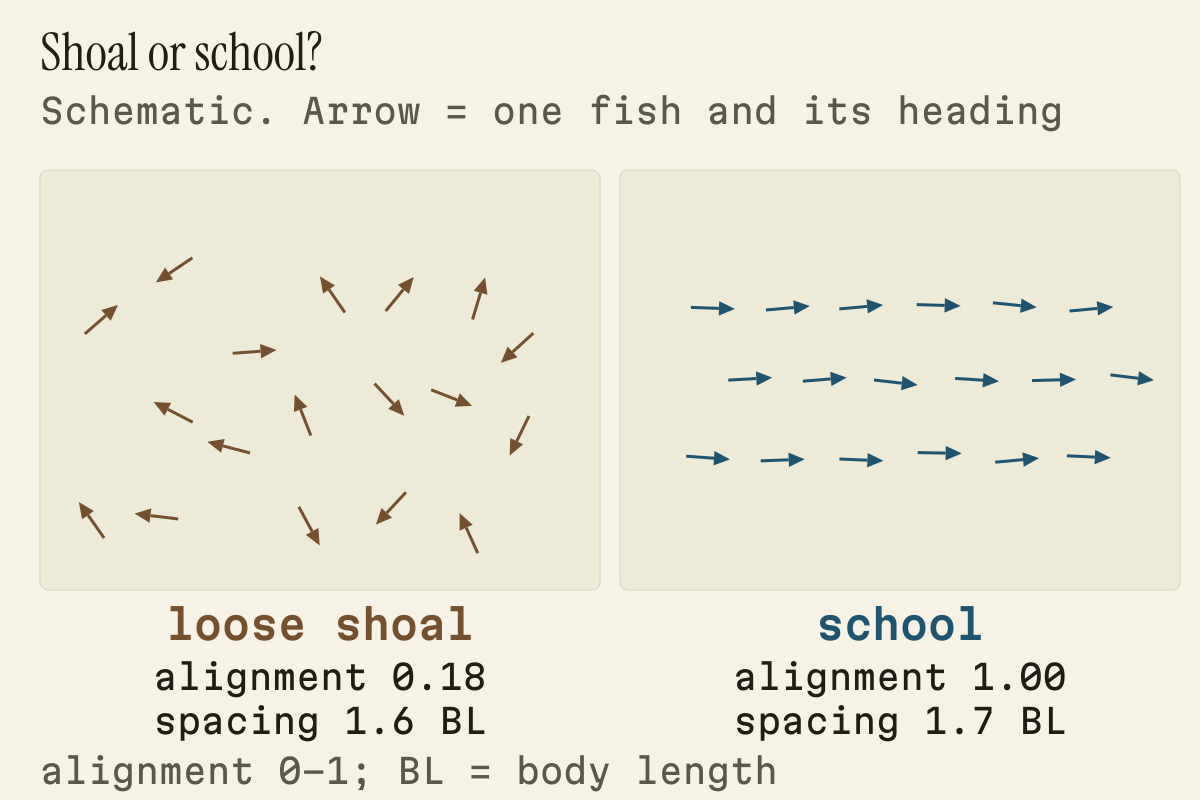
Schematic, not fish data: a loose shoal and a school drawn with 18 arrows each, spaced about the same and differing in how well the arrows line up.
Worked from Alignment and spacing computed from the 18 arrows drawn in each panel, not from fish data.
"Shoal versus school, schematic" by Sniff, Purr, Preen & Shoal, https://sniffpurrpreenandshoal.com/fish/shoal-vs-school/, licensed under CC BY 4.0 (https://creativecommons.org/licenses/by/4.0/)
In the 2013 review, a shoal is a group of fish that stay together by choice, which the authors call a voluntary association of individuals. The review credits that sense of the word to Pitcher and Parrish, writing in 1993. Nothing in it requires the fish to face the same way or swim at the same pace.
Within shoals, the review describes a gradient rather than separate boxes. At one end is the swarm, an unpolarized shoal. Polarization here means how closely the fish's headings line up, so in a swarm the fish point in many directions. At the other end is the school, a polarized shoal, in which the fish face the same way and keep their speeds matched.
That makes the relationship run one way. A school is still a shoal, one whose members move in step. A shoal that hangs together while its fish face every which way is not a school. The point where a shoal turns into a school is not fixed in the review's summary: it places groups along the gradient by degree, according to how polarized they are and how closely their speeds match.
A later section of the review draws the same line from another side. For shoaling, it points to fish coordinating where they are in space. For schooling, it points to fish coordinating both speed and direction.
What the arrows show
The drawing above puts that in arrows instead of fish. Each panel holds 18 arrows. Alignment in this diagram is the length of the average arrow direction: 1 when every arrow points the same way, close to 0 when the directions cancel out. The left panel of the diagram scores 0.18 and the right panel 1.00.
Spacing comes out nearly even. In the schematic, the average distance from each arrow to its nearest neighbor is 1.6 body lengths on the left and 1.7 body lengths on the right, so the two groups are about equally tight. What separates them is direction, which matches the review's point: staying together makes a shoal, and lining up with matched speed makes it a school. A still drawing cannot show speed, so the schematic shows only half of that.
Who defined the two words?
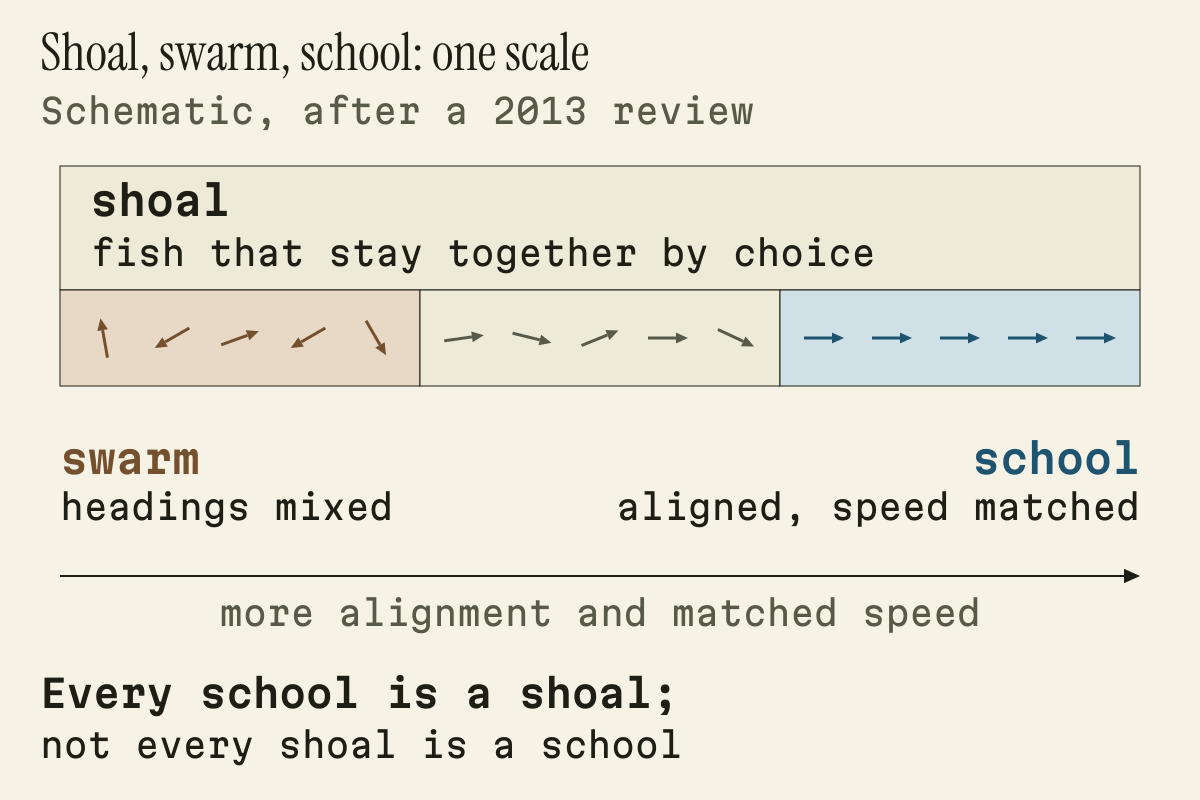
Schematic after the 2013 review: shoal is the wide word, and swarm and school sit at the two ends of one scale inside it.
Worked from The 2013 review by Delcourt, Denoël, Ylieff & Poncin, read in full and restated rather than quoted.
"Shoal, swarm and school as one scale, schematic" by Sniff, Purr, Preen & Shoal, https://sniffpurrpreenandshoal.com/fish/shoal-vs-school/, licensed under CC BY 4.0 (https://creativecommons.org/licenses/by/4.0/)
Data: Delcourt, Denoël, Ylieff & Poncin (2013), Fish and Fisheries 14:186-204, facts restated
Both reviews read for this page point back to one short paper. In 1983, T. J. Pitcher published a three-page paper titled Heuristic definitions of fish shoaling behaviour in the journal Animal Behaviour. Only its bibliographic record was read here, so its own wording is not given on this page.
The 2013 review cites that 1983 paper, together with two papers from 2002 by Couzin and colleagues and by Parrish and colleagues, for the swarm-to-school gradient. For the plain meaning of shoal, it cites Pitcher and Parrish in 1993.
A second review from the same Liège group adds a warning. In 2012, Delcourt and Poncin published a review of shoals and schools in Reviews in Fish Biology and Fisheries, read in abstract. By the abstract, Pitcher's definitions are treated as the standard in the field, but they rest on a conceptual test of sociability and give researchers no tools to measure these behaviors.
The abstract gives two reasons numbers are needed. Studies of different populations, species and treatments, by different authors, cannot be compared without shared measures, and those measures also let computer models of group behavior be tested against real data. The abstract also reports a series of conceptual confusions over the three terms in the scientific literature and in talks at meetings.
The full text of that 2012 review is held behind a request-a-copy button in the Liège repository, so how it proposes to measure the terms is not reported here. Its record lists local and global polarization among its keywords.
| Term | Meaning, restated | Credited to | Read for this page |
|---|---|---|---|
| Shoal | Fish that stay together by choice | Pitcher and Parrish 1993, cited in the 2013 review | Full text, read only (2013 review) |
| Swarm | A shoal whose fish do not line up | Pitcher 1983 and two 2002 papers, cited in the 2013 review | Full text, read only (2013 review) |
| School | A shoal whose fish line up and match their speed | Pitcher 1983 and two 2002 papers, cited in the 2013 review | Full text, read only (2013 review) |
| The terms as a set | Treated as the standard, but with no way to measure them | Delcourt & Poncin 2012 | Abstract only |
Download the shoal and school terms (CSV) (what the file holds) Data: Delcourt, Denoël, Ylieff & Poncin (2013), Fish and Fisheries, facts restated; Delcourt & Poncin (2012), Reviews in Fish Biology and Fisheries, abstract only
From Aristotle to video tracking
The words are recent, but the behavior has been noticed for a long time. The 2013 review, citing a 1999 paper, credits Aristotle with the first report of schooling in fish. Measuring it came much later. By the review's account, the first real quantitative studies of fish groups were run less than 60 years before it was written, and the early measurements were done by hand.
From the 1980s on, researchers tried to reproduce the patterns of moving groups with computer simulations built on rules set in advance for how each fish reacts to the others. The review notes that the computed and natural patterns could match well while the rules real fish follow stayed poorly explained. Video tracking of many fish at once, its main subject, is offered as a way to read those rules from real groups.
The behaviors also reach beyond fish. The same review notes that shoaling and schooling have been reported in sharks, in squid and their relatives, in crustaceans and in amphibians.
Do fish in a home tank school?
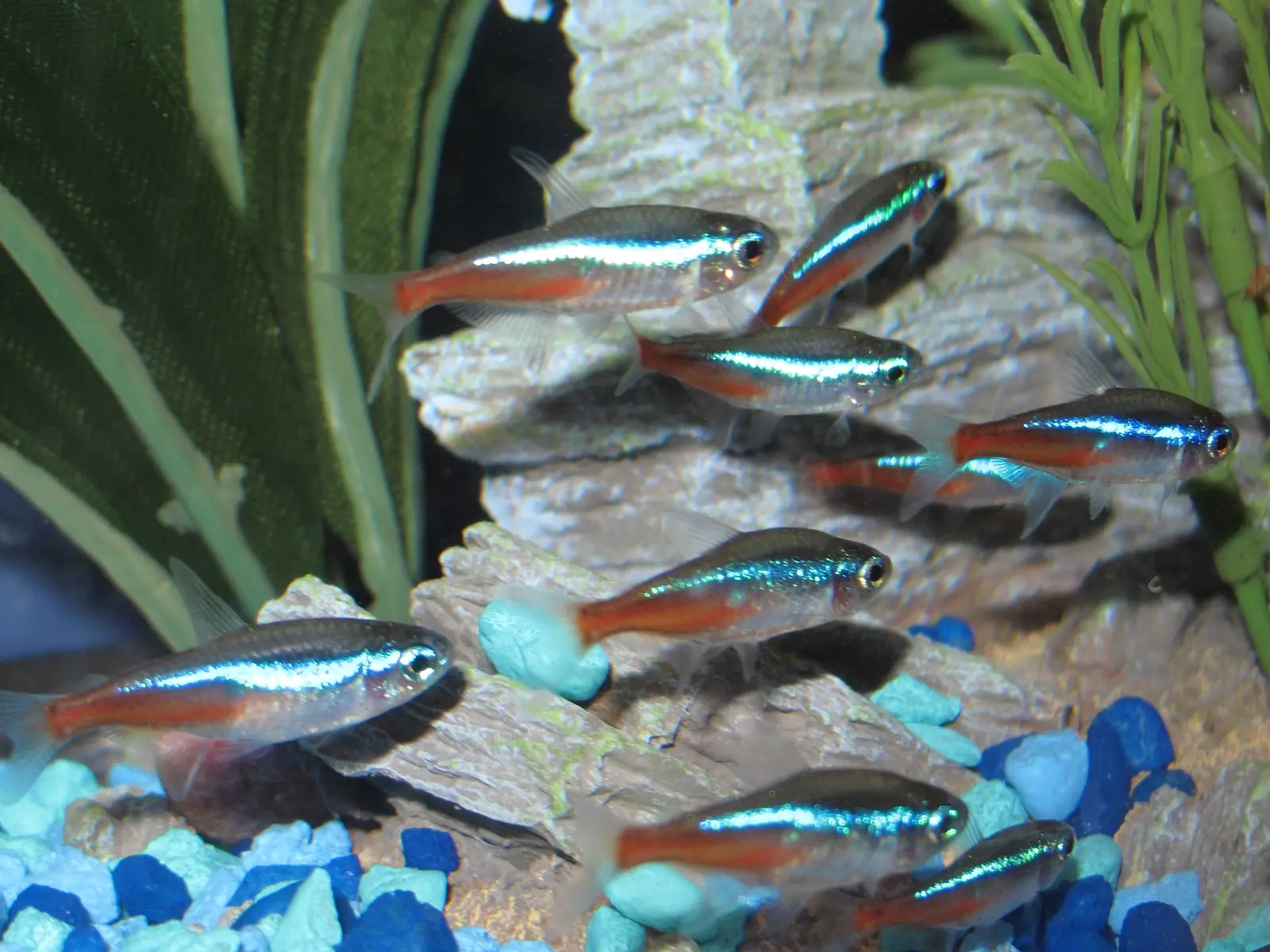
Nine neon tetras, labeled Paracheirodon innesi on the photo's file page, most of them facing the same way at the moment the picture was taken.
"Paracheirodon innesi group" by Brandy Dopkins — https://commons.wikimedia.org/wiki/File:Paracheirodon_innesi_group.jpg — CC BY-SA 2.0 (https://creativecommons.org/licenses/by-sa/2.0/)
None of the sources read for this page tested fish in home tanks, so they cannot say how often a group of tetras in a living room schools. They do show that one species can do both. The 2013 review describes the zebrafish, one of the most widely used laboratory animals, as a fish that adopts both shoaling and schooling. The review ranks it as the third most important laboratory animal after mice and rats, and notes that small teleosts in general serve as lab models for group behavior.
A photograph needs care here. In the picture above, most of the nine fish face right, which looks like the aligned end of the scale. One frame cannot show whether they also match speed, or whether they will still be aligned a second later, so a still image can suggest a school without showing one.
Read as a scale, the two words also allow a group to move along it. In the review's terms, a group is placed by its degree of alignment and speed matching, not sorted once and for all. How far and how often a tank group shifts along that scale is not measured in the sources read here.
None of this sets a group size for any species, and this page does not say how many fish a tank can hold. A fish that hides, stops eating or breathes hard is a health question for a veterinarian who treats fish. How much water a tank holds, by geometry, is worked through in the Tank Volume Calculator, and a tank animal with a very different story, one that rarely leaves its larval form, has its own page in Axolotl Metamorphosis.
Why do fish swim in schools?
The 2013 review does not settle it. Instead it lists questions that tracking many fish at once could help answer, which shows how open they still are:
- Whether schooling has a hydrodynamic use, with fish swimming through the trail of swirls that other fish leave behind, called an inverted von Kármán street; the review cites work going back to Weihs in 1973.
- How fish synchronize their movements, for example when a predator attacks.
- How fish in a group pick up information and pass it on to each other.
- Whether a group follows outside cues, such as current or light, or organizes itself as each fish responds only to its nearest neighbors.
Each item is framed in the review as something still to be tested, not as a finding. Tracking group behavior, the review suggests, could also help measure the well-being of social species in laboratories, fish farms and zoos. The review also points to a practical obstacle: on video, fish pass in front of one another, and those moments are a frequent source of errors in telling individuals apart.
What is still unknown, from the sources read here, is where common aquarium species sit on the swarm-to-school scale in a home tank, and how fish keep their spacing. No readable source on the senses behind that spacing turned up for this page, so the question is left open rather than answered from secondhand accounts.
Sources
- Delcourt J, Denoël M, Ylieff M, Poncin P (2013). "Video multitracking of fish behaviour: a synthesis and future perspectives." Fish and Fisheries 14(2):186-204. hdl.handle.net/2268/109041Read: Full text, read only; author manuscript in the University of Liège repository; facts restated, no text, tables or figures reproduced
- Pitcher TJ (1983). "Heuristic definitions of fish shoaling behaviour." Animal Behaviour 31(2):611-613. doi.org/10.1016/S0003-3472(83)80087-6Read: Bibliographic record only
- Delcourt J, Poncin P (2012). "Shoals and schools: back to the heuristic definitions and quantitative references." Reviews in Fish Biology and Fisheries 22:595-619. orbi.uliege.be/handle/2268/114403Read: Abstract only; the full text is available only on request
Cite this page
Sniff, Purr, Preen & Shoal. “Shoal vs School: A School Is a Shoal That Moves in Step.” Published November 20, 2026. https://sniffpurrpreenandshoal.com/fish/shoal-vs-school/. Accessed on the day you read it.
How studies are read and numbers recheckedMending basket: every correctionReport an error on this page (contact@sniffpurrpreenandshoal.com)
More from Fish Minds & Tanks
Shoal Research story
Goldfish Memory: The 3-Second Claim Meets Two Lab Studies
Picture credit
"Cyprinus auratus, The Gold-Fish: Ichthyologie, ou Histoire naturelle des poissons, Plate 93" by Marcus Elieser Bloch (engraved by C. F. Gürsch); Biodiversity Heritage Library — https://commons.wikimedia.org/wiki/File:Ichthyologie;_ou,_Histoire_naturelle_des_poissons_(Plate_93)_(6918365142).jpg — Public domain (EU: Marcus Elieser Bloch died 1799, more than 70 years ago (life plus 70 years); the engraver C. F. Gürsch's death year not traced; the plate was engraved by 1796; US: published before 1931; faithful scan)
Shoal Tool page
Aquarium Volume Calculator: Glass and Gravel Take a Share
Picture credit
"Freshwater nano aquarium" by Chris Penny — https://commons.wikimedia.org/wiki/File:Freshwater_nano_aquarium.jpg — CC BY 2.0 (https://creativecommons.org/licenses/by/2.0/)
Shoal Tank card entry
Axolotl Metamorphosis: In Paris, Some Offspring Changed
Picture credit
"Axolotl (Ambystoma mexicanum), Aquarium Dubuisson, Liège" by Vassil — https://commons.wikimedia.org/wiki/File:Axolotl_Ambystoma_mexicanum_Aquarium_Li%C3%A8ge_30012016_1.jpg — CC0 1.0 (https://creativecommons.org/publicdomain/zero/1.0/)